Everything You Need to Know About Robin Hood *
A Lebanese Friends First Baseball Game
Three Stories with J.D. Salinger
Everything I Need to Know I Learned from Omar Vizquel
The History of James Bond on Film
General
Baseball
Biking
Books
Business
Culture
Hiking
Jean Gabin
Jordys Reviews
Lancelot Links
The Media
Microsoft
Movies
Movies - Box Office
Movies - Foreign
Movies - The Oscars
Movies - Reviews
Movies - Reviews - 2010
Movies - Studios
Movies - Theaters
Movies - Trailers
Music
Personal Pieces
Politics
Quote of the Day
Robin Hood
J.D. Salinger
Seattle
Seattle Mariners
Superheroes
TV
Vietnam
What Liberal Hollywood?
Word Study
Yankees Suck
Roger Ebert
David Edelstein
Film Experience Blog
Patrick Goldstein
Dave Kehr
Large Ass Movie Blogs
Le Monde
Northwest Film Forum
James Rocchi
Jeffrey Wells
Hendrik Hertzberg
Clay Shirky
Andrew Sullivan
Tom Toles
USS Mariner
Joe Posnanski
Andrew Engelson
Tim Harrison
Jessica Thompson
Uncle Vinny
Review: "Au Revoir Taipei" (2010)
WARNING: WO BU YAO GEI NIMEN SPOILERS
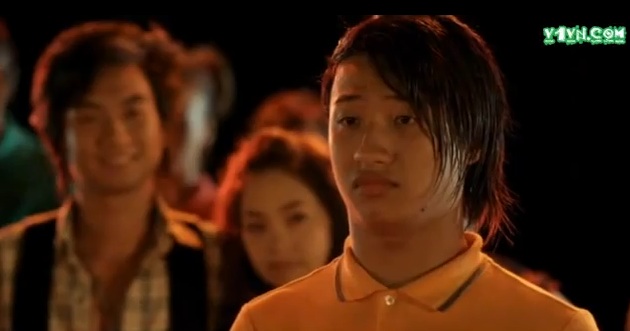
“Au Revoir Taipei” begins with a farewell scene next to a taxi on a wet Taipei street and ends with a farewell scene next to a taxi on a wet Taipei street, and much of the movie, which is charming and funny, is how the main character, Kai (Jack Yao), switches from being the guy left standing in the street to the guy riding away in the taxi. And whether he’s happier as a result.
Kai helps his parents with their noodle shop but he’s focused on his girlfriend, who, alas, is now in Paris. (She’s the one who left by taxi to start the film.) Kai wants to impress her so he spends his free time on the floor of a bookstore learning French; then he leaves her long-distance voicemails in stilted French reminiscent of the Colorado postal carrier in “Paris, je t’aime”—“Bon jour, Faye. Sans toi, Taipei est triste, tres triste”—before lapsing back into rapid-fire Mandarin. We see him leave several such voice mails. She never picks up. Not a good sign.
There’s another girl, of course, Susie (Amber Kuo), who works at the bookstore and teases him about his floor sitting. “This isn’t a library, you know,” she says. She quickly develops a crush on him, but, though she’s cute, he can't be bothered. He’s interested in the girl who isn’t there.
Meanwhile, Kai’s friend, Gao (Chiang Kang-Che), a sweet, supertall, mouth breather, has a crush on a fellow employee, Peach, at the convenience store where they both work.
Meanwhile, a full-of-himself cop, (Chang Hsiao-chuan), takes his girlfriend for granted until she leaves him.
Meanwhile, a neighborhood gangster, Bao Ge, near retirement, and fronting a legitimate real estate business, has fallen in love and agrees to one more score before he’s done.
Meanwhile, the gangster’s nephew, Hong (Ko Yu-Luen), wearing the orange pants and vest of a real estate agent, and about to inherit his uncle’s legitimate real estate business, wants a piece of the illegitimate action, and, with his ne’er-do-well buddies, all dressed in orange suits with big blue ties, plots to rob his uncle of his last, big score.
All of these elements collide one hilarious evening.
Writer-director Arvin Chen has a good visual shorthand. When Kai finally gets through to Faye, for example, we see him in his room, pacing and talking. Then he stops pacing. “Why?” he asks. Cut to: Kai in bed, crying.
Determined to fix their relationship, he asks his parents for the money for a plane ticket to Paris but they scold him for being impractical. So he goes to Bao Ge, who, amused by this neighborhood kid, and nostalgic about his own loves—first or otherwise—loans him the money. Then he asks a favor.
Kai is supposed to take a package with him to Paris, but the exchange is handled clumsily, and watched by both the cops and the nephew’s ne’er-do-well gang. Everyone gives chase. Kai and Bao bump into Susie, but, Gao, slow and intent on food, is subsequently separated from the others and kidnapped by the orange-suit gang—although these guys come off less as gangsters than confused high school kids on a caper. “What do we do with him?” one asks. Pause. Longer pause. Finally Gao, with a vague, uncertain lilt, speaks up: “Just drop me off anywhere around here,” he says. It's a great line reading.
Tied up in a hotel room, he shares restaurant information with the gang while they give him relationship advice, such as it is, about Peach. They play mah-jong and he trumps them. “I told you guys,” he says. “I have mad mah-jong skills.” He’s like a pleasant, less-icky version of Napoleon Dynamite.
Is too much of the film derivative? Along with “Napoleon Dynamite” and “Paris je’taime,” I caught whiffs of early Woody Allen in the whimsical soundtrack and Wes Anderson in the tone, camera placement, and the uniformity of clothes (here: orange suits) as a running visual gag. One joke comes directly from “Midnight Run” while the ending is reminiscent of the ending of “Slumdog Millionaire.” Everyone dances.
Even so, I had a great time watching “Au Revoir, Taipei.” The actors who play Gao and Hong are both hilarious, while the romantic leads are cute and sweet. One could call Amber Kuo’s Susie the quintessential Taipei girl: feisty, pouty, fragile. You fall in love with her and want to smack Kai for taking so long to fall in love with her.
It’s a world full of passivity and best-laid plans but mostly it’s a very safe world: broken hearts are easily mended, young gangsters and cops are easily distracted, and the gun introduced in the first act doesn’t go off in the third.
No Comments yet | Permalink
My Jackie Chan (成龍) Retrospective
The remake of "The Karate Kid" opens today, starring Will Smith's son. Second-billed is some guy named Jackie Chan, with whom I have something of a history. At least I keep writing about him:
- Becoming a Jackie Chan Fan: MSNBC, August 2007
- Review of "Drunken Master II": The Seattle Times, October 2000
- Review of "The Medallion": The Seattle Times, August 2003
- Review of "Around the World in 80 Days": The Seattle Times, June 2004
- Review of "The Spy Next Door": January 2010
How big of a fan was I? Not enough to like "The Medallion," or "Around the World in 80 Days," or "The Spy Next Door," but in the mid-1990s I was actually a member of the Jackie Chan Fan Club—the only fan club (officially, Salma!) I've ever been a member of:

Hell, this is a dream I had back in 1994—back when I used to write down my dreams:
Jackie Chan and his entourage are on an old "Mike Douglas Show" from the 1970s. They are the main guests of the day. Jackie is so enthusiastic he comes across as clownish. He's depicted as "the wacky stuntman/actor from Hong Kong." There's a musical number as well, with another actor (his co-star from "Armour of God"?) singing, then sprinting towards the camera, then over the camera; one imagines him sliding on his knees toward the audience. It's so cheesey I’m embarrassed. Jackie, meanwhile, is in the background, sometimes clowning, sometimes playing an instrument. Nobody gets the talent that’s there, but they’re not exactly demonstrating it, either.
1994 was the year I tried to get anyone in America to publish anything on Jackie Chan. No one was interested. "He's the biggest movie star in the world," I'd say, "and we don't know who he is!" They preferred not knowing. They couldn't tie it to anything being sold so they felt there was no point. The one pub that actually published a piece of mine on Jackie was The Stranger, an alternative weekly here in Seattle, and they did it because something was being sold. The Varsity Theater in Seattle was holding a retrospective on Hong Kong cinema in general and Jackie's cinema in particular, so they gave me 1,000 words. It was called "Fightingest Man Alive" (not by me) and appeared in September 1994. Excerpts:
I'll cut to the chase. Jackie Chan is the greatest action star making movies today. He may be the greatest action star in the history of cinema...
What action stars do we admire? Sylvester Stallone and Arnold Schwarzenegger. What do they do? Not much. They look strong and hold guns and enunciate (just barely) bad puns as they blow away bad guys. What does Jackie do? He fights, yes, but he also runs away. He is self-effacing. He clowns. ... His physique is the result of his training. For Stallone and Schwarzenegger, their physiques are the reason for their training. There's a difference and it shows...
Even a western star with a martial arts background like Jean-Claude Van Damme doesn't compare. In Project A (1983), Chan is fleeing his enemies, riding a bicycle through narrow alleyways, when a bad guy blocks his way. Unable to turn around, Chan puts his weight on the handlebars, plants his feet on the opposing walls, swings the bike like a weapon and knocks the guy down. A second later he continues his flight, not realizing his bike seat has fallen off. Cue grimace. This is the essence of Jackie Chan: the extraordinary followed by the farcical. Van Damme, in comparison, may use his legs to suspend himself between two walls, but the way the camera lingers on this talent is narcissitic, and, in the end, duller than spit. In the time it takes, Jackie could have fought past 10 henchmen and continued his lurching flight to safety.
Inaimate objects become animinated in his hands in a way that has not occurred in the movies since Fred Astaire danced with hat-trees. Give Arnold a wooden bench and what does he do with it? Probably hits someone over the head. ("Have a seat.") Give Jackie a wooden bench and it becomes not just a weapon but a thing of beauty...
That was a long time ago. I'm glad he's still rolling. I'm glad I'm still rolling. I hope "Karate Kid" does well...for his sake. Hsie hsie ni, Cheng Long...

Review: "L'enfer d'Henri-Georges Clouzot" (2009)
WARNING: HELLISH SPOILERS
In an episode of “Dirty Sexy Money,” Craig Wright’s short-lived, slightly skewed take on the “Dynasty”s of the world, Nick George (Peter Krause), lawyer to the wealthy Darling family, finally gets around to donating some of his money to charity. That was the reason he took the job in the first place—so he’d be rich enough to help his favorite causes—but money and power have already begun to curdle things for him, and as one non-profit thanks him profusely for the check, saying, “You have no idea how much this will change things,” Nick smiles and responds, “I know. But I’m giving it to you anyway.”
I thought of this scene while watching “L'enfer d'Henri-Georges Clouzot,” Serge Bromberg and Ruxandra Medrea’s documentary on one of the great unmade films by one of the great French film directors.
What sinks a film already in production? It’s rarely one thing. In “Lost in La Mancha,” a 2002 documentary on Terry Gilliam’s ill-fated attempt to make a modern Don Quixote, with Johnny Depp as his Sancho Panza, the problems are numerous: a tight schedule, crappy weather, and ill health (Gilliam’s aging Don Quixote, Jean Rochefort, had to return to France with an enlarged prostate). But what truly killed the production was an unwillingness to compromise. When Harvey Keitel suddenly seemed wrong for “Apocalypse Now,” Francis Ford Coppola replaced him with Martin Sheen and finished the film. When Jason Robards fell ill during “Fitzcarraldo,” Werner Herzog replaced him with Klaus Kinski and finished the film. But when Rochefort returned to France with his enlarged prostate, Gilliam waited. And waited. And waited. Rochefort was the Don Quixote he wanted and he refused to get another. And he never finished the film.
By 1964, when he began production on “L’enfer,” his tale of insane jealousy between a young married couple in a small, resort town in southern France, Henri-Georges Clouzot was already a legendary director, but a decade removed from his more famous films, “Le salaire de la peur” (“Wages of Fear”) and “Les diaboliques,” and two decades removed from my personal favorites, “Le corbeau” and “Quai des Orfevres.”
More, since his last film, “La vérité” with Brigitte Bardot, in 1960, the New Wave, French or otherwise, had taken hold of the imagination of world cinema; and while the young artistes certainly admired Clouzot, some felt his craftsmanship and storyboarding—everything planned beforehand so he could concentrate on the actors—were at odds with the New Wave’s love of the improvisational. They admired him but felt something about him was... passé.
Clouzot himself had become enamored of Federico Fellini’s “8 1/2,” and its, to him, “new way of using images,” and one wonders if he didn’t feel the need to prove something—either to the upstarts or to himself.
“L’enfer” was being bankrolled by Columbia Pictures, and Hollywood executives arrived early in the process to screen the first shots. One anticipates their reaction. A European director who wants to use images “in a new way” versus American moneymen who are never interested in the new or artistic. They’ll give him dull notes. They’ll whittle him down. They’ll point him toward the obvious.
Instead they did something more disastrous. They gave him money.
They loved what they saw and Clouzot received “an unlimited budget.” Says one of the crew: Clouzot then “went off into a world of tests that were completely new to the camera.”
We see some of these tests—depicting husband Marcel’s descent into the madness of jealousy—and they’re startling and beautiful nearly 50 years later. Lights swirl around the face of star Romy Schneider, playing the wife, Odette, and in milliseconds she switches from dutiful to demonous and back again. Is she smiling at me or laughing at me? What secrets does she hold? Who IS she? I went through a bout of extreme jealousy 25 years ago and these shots brought it all back again.
Most of the movie was filmed in black-and-white, but for these delusional scenes—his “Oz,” as it were—Clouzot used color. He filmed Schneider waterskiing and turned the lake blood red. He filmed her with cold, blue lipstick. He became obsessed with Marcel’s obsession. The plan was for four weeks on location and 14 weeks in the studio, but Clouzot was falling behind schedule and the crew felt directionless. One of his leads, Serge Reggiani, who played Marcel, and for whom Clouzot fought to get on the film, didn’t like this lack of direction—for the movie or his own character—and walked off the set, never to return. Now Clouzot had to find a new lead and reshoot scenes before they drained the reservoir in a few days.
And that’s when he had a heart attack. The fact that it happened while he was filming two women, Schneider and co-star Dany Carrel, kissing on a boat, is amusing sidenote.
Clouzot lived another 13 years, and made one more film, “La Prisonniere” in 1968, but “L’enfer” was never finished.
What might it have been? Let me state outright that I’m not much of a fan of movies where form overtakes content—as in Clouzot’s delusional scenes—or where, as moviegoers, we see the lead’s problem at the outset (he’s a gambler, he’s an alcoholic, he’s consumed with jealousy), and then watch his slow, inevitable descent. All we’re left to wonder is, “Where’s bottom?” and I want more to wonder than that.
That said, what remains of “L’enfer” looks amazing. It’s the maestro showing the upstarts a few things.
Like Gilliam’s Don Quixote film, the problems with “L’enfer” begin with a tight schedule and end with ill health, but in the middle, rather than the bad weather Gilliam encountered, Clouzot found good fortune. One can imagine him smiling as Columbia executives announced his unlimited budget. One can imagine him saying, "You have no idea how this will change things."
No Comments yet | Permalink
Review: "Zona Sur" ("Southern District") (2010)
WARNING: THE DECLINE AND FALL OF SPOILERS
“Zona Sur” (“Southern Disrict”) is Juan Carlos Valdivia’s film about the fall of a wealthy, decadent family in modern-day La Paz, Bolivia, and do you see how my words are running to the right, always to the right? How do you feel now that I’ve mentioned that my words are moving to the right, always to the right? Aren’t you paying more attention to the fact that my words are running to the right, always to the right, than to what I’m actually saying?
That’s what watching “Zona Sur” is like.
The movie opens in a lush garden outside a nice home in La Paz, where Andres (Nicolas Fernandez), the youngest son of family matriarch Carola (Ninon del Castillo), returns from shopping with Wilson (Pascual Loayza), the cook and butler; and as they talk with the family gardener/housekeeper, the camera keeps drifting to the right until it turns in a complete circle, 360 degrees, and winds up where it started. Then the next scene begins in the kitchen, with the camera continuing its rightward, circular drift. “Interesting,” I thought. “I wonder how long Valdivia can keep this up?”
Answer? The entire frickin’ movie.
Every once in a while, when young Andres is in his tree house, or on the terra-cotta roof of the house, where he talks to his imaginary friend, Spielberg (yes, that Spielberg), the camera pans up, but that’s about the only time we’re saved from this rightward drift. Otherwise it’s a slow, dizzying circle of a movie. The family’s drifting? They’re drifting down? Whatever. Just stop.
We never see the family flush. Carola is still wheeling and dealing with whatever relationships she has, but she’s running out of money. She hasn’t paid Wilson in six months, and her bratty kids, Patricio (Juan Pablo Koria), and Bernada (Mariana Vargas), are in college or about to start college. They remain oblivious to their circumstances, however, and obsessed with love (Bernada) and sex (Patricio). Patricio is so spoiled and insular that his mother buys him condoms for his frequent trysts with his girlfriend in his room. He talks of becoming a great constitutional lawyer, but the only time we even hear about him outside the house (because we never actually see him, or almost any of them, outside the house), he loses the family car in a poker game to Iraqis. He’s a dolt. And we know why. Even here he bends his mother to his will. Initially she's furious that he could be so careless, so foolish. Later, while she’s laying in bed, he gives her a foot massage, then kisses her foot. Her rubs her neck. “Do you forgive me?” she asks. “You’re such a ball buster,” he responds. Yes, their relationship is icky.
Meanwhile, Wilson, who hasn’t been paid in six months, is beginning to resent being taken advantage of, and is lax in responding to Carola’s demands. He uses her shower and lotions when she’s not there. As money diminishes, lines are blurred.
The family is virtually fatherless (she’s divorced), and different members often stand for long, somber shots looking out windows. They’re trapped there, you see. They’re insular. They don’t know how to live in the world. The only member who doesn’t do this, and who’s worth a damn, is Andres. He wants to learn how to cook, like Wilson, and he asks all the adults he meets what they wanted to be when they were kids. It’s as if he’s trying to figure out his place in a world where, yes, he’ll need a job.
But we know all of this 15 minutes in. The rest, 90 minutes, is downward drift of a beautifully photographed family that isn’t worth our time.

The kids. She can't meet her lesbian lover outside zona sur; he can't buy his own condoms.
No Comments yet | Permalink
Cesars 2010
The nominees for the French Cesars were announced last week, and Un Prophete (A Prophet), whose trailer I've seen a dozen times at Landmark theaters in the last month, and which is among the front-runners for the Academy's best foreign-language film, was the big dog, le grand chien, with 13 nominations, including best picture, director, actor, supporting actor and original screenplay. According to boxofficemojo, Sony Classics will finally release it here on February 26, but I'm not sure where "here" is yet. NY and LA? Probably. Fingers crossed for more. Hell, fingers crossed for Arkansas.
Speaking of—foreign films—what a motley crew the Cesars chose! At the same time they obviously don't suffer from the same strictures the Academy operates
under—one film per country, selected by said country, etc.—because there are three Hollywood productions among the nominees. Mais..."Gran Torino," France? Vous etes fous?
Last year, by the way, "Seraphine" won the Cesar for meilleur film over, among others, "Entre les murs," "Il y a longtemps que je t'aime" et "Paris." "L'heure d'ete," my favorite film from last year, received only one nomination: meilleure actrice, un second role, for Edith Scob, for playing the mother, or grandmother, Helene.
Les nominees...
MEILLEUR FILM (BEST FILM)
- A L’ORIGINE (IN THE BEGINNING)
- LE CONCERT (THE CONCERT)
- LES HERBES FOLLES (WILD GRASS)
- LA JOURNÉE DE LA JUPE (SKIRT DAY)
- RAPT
- UN PROPHÈTE (A PROPHET)
- WELCOME
MEILLEUR RÉALISATEUR (BEST DIRECTOR)
- JACQUES AUDIARD, A Prophet
- LUCAS BELVAUX, Rapt
- XAVIER GIANNOLI, In the Beginning
- PHILIPPE LIORET, Welcome
- RADU MIHAILEANU, The Concert
MEILLEUR ACTEUR (BEST ACTOR)
- YVAN ATTAL, Rapt
- FRANÇOIS CLUZET, In the Beginning
- FRANÇOIS CLUZET, Le dernier pour la route
- VINCENT LINDON, Welcome
- TAHAR RAHIM, A Prophet
MEILLEURE ACTRICE (BEST ACTRESS)
- ISABELLE ADJANI, Skirt Day
- DOMINIQUE BLANC, L’Autre / The Other One
- SANDRINE KIBERLAIN, Mademoiselle Chambon
- KRISTIN SCOTT THOMAS, Partir / Leaving
- AUDREY TAUTOU, Coco Before Chanel
MEILLEUR ACTEUR, UN SECOND RÔLE (BEST SUPPORTING ACTOR)
- JEAN-HUGUES ANGLADE, Persécution
- NIELS ARESTRUP, A Prophet
- JOEYSTARR, Le bal des actrices
- BENOIT POELVOORDE, Coco Before Chanel
- MICHEL VUILLERMOZ, Le dernier pour la route
MEILLEURE ACTRICE, UN SECOND RÔLE (BEST SUPPORTING ACTRESS)
- AURE ATIKA, Mademoiselle Chambon
- ANNE CONSIGNY, Rapt
- AUDREY DANA, Welcome
- EMMANUELLE DEVOS, In the Beginning
- NOÉMIE LVOVSKY, Les beaux gosses
MEILLEUR SCÉNARIO ORIGINAL (BEST ORIGINAL SCREENPLAY)
- JACQUES AUDIARD, THOMAS BIDEGAIN, ABDEL RAOUF DAFRI, NICOLAS PEUFAILLIT, A Prophet
- XAVIER GIANNOLI, In the Beginning
- JEAN-PAUL LILIENFELD, Skirt Day
- PHILIPPE LIORET, EMMANUEL COURCOL, OLIVIER ADAM, Welcome
- RADU MIHAILEANU, ALAIN-MICHEL BLANC, The Concert
MEILLEURE ADAPTATION (BEST ADAPTED SCREENPLAY)
- STÉPHANE BRIZÉ, FLORENCE VIGNON, Mademoiselle Chambon
- ANNE FONTAINE, CAMILLE FONTAINE pour Coco Before Chanel
- PHILIPPE GODEAU, AGNÈS DE SACY, Le dernier pour la route
- LAURENT TIRARD, GRÉGOIRE VIGNERON, Le petit Nicolas
- ALEX RÉVAL, LAURENT HERBIET, Wild Grass
MEILLEURE PHOTO (BEST CINEMATOGRAPHY)
- CHRISTOPHE BEAUCARNE, Coco Before Chanel
- LAURENT DAILLAND, Welcome
- STÉPHANE FONTAINE, A Prophet
- ÉRIC GAUTIER, Wild Grass
- GLYNN SPEECKAERT, In the Beginning
MEILLEUR MONTAGE (BEST EDITING)
- CÉLIA LAFITEDUPONT, In the Beginning
- HERVÉ DE LUZE, Wild Grass
- ANDRÉA SEDLACKOVA, Welcome
- LUDO TROCH, The Concert
- JULIETTE WELFLING, A Prophet
MEILLEUR FILM ÉTRANGER (BEST FOREIGN FILM)
- AVATAR; directed by James Cameron
- GRAN TORINO; directed by Clint Eastwood
- MILK; directed by Gus Van Sant
- J’AI TUÉ MA MÈRE / I KILLED MY MOTHER; directed by Xavier Dolan
- PANIQUE AU VILLAGE; directed by Stéphane Aubier and Vincent Patar
- THE WHITE RIBBON; directed by Michael Haneke
- SLUMDOG MILLIONAIRE; directed by Danny Boyle

Review: "Coco Before Chanel" (2009)
WARNING: SIMPLE, ELEGANT SPOILERS
A story has a dramatic arc, a life doesn’t. That’s always been the problem with biopics. So you understand why filmmakers such Anne Fontaine, who directed and co-wrote “Coco Avant Chanel,” decide to dramatize a portion of the life rather than the whole, long, messy thing. You also understand why Fontaine chose this portion of Chanel’s life: the portion—for those whose French is worse than mine—before she became a fashion icon. People like watching people rise. Audiences are made up of folks with unfulfilled dreams who enjoy sitting in the dark watching someone with whom they can identify fulfill theirs.
So why doesn’t the movie work? Does the title character remain too unknowable? Is her love affair with Arthur “Boy” Capel too uninteresting? Are the clues to how she will eventually transform the fashion world, and thus the world—having women dress for women, and for comfort, rather than in the confining corsets and plumy hats and long heavy dresses of the period—too facile? Does the movie not care enough about why she matters (fashion and proto-feminism) in favor of why she doesn’t (love love love)?
Is it all of the above?
The movie begins when Gabrielle Chanel, age 10, all big dark eyes, is deposited at a Catholic orphanage and casts a final, bewildered glance at the carriage driver, seen in quarter-view, who, one assumes, and assumes correctly, is her father. Historically, this orphanage was where Gabrielle learned to be a seamstress, and where, one suspects, the austerity and simplicity of the nuns’ habits made an impression on her fashion sense, but we only get glimpses of this. We mostly take away a sense of powerlessness and loneliness in echoing hallways.
Cut to: A music hall during the belle époque, where Gabrielle (now Audrey Tautou) and her sister, Adrienne (Marie Gillain), perform the song “Qui Qu’a Vu Coco,” before rowdy crowds, then mingle with the guests, mostly upper-crust military officers and barons. Gabrielle, quickly dubbed “Coco” after the song, is a lousy mingler, but she pares (and pairs) nicely with Etienne Balsan (Benoit Poelvoorde), who is rich, cynical, out for a good time, and amused by Coco’s bluntness. Coco’s sister becomes the mistress, possible wife, of one Baron, but Balsan leaves for his estate in Compiegne, near Paris, without proffering an invitation to Coco. So she simply shows up.
The belle époque was la belle époque (the beautiful time) for aristocrats like Balsan, not poorhouse candidates like Coco, and she bristles under the strictures of their unequal relationship. So do we. It’s pretty icky. At first he keeps her hidden. When she comes out anyway, he wants her to perform. She disapproves of the waste and frivolity of the upper classes, and wants work, but wonders what she can do. Sing and dance? Become an actress like Balsan’s frequent guest, and former lover, Emilienne d'Alençon (Emmanuelle Devos)? All the while Coco becomes known for her simple, more freeing, more boyish fashion sense. Emilienne keeps asking about her hats. Can you make me one? Here’s my rich friend. Can you make her one?
The story is obviously moving in this direction but the title character doesn’t seem to realize it. Is this good? An example of life happening while you’re busy making other plans? Or is it bad: The filmmaker’s assumption (film-in-general’s assumption) that audiences are only interested in what Gore Vidal famously called love love love?
Yes, Coco falls in love, with British coal magnate “Boy” Capel, and off they go for a weekend by the sea, where she gets the inspiration for the striped sailor’s shirt and the little black dress. Nice weekend! There’s a good scene in the tailor shop where she lays out her black-dress specifications, resisting, all the while, the tailor’s polite push toward the conventional. Him: It should be peach tones. It should have a corset. It should have a belt. Her: Non, non, non. Her stubborn insistence reminds me of many women I’ve known. They like it how they like it. Of course most women I’ve known aren’t inventing the little black dress.
Coco’s happy with Capel but he’s got a secret—he’s marrying British money—and Balsan spills the beans, partly from jealousy, partly because he cares about Coco and doesn’t want her hurt. Balsan’s role throughout is reminiscent of the role of Bror Blixen (Klaus Maria Brandauer) in “Out of Africa”: the disreputable man the heroine is stuck with but uninterested in, even though he’s the most interesting character onscreen. Neither man is particularly attractive, either, but both have a laissez faire bluntness that’s fun to be around and vaguely sexy. Balsan even proposes to her.
Instead she starts a hat shop in Paris. Finally! one thinks. Ten seconds later, a woman says, “Look, a gentleman.” Oh no! one thinks. Yeah, it's “Boy” Capel. More love-making. More promise-making. They’ll have two months by the sea. Then he dies in a car accident. She sees the wreck. She cries. Then she makes dresses, puts on a fashion show, and everyone applauds. FIN.
Really? That’s it? I know the title is the title, but... The movie is based on a book by a woman, written and directed by a woman, yet it almost feels sexist in how much it ignores why Chanel’s relevant.
Maybe fans already know too much about her career and wanted the gossip. Maybe people always want the gossip. Me, I knew little about her going in so it was all news, but the movie left me wondering to what extent she was part of a trend and to what extent she was way ahead of the trend. Did she single-handedly put women in pants? In this fact alone you see the redefinition of beauty in the 20th century. Voluptuous women tend to look better in dresses, thinner women in pants. Thus, with women in pants, western society’s definition of beauty shifted from the voluptuousness of the belle époque toward the straighter lines of Twiggy and Kate Moss. Coco was not considered beautiful, then helped redefine beauty closer to how she looked. Not bad! This shift also led to anorexia. There are corsets in the mind no fashion designer can remove.
In the end, “Coco Avant Chanel” has some of the realism of French films (she prostituted herself to get ahead) but more often the glossy, hazy, dishonest feel of Hollywood films. Coco apres Chanel once said, “In order to be irreplaceable one must always be different.” This one isn’t, and it's disposable.
No Comments yet | Permalink
Lancelot Links
- I have to admit I'm a bit of a curmudgeon when it comes to the Internet—it wastes too much time, it doesn't make enough money, there's so, so much crap on it—but every once in a while it tosses up something beautiful. This week it's Danny MacAskill's "Inspired Bicycles" video, which is like parkour for bike riders. I love this kind of thing because I'm so not like this. Kids, don't try this at home.
- Speaking of bikes and "crazy," my friend Andy Engelson, who recently moved to Hanoi, finally got his bike out and rode around in Vietnamese traffic. Let Danny MacAskill try that!
- Over at the Film Experience blog, Nathaniel Rogers crunched the foreign-language Oscar numbers and came up with: "France." That's the country that has the most recent noms and the most noms all-time. I love this kind of thing. Scroll down and it's obviously a work in progress, too, so keep coming back. It also raises questions. Beyond borders, what does the Academy reward? Or ignore? I think this looking at France. In the last 20 years, the one French film that actually won best foreign-language film was...Indochine? Long and stately and self-important without making a lick of sense. But the Academy's gotten better in recent years. Haven't they?
- Interesting column by David Leonhardt of the Times on med-mal practice and insurance rates. The money quote: "Here, then, is the brief version of the facts: The direct costs of malpractice lawsuits—jury awards, settlements and the like—are such a minuscule part of health spending that they barely merit discussion, economists say. But that doesn’t mean the malpractice system is working."
- Will Ferrell Answers Internet Questions. One of the best takes on the lack of civility around these parts.
I didn't watch the Emmys last Sunday (who does?) but I did check out Neil Patrick Harris' opening song, "Put Down the Remote," which was a lot of fun and veered toward brilliance halfway through with this verse:
Straight from "Mad Men" there's Joan
Oh, the curves she's shown
They could make a blind man say "Damn"
She could turn a gay straight
Oh wait
Never mind, there's Jon Haaaaaaam!
And yes, I checked it out online for free. I'm part of the problem. But I'm trying to be civil. I'm trying real hard.
4 Comments | Permalink
Le Monde lede of "Adieu, Gary"
Voici déjà quelque temps que le cinéma, à l'instar d'un public touché par la crise, ne prend plus de vacances. Chaque été, entre un mastodonte de l'animation hollywoodienne, quelques titres d'auteurs confirmés, une brochette de reprises savoureuses et un lot avarié de fins de série, se glisse donc une découverte à la fraîcheur bienvenue.
The cinema, following the example of a public affected by the economic crisis, can’t take vacations anymore. Every summer, between the mastadon of Hollywood animation, several titles from confirmed aueturs, a kabob of savory revivals and a rotting batch of oddities, slips a discovery of welcome freshness.
Where Goebbels and Hollywood Agree
Hey all. Just got back from a family vacation in Minnesota, where I re-encountered two of my favorite junk foods: Old Dutch Rip-L Potato Chips and Sebastian Joe's ice cream. It's a good thing I don't live there anymore or I'd be 200 pounds.
While on vacation I read Cinemas of the World by James Chapman, from which I'll be quoting in the next couple of days. A bit academic but mostly interesting and always informative. British press. Here's the first of them:
Triumph des Willens represented the high point of Nazi propaganda: it enshrined the 'Hitler myth' so completely that no further films of the sort ever needed to be commissioned. Goebbels, for his part, was firmly of the opinion that feature films should provide escapist entertainment for the masses and that direct propaganda should be confined to the newsreels.
No Comments yet | Permalink
Review: "Touchez pas au grisbi" (1954)
WARNING: THE WORLD’S COOLEST MOVIE SPOILERS
There is something measured and specific about Jacques Becker’s films. Nothing is hurried and nothing essential is left out. As viewers, we sometimes guess where things are going, but when they wind up there we still feel slightly shocked, certainly saddened. Some of Becker’s protagonists, too, know how things will play out but they never jump ahead. They may assume the worst in their fellow man but they don’t act on that assumption. To do so would be dishonorable.
The honorable man in Becker’s “Touchez pas au Grisbi” (1954) is Max, an aging gangster, played by aging movie star Jean Gabin, who was, at the time of the production, 15 years removed from his heyday. “Grisbi” gave him a second life. He made 50 more movies.
Today Gabin is a legend. In 1999 he was voted “the actor of the century” in a French poll, and one of the few English language books about him (as well as a blog) is entitled “The World’s Coolest Movie Star.” Here, Gabin straddles the line between cool and weary, but his weariness isn’t a result of the world overwhelming him. The opposite. It underwhelms. It’s entirely predictable.
We first see Max at the restaurant of his choice, Madame Bouche’s, a gangster hangout in Montmartre (but classy), where those at his table, including his partner, Riton (Rene Dary), hang onto his every reluctant word. After dinner they pile into a car and head to a strip club (but classy), where Max, with shrugging matter-of-factness, brokers a deal between the owner, “Fats” Pierrot (Paul Frankeur) and Angelo, a rival gangster (Lino Ventura), then discovers Angelo backstage lip-locked with Riton’s girl, Josy (a young Jeanne Moreau). Roger Ebert, in his 2004 review, is excellent on the next scene:
This would come as particularly bad news to Riton, who fancies himself a ladies' man and thinks Josy belongs to him, but look how elegantly Becker resolves the situation. Instead of telling his pal that he's a cuckold, Max advises Riton to give up Josy. He points out aging playboys steering hookers around the dance floor, calls attention to the bags under Riton's eyes and suggests they go home early. Riton suggests he stay for one more drink. No, says Max, with that flat, calm Gabin delivery; he knows what one more drink will lead to: A bottle of champagne with Angelo, and then having to take the girls out for onion soup, and then having to have sex ... it's easier just to leave now.
Riton doesn’t but Max does, and he’s followed home by a couple of Angelo’s mugs, whom he handles with dispatch, then calls to warn Riton. We don’t know it yet but Max has already figured it all out. All the evidence is there for us, too, buried in the details of the film. That $50 million gold heist from Orly Airport Max was reading about at the beginning? Max and Riton pulled it off. So of course Riton had to brag about it to Josie. And of course Josie spilled the beans to her lover, Angelo, who of course wants the gold.

Ah, to be an aging, world-weary French gangster
Max explains all of this—slightly fed-up—to Riton in Max’s safe house. It’s a scene unprecedented in gangster movies and it’s Becker at his measured and specific best. After Max explains to Riton that their $50 million heist was his last job and he doesn’t want Riton to eff it up, the two sit, drink wine, and eat biscuits and pate. They put on pajamas and brush their teeth. They go to bed. But within the quotidian details is the difference between the two. Max knows and accepts what he is. Riton checks out the bags under his eyes and is saddened by what he sees. The next morning he fights it. He goes to see Josie but is captured by Angelo. He’s held hostage for the gold.
Ebert raises the following question:
Does Max love Riton? Max seems to be the current or former lover of almost every woman in the movie, and yet, yes, Riton is who he loves.
Sure, he loves him. But loves loves? I’d give that a Gabin-esque shrug. There’s another great scene where Max, in voice-over, thinks about what a screw-up Riton has been, and whether he should leave him to his fate. It’s the only moment where we get a voice-over in the movie and it’s the only moment where we get this side of Max. That’s why the voice-over. Saying it aloud isn’t Max. But the thoughts are there.
One wonders why Max carries him, though. Is it just the honor of the thing? His need to remain loyal to his friends? Psychologists might call Max an enabler, and maybe there’s something there. He’s assured of his superiority by hanging with screw-ups.
Yet, if anything, Max’s cool results less from a sense of superiority and more from remaining a reluctant participant in the continuing charade. He wants his restaurant, he wants his girls, he wants as little danger as possible. But—in the overused phrase—they keep pulling him back in, and he goes with a shrug. He knows how it’ll play out—not well—but he goes anyway. You want to play this? I’ll play it. Since he has no illusions he sees things clearly and remains a step ahead.
I’m wondering about the end. There’s that scene, after Max learns that Riton has been kidnapped but before the deal has played out, where he visits his mistress, and, post-coital, holds up her hand and looks at the jewels on her wrist. Becker loves his details—his details are clues—and after it’s all over the mistress is no longer an afternoon visit for Max. He’s out with her at Madame Bouche’s. Because of the jewels and what they represent? Max’s payday, the gold, has been lost and he doesn’t want to go back in, so is this his compromise? Give up some independence for some money? Or is it all merely temporary until things quiet down and he can once again sketch out a plan that will allow him that final chance to retire on his own terms? Either way, we could all use such a fallback position.

The fallback position
The French during this period were great with aging gangster movies—see “Bob le Flembeur” and “Rififi”—but I’m wondering where the great aging American gangster movies are. Do we have them? Do we count “The Godfather”? Or “The Godfather—part III”? Or are all aspects of American society a young man’s game, including its underworld?
P.S. Not to be too Netflix about this but: If you liked “Grisbi” you have to check out Jacques Becker’s last film, “Le Trou”—literally “The Hole,” and slang for “The Jail”—about a jailbreak among honorable men. It may include the best last line in movie history, and one that suggests, in two words, Becker’s entire oeuvre. It suggests an entire way to live.
No Comments yet | Permalink
Review: "L'emmerdeur" (2008)
WARNING: AS MANY SPOILERS AS FRANCOIS PIGNONS
As you watch “L’emmerdeur” (“A Pain in the Ass”), the latest comedy from Francis Veber, and as you’re enjoying the typical Veberian patterns—the comedic clash between an emotional, obtuse man (the feminine), and a tough, professional and slightly dangerous man (the masculine)—you realize, after about 45 minutes, that most of the action is taking place in two adjoining hotel rooms. And you think, “Hell, this could’ve been a play. How odd that Veber wrote such a play-like film so late in his career.”
At least that’s what you think if, like me, you really don’t know Veber. Afterwards I learned that “L’emmerdeur” is a remake of a 1973 film of the same name, which was based upon Veber’s 1969 play, “Le contrat,” which was also the basis for Billy Wilder’s last film, “Buddy Buddy,” in 1981. It's been told a lot, in other words. Is it worth revisiting?
The set-up still works. A hitman, Jean Milan (Richard Berry), attempting to kill a high-level witness, takes an adjoining hotel room with a man, Francois Pignon (Patrick Tims), trying to kill himself. And the incompetence of the latter disrupts the super-competence of the former.
Pignon’s wife has left him for her shrink and he’s a puddle. He calls her, declares his suicidal intentions, then tries hanging himself from the bathroom shower. It breaks, alerting the hotel clerk in Milan’s room, who wants to call the police. Since the last thing Milan needs is cops flying around while he’s trying to assassinate someone in the plaza below, he takes responsibility and shoos the clerk away. But now he’s responsible. The cops would’ve been easy in comparison.
Tims is the 8th actor to play Pignon, the nom de choix for the feminine half of Veber’s buddy comedies. Others include Gad Elmelah in “La doublure” (2006), Daniel Auteuil in “Le placard” (2001) and Jacques Villeret in “Le diner de cons” (1998). But the most famous and probably the best to take on Pignon was Pierre Richard in two Veber comedies with Gerard Depardieu in the 1980s: “Les comperes” (remade as “Father’s Day” in the U.S., with Robin Williams in the Pignon role) and “Les fugitifs” (remade as “Three Fugitives” in the U.S., with Martin Short in the Pignon role). You could add “Le chevre” (1981) to the mix, too. Veber wrote and directed it, Depardieu starred as the tough guy, and Richard played the hapless half named Francois...Perrin. Basically the same deal.
Not to be mean but Tims made me long for Richard. Pignon is such a bothersome character that one invariably roots for the other guy, even if, as here, the other guy’s a professional killer. Because at least he’s professional. But Richard had a dreamy quality that made his Pignon palatable. There was something crisp and determined about his dreaminess, too. He may have been wrong, but he was only wrong because the world is wrong. You need Depardieu’s headbutting ways to get by, and Richard’s Pignon only half-understood this. In a way he seemed determined not to understand this. He preferred his brand of idiocy to the world’s.
The Pignon of “Le diner de cons” worked in a different way. In that film, which was the highest-grossing film in France in 1998, the set-up was so horrible—a group of successful, professional men inviting the biggest idiot they could find to a dinner, at which a champion idiot would be crowned, with Pierre Brochant, of course, choosing Pignon—that we had no sympathy at all for Brochant, and in fact cheered on Pignon as his genial idiocy slowly ruined Brochant’s life. Brochant asked for what he got. He invited it in.
Tims’ Pignon is not dreamy and he’s not genial, and the hitman Jean Milan never invited him in. Plus the notion that this schlumpy Pignon was ever the husband of the gazelle-like Louise (Virginie Ledoyen, 16 years Tims’ junior) seems too absurd even for comedy. I could see her marrying Richard and his brand of dreaminess. But what does Tims bring? What’s his redeeming factor? Does he have one? That’s one of the main problems with the film.
A side-note. Could the Veberian dynamic (the masculine-feminine “buddy” film) work with an actual female in the Pignon role? I doubt it. It would disrupt the comedic dilemma. I.e.: What does a professional tough guy do when forced into partnership with an emotional puddle who is not a woman? You turn the character into a woman and you sacrifice comedy for romance.
There’s a phrase I use a lot as an editor, and I first thought of it while watching the final scene of Clint Eastwood’s “Million Dollar Baby”: a soft landing. It’s a shot that brings us back to earth with nary a bump and yet is so resonant that it glides us along even as the credits roll. It’s a beautiful thing when done right and Veber’s the master. Even his disappointing films, such as “Le chevre,” give us soft landings, and “L’emmerdeur” is no different. The cops, finally alerted to trouble, shoot a tear-gas canister into Milan’s room. On the bed, Pignon, stronger now, taking charge now, puts his arm around the undone professional killer and assures him that, even in prison, he will always stick by him and never abandon him. He says this as clouds of puffy gas fill the room, slowly enveloping the two. And in that shot we finally get the dreaminess we needed all along.
No Comments yet | Permalink
Review: "Wind Blows in the Meadow" (2009)
You get the feeling something has been lost in translation in the Iranian film “Wind Blows in the Meadow.” The meadow, for example. “Wind Blows Through the Woods” would be a more accurate title but the subtitles screw even this up, calling a patch of snow- and ice-covered trees near a northern Iranian mountain village a “jungle.” Too bad. The wind that blows in the woods is one of the film’s key symbols. It loudly and ominously loosens ice and snow onto the people below. It portends disaster.
The movie begins simply. A man goes into the woods and cuts down a tree with a chainsaw. He’s cutting off its branches when he suddenly screams. It’s rolled over onto him.A young woman with beautiful dark eyes buys supplies at the local store, then says “Put it on my account,” and gets a nasty look from the proprietor. Outside a young man with Down syndrome tries to give the girl some jewelry, but she regards it, and him, with something between horror and hatred. What’s going on?
Everything falls into place in the next scene. The woodsman, Taleb, is bedridden and in debt, and so he’s promised the hand of his daughter, the dark-eyed Shouka, to Shokrollah, the boy with Down syndrome. No, wait, she’s been promised to his father, the old but tough Nasir. No, she has been promised to Shokrollah, who is horribly smitten and wants to kiss her, while she can only regard him with disgust.
OK, so not everything falls into place.
I have to admit, after the family patriarchs finalize the upcoming marriage, and after Shouka’s mother (mother-in-law? aunt?) chastises the girl for refusing to come when called, and then Shouka does, standing there beautiful and defiant, I kind of rolled my eyes. I thought: OK, this is one of those Lifetime-Channel movies for the indie filmgoer. They go pretending to embrace the foreignness of the film but truly embrace its western aspects: in this case, the defiance of a beautiful woman in a backwards, patriarchal (and horribly, horribly foreign) setting. Plus aren’t her scarves gorgeous?
I also knew, from the synopsis, that the plot concerns a Romeo and Juliet type relationship, and so, like women everywhere, I sat back and waited for Romeo to show up.
The film is better than that. It’s more foreign than that. At a tea house, a tailor, Rafie, agrees to do the wedding up fine—suit for the groom, dress for the bride—and one assumes his assistant, Jalil, a vaguely handsome young man with dark hair and high cheekbones, will play Romeo, as he does. But he’s not much smarter than Shokrollah, and he’s slow to realize his role in the story. He’s also not that handsome, or interesting, or courageous. You think: She could still do better.
Once Jalil overhears Shouka’s complaints, though, and then sees her in her wedding dress, he concocts a scheme to delay the wedding long enough for Shouka to talk to her aunt, who talks to Taleb, who calls off the wedding. But it turns out the old man, Nasir, and Yahya, his brother (eldest son?), are not to be trifled with. Hell, Jalil barely looks at Shouka before Yahya is threatening him with a knife. Things get fairly lawless, and one wonder if this is a lawless society or if Nasir and Yahya are like the Iranian-village version of the Mafia. That would make Rafie the tailor a kind of Enzo the Baker who performs a favor for the local don...that goes horribly awry.
I like the fact that I don’t know. I don’t know Iranian society, let alone Iranian mountain-village society, so I miss all the cultural signifiers. I’m dropped in the middle of this story, which, sans a chainsaw and truck, could’ve taken place 500 or 1,000 years ago, and am forced to feel my way around.
It’s its very foreignness, in other words, that intrigues. At the same time, what kicks the story into high gear are two of the more ancient and universal lessons we know: beautiful women are coveted; and men are brutal.
No Comments yet | Permalink
Review: “L’Heure d’ete” (2008)
“L’Heure d’ete,” pluralized to “Summer Hours” in the English translation, would make a good double-feature with “Rachel Getting Married.” Both films depict family tension surrounding a major event: a wedding for “Rachel,” a death for “Summer.” If someone thinks up a good birth movie, we’ve got our triple bill.
The film begins with kids and dogs racing through the woods, and into the backyard of a cottage house, on a treasure hunt. It becomes a story about giving up treasure.
The owner of the cottage house is Helene (Edith Scob), and everyone’s gathered for her 75th birthday. Along with Eloise, the housekeeper, we see five adults eating, drinking and smoking around the backyard table, and can surmise, without explicitly being told, which are Helene’s kids and which are in-laws. Maybe it’s the way Helene’s kids sit, or speak, or speak more, but we understand by merely observing who’s who. There’s Frederic (Charles Bering), the eldest, who has something weary about him; Adrienne (Juliet Binoche), the New Yorker, who has something hard about her; and Jeremie (Jeremie Renier), the youngest, who lives abroad in China, working for les baskets Puma.
Even as Helene enjoys the company, and the chaotic life the kids and grandkids bring, she’s preparing for her own death, and takes Frederic, the only child still living in France, through the house, detailing which precious object should go where. Every family has precious objects but these are truly, prestigiously precious: paintings by Corot, a Hoffman armoire, vases by Bracquemond, and pieces of a sculpture by Degas, which, sometime in the past, Helene’s kids broke while playing. Her uncle, Paul Berthier, was a great artist (and, we find out later, her lover), and these are the remnants of the family’s artistic past. Helene counsels selling this, giving that to the Musee d’Orsay, but Frederic, who has trouble talking about the death of his mother with his mother, assumes everything will stay the same: the kids will keep the house and the works of art. She assumes otherwise. She counsels otherwise. Why have this weight on you? Start anew.In cinematic time, her death comes swiftly and without drama. Frederic—a Parisian economist who’s written a book that’s not well-received—goes into an office building where someone expresses their condolences and they pick out a cemetery plot. And that's it. Driving to the cottage house, Frederic stops the car and cries, while Adrienne, with her American boyfriend, sheds a few tears in the hospital, but that’s the extent of the outward emotion. Everything else is inward. And business. And choices.
The mother was right: the kids vote to sell the place. Adrienne is getting married to the American and doesn’t know how often she’ll be back, while Jeremie has agreed to a five-year commitment with Puma in Beijing, and his family plans to summer in Bali. Frederic acquiesces to all of this, sadly, but without much of a struggle. There are no villains here, just life spreading out, going where it goes, and the rest of the movie is disillusion of the cottage and its precious artifacts. At one point, Eloise, the housekeeper, returns for a visit and sees strangers—art dealers, reps from the Musee d’Orsay—removing this painting, taking that exquisite desk. Basically messing up the place she cleaned up for decades. It’s a sad sight. “For the family, it must be sadder,” she adds, but one wonders. Eloise seems to have a deeper connection with the place, and with Helene. She has no kids of her own, just a nephew, a taxi driver who drives her around. He loves her, hugs her, then leaves her at the doorstep of her apartment—the same way Helene, earlier, was left at the steps of her house after the kids and grandkids left.
The grown-up siblings have both familiarity with, and distance from, one other. They assume they know each other but there’s also curiosity. I love you, but who are you again? Or now? When Adrienne rushes into a taxi after a meeting with their lawyer, the two brothers, walking to a cafe, comment on how she’s like their mother:
“She’s running from something,” one says.So no villains here, but writer/director Olivier Assayas, who has made movies about global disconnect before (“demon lover”), seems to be commenting upon some aspect of specifically French dissolution. Two-thirds of Helene’s kids live abroad, the grandkids are “into America,” the artifacts wind up in museums. What aspect of French culture is still part of French daily life? Where and what is the treasure now?
(pause)
“Not us, I hope,” the other says, and both laugh.
“L’heure d’ete” is suffused with sadness but not nostalgia. Life expands, life contracts, life ends, life goes on. Assayas could’ve ended the film at the Musee d’Orsay, with the desk on display, looking “caged,” according to Frederic, but chose, instead, a more ambiguous end. He takes us back to the cottage house, where Frederic’s kids throw a huge, loud summer party. At first one is appalled that Helene’s place has been taken over in this fashion. But is this better? It's vibrant. It's life. The final shot is of the eldest daughter and her boyfriend, young and unburdened, running away from the camera and toward whatever it is they’ll create, and collect, and leave behind.
No Comments yet | Permalink
Where Have You Gone, Vladimir Visotsky?
Last week I watched a film called "Ivan Vasilevich: menyaet professiyu" (translated, in attention-getting fashion, to "Ivan Vasilevich: Back to the Future"), which I rented from Netflix as much for the description as anything:
When his time machine malfunctions, scatterbrained inventor Shurik (Aleksandr Demyanenko) accidentally transports Ivan the Terrible to 1973 Moscow and simultaneously sends small-time crook and apartment manager Ivan Bunsha -- a ringer for the despot -- to the 16th century. Wackiness ensues as Shurik attempts to set things right in this Soviet sci-fi comedy of errors featuring Yuri Yakovlev in dual roles as Bunsha and the czar.
A wacky Soviet-era comedy? Who would've thought? And it is that, although, in the end, more curiosity than laugh-out-loud comedy. It's one part "Les Visiteurs," one part Bollywood, one part "Benny Hill" without the girls. One imagines if the film had gotten out in 1973 it would've gone a long way toward dispensing the notion of the stoic Soviet empire. Yes, even in the middle of detente. But of course "getting out" was always the problem.
Halfway through the film, in modern-day (1973-era) Moscow, Ivan the Terrible, who isn't so terrible, turns on a tape recorder, hears music, and smiles. The singer was familiar. I'm pretty sure it was Vladimir Visotsky, whose angry song Baryshnikov danced to in his tennis shoes in "White Nights"— and about which I wrote for an MSN "Top 10 Dance Scenes" piece way back when.
The difference between the time I wrote that piece (2004) and now? It's easy as hell, now, to find footage of the singer. Here he is, for example, on a Soviet-era TV show, singing in his gravelly, impassioned voice. Check it out.
Worst Netflix Summary Ever
WARNING: SPOILERS
The following is Netflix's description (both onsite and on their DVD sleeve) of Akira Kurosawa's "The Bad Sleep Well" (1060):
Koichi Nishi (Toshiro Mifune) is distraught after his father's demise, which he blames on the cutthroat corporate environment in which he worked. Desperate to avenge his father's senseless death, Koichi begins to tamper with the sanity of each person who ever wronged the man. He starts with the cake at his very own wedding; per Koichi's instructions, the confection has been specially crafted to remind the attendees of their darkest secrets. …
In case you haven't seen the film (and are still shamefully reading this): The movie opens with the wedding of the daughter of a high-ranking public official, at which reporters gather in anticipation of the arrest of this official and several of his right-hand men. We follow the initial police investigation into the scandal — apparently the government accepted a high bid on a construction project for kickbacks — but government and corporate officials remain tightlipped and no one's prosecuted. Then two of the right-hand men kill themselves. No, just one. Koichi Nishi (Mifune), the groom at the wedding, prevents the other from doing so. Why? We find out an hour and twenty minutes in: He's the son of an official who killed himself five years earlier — in another scandal, protecting these same guys — and he's been plotting revenge ever snce.
In other words, in their first sentence, Netflix gives away the goods. As for their last sentence? The description reminded me of that early "Star Trek" episode in which people act out their darkest secrets (Sulu turns into a barechested swashbuckler, etc.), but, in the Kurosawa film, there's nothing in the cake in question. It was simply baked in a way to remind the men of a shared dark secret. Singular.
Oh well. IMDb.com gives away the plot, too. No tight lips here anyway.
A shame because the first half of the movie is the best. It loses itself in the second.
Dialogue of the Day: "Cesar" (1936)
A group of friends gather in the kitchen as a friend, Honore Panisse, dying upstairs, confesses to a priest.
Cesar: One thing worries me, though. What if our God isn’t the true god?
Felix: Good lord! What are you saying?
Cesar: I know Moslems, Hindus, Chinese, blacks. Their god isn’t the same as ours. What’s a sin for us isn’t necessarily a sin for them. They may not be right but suppose they are, Monsieur Brun.
Brun: That’s the question.
Cesar: Poor old Panisse is well-prepared for a meeting with Elzear’s God. But suppose that up there in the clouds, he finds a god he doesn’t know at all. A red, black or yellow one. Or one like you see in antique shops, wth a big belly and lots of arms. What could poor Panisee says to a god like that? How would they communicate? Put yourself in his place. Tired by your death and dizzy after your journey, trying to make yourelf understood to this god. You pray and he says, “What’s that? What are you saying?” All in Chinese.
Felix: That’s tragic. You give me the creeps.
Woman: So the Bible’s all a lie? Aren’t you ashamed to talk like that in front of an altar boy?
Woman 2: If you went to church more, you’d know there’s only one god – ours!
— from "Cesar" (1936), the third of Marcel Pagnol's "Fanny" trilogy
1 Comment | Permalink
How W. is Dumber than a Fascist
Andre Harris: Bearing in mind what you learned in the last war, the results of National Socialism, which, as you explained, had a certain appeal or charm about it at one point in your life, bearing this in mind, would you change the choices you made at that time?
Christian de la Mazière: Yes, of course. I think only an idiot would refuse to change their opinion.
— from "Le Chagrin et le pitie" (1971), Marcel Ophuls great documentary on the occupation of France during World War II. The original New York Times review can be read here. Among the many fascinating details — the equivocation of collaborationists, the straightforward account of an aristocrat like de la Maziere, the sad amusement (and heroics) of Pierre Mendes-France, who had to wait for two lovers to seal the deal, or at least the agreement, and leave, before he could climb down from a prison wall and escape an unjust sentence, along with the horrors of such propaganda films as "Le Juif Suss" — I was also intrigued to discover that, in French anyway, sorrow (chagrin) is masculine, while pity (pitie) is feminine. True? And does this expand our interpretation of "Annie Hall"? Feel free to discuss.
No Comments yet | Permalink
Redford/Pfeiffer, Connery/Zeta-Jones, Etc.
"Now we see what you're really after. You're marrying Fanny because she's young and pretty and you want to rub your leathery old hide up against her soft skin. ... I find it disgusting. I am disgusted."
— Cesar (Raimu) to Panisse (Fernand Charpin) in Marcel Pagnol's "Fanny" (1932)
No Comments yet | Permalink
Francois Truffaut Quote of the Day - II
Charlie is in bed with Clarisse. She's topless with the sheet near her waist. Charlie pulls it above her breasts.
Charlie: This is how it's done in the movies.
Clarisse: Ha ha. (Pause) I saw Torpedoes in Alaska at the movies this afternoon.
Charlie: Any good?
Clarisse: John Wayne shows how America only wants peace.
Charlie: Well, well. The Yanks are just like me.
— from Francois Truffaut's Tirez sur le pianiste (1960)
No Comments yet | Permalink
Francois Truffaut Quote of the Day - I
"We almost didn't make it at first. I'd watch her over breakfast, wondering how to get rid of her. But then I thought, 'Where do you get these ideas?' And I found no answer."
— Passerby, happily married after 11 years, in Francois Truffaut's Tirez sur le pianiste (1960)
No Comments yet | Permalink
Hail Cesars
The nominees for the Cesars are out, and "Public Enemy No. 1," about French gangster Jacques Mesrine (Vincent Cassell), set a record with 10 nominations. It was also the third-highest grossing film in France last year. Is the Academy of Motion Picture Arts & Sciences listening? Are the studios?
Here's the list of nominees for best picture:
- Entre le murs (The Class)
- Il y a longtemps que je t'aime (I've Loved You So Long)
- L'Ennemi public no. 1 (Public Enemy Number One)
- Paris
- Le Premier jour du reste de ta vie (The First Day of the Rest of Your Life)
- Seraphine
- Un conte de Noel (Christmas Tale)
The Cesars will take place on Feb. 27 in Paris.
B.O. for Best Pics
“Plus de 4 millions de Shrektateurs”
That 4 millions isn’t euros; it’s people. It’s asses in the seats. That’s how movie popularity is tabulated in France. As opposed to in the U.S. where it’s all about the dollars, and where, if you’re paying any attention at all, you have to adjust for inflation to get the true measure of a movie’s popularity.
Feel free to let each measurement stand for each culture.
So it’s the Friday after the noms and the studios are busy things. Universal, unwilling to do the heavy lifting for “Frost/Nixon” in December, is finally expanding Ron Howard’s film from 153 theaters to more than 1,000. Other films that are expanding: “Slumdog Millionaire,” “The Wrestler,” “Rachel Getting Married,” “Revolutionary Road.” There’s a pattern, and it follows the pattern of previous years, and it’s getting a little old.
That said, here’s how the best picture nominees look in terms of box office before the expansion:
| Movie | Domestic $ | Thtr High | 2008 BO Rank |
| The Curious Case of Benjamin Button | $104M | 2988 | 22 |
| Slumdog Millionaire | $44M | 582 | 62 |
| Milk | $20M | 356 | 111 |
| Frost/Nixon | $8M | 205 | 145 |
| The Reader | $8M | 507 | 148 |
Kudos to the way Paramount handled “Benjamin Button.” It put it out there in December. It didn’t wait for the Academy to bestow what it would. More congrats to Fox Searchlight who pushed “Slumdog” in the right ways.
But — and I’ve said it before — what lazy bastards over at Universal. In some ways “Frost/Nixon” is the most accessible of these films and yet it is, until the noms, the least-available. 145th??? I’m almost hoping it bites it at the box office during the next few weeks. Just to show Universal. Of course they’d probably take the wrong lesson away from the experience and stop getting involved in films like "Frost/Nixon" altogether.
Meanwhile, their art-house division, Focus Features, rumored to be on life-support, appears to be doing nothing with “Milk.” Of the little-seen best picture nominees, it’s the one that’s not expanding, and it's the one, along with "Slumdog," that's most deserving of a big audience.
Feel free to let that irony stand for the culture.
1 Comment | Permalink
My Year of Watching French Cinema
A quick word on some of the new images cycling to our left.
Late last year I was getting sick of that first image you’d see every time you navigated to this site: me, in the summer of 2007, slouched over and writing in my notebook on a bridge in le Somail in southern France. It made sense — here’s my writing, so here’s me writing — but it was getting old. We needed something new.
The images now cycling through are hardly new — most are old movie posters — but they’re new to me. I watched most of them for the first time in 2008. Excluding movies I watched for research (the Batman films, the Tyler Perry films), and films seen in the theater, I rented and watched, according to Netflix, 84 films in 2008. It seems like a huge timesuck but most of them were worthwhile. I’ve divided them into categories below.
We all arrive in our culture in medias res and spend most of our lives trying to catch up, and this was the year I tried to catch up with French cinema. Infinitely more difficult than catching up with pre-1963 U.S. cinema. How many Bogart and Cagney references — from Woody Allen to Frank Gorshin — did I see before I saw a Bogart or Cagney film? Hundreds. I knew these guys before I knew them. But no one referenced Jean Gabin when I was growing up. It wasn’t until this year, at the embarrassing age of 45, while watching Max Ophuls’ Le Plaisir, that I went: “Hey, isn’t that the guy from Touchez Pas Au Grisbi? And Port of Shadows? And La Grande Illusion?” Which lead to Can Can and Pepe Le Moko and La Bete Humain and Les Bas-Fonds. For those unfamiliar: Imagine Spencer Tracy with Humphrey Bogart’s roles and Katherine Hepburn’s longevity. Voila.
Thoughts, for what they’re worth, crystallized. Love Max Ophuls and Henri-Georges Clouzot. Jean-Pierre Melville strikes me a little cold. The French New Wave is beginning to annoy. The humor in Les Visiteurs doesn’t travel well but the humor in Le Diner de Cons does. La Faute au Fidel!, about a girl growing up in Paris, feels like me growing up in Minnesota.
As for American films? Boy, Gone Baby Gone was good. God, Brando was powerful in Julius Caesar. Jesus, how come Red Belt didn’t get better reviews?
This was also the year “catching up” felt more and more like a losing proposition. The more you know, the less you know, and I definitely don't know much about world cinema. How do you catch up with entire cultures? But you keep at it. You begin to plan. How much time do I have left? What’s worth that time?
The movies in bold were worth my time.
FRENCH FILMS
Boudu Sauve des Eaux (1932)
Les Miserables (1934)
Pepe le Moko (1936)
Le Quai de Brumes (1939)
Le Corbeau (1943)
La Ronde (1950)
Casque d'Or (1952)
Le Plaisir (1952)
The Earrings of Madame de... (1953)
French Cancan (1954)
Les Diaboliques (1955)
Nuit et Brouillard (1955)
Bob Le Flambeur (1956)
Les Liaisons Dangereuses (1959)
Pickpocket (1959)
The Umbrellas of Cherbourg (1964)
Le Vieil Homme et L’Enfant (1967)
Le Cercle Rouge (1970)
La Souffle au coeur (1971)
Cet Obscur Objet du Desir (1977)
Coup de Torchon (1981)
Au Revoir Les Enfants (1988)
La Gloire de Ma Pere (1990)
Le Chateau de Ma Mere (1990)
Les Visiteurs (1993)
Trois Couleurs: Bleu (1993)
Trois Couleurs: Blanc (1994)
Trois Couleurs: Rouge (1994)
Le Diner de Cons (1997)
Henri Cartier-Bresson: Biogrpahie eines Blicks (2003)
Le Placard (2001)
Un Long Dimanche de Fiancailles (2004)
La Faute au Fidel! (2006)
Avenue Montaigne (2006)
Le Scaphandre et le Papillon (2007)
OTHER FOREIGN FILMS
The Flowers of St. Francis (1950)
Sansho Dayu (1954)
The Seventh Seal (1957)
Wild Strawberries (1957)
Sholay (1975)
Gegen die Wand (2004)
Crossing the Bridge: The Sound of Istanbul (2005)
4 Months, 3 Weeks and 2 Days (2007)
Mongol (2007)
Om Shanti Om (2007)
El Orfanato (2007)
Lust, Caution (2007)
RECENT U.S. FILMS
The Pursuit of Happyness (2006)
Grindhouse: Death Proof (2007)
The Kingdom (2007)
The Darjeeling Limited (2007)
Gone Baby Gone (2007)
The Savages (2007)
Before the Devil Knows You're Dead (2007)
Walk Hard: The Dewey Cox Story (2007)
The Other Boleyn Girl (2008)
The Bank Job (2008)
In Bruges (2008)
Redbelt (2008)
Harold and Kumar...Guantanamo Bay (2008)
Baby Mama (2008)
Forgetting Sarah Marshall (2008)
Get Smart (2008)
You Don't Mess with the Zohan (2008)
OLDER U.S. FILMS
Crossfire (1947)
Ace in the Hole (1950)
The Band Wagon (1953)
Julius Caesar (1953)
The Longest Day (1961)
Becket (1964)
Silent Movie (1976)
All That Jazz (1979)
DOCUMENTARIES
I, Claudius: The Epic That Never Was (1965)
Stanley Kubrick: A Life in Pictures (2001)
Imaginary Witness (2004)
Taxi to the Dark Side (2007)
In the Shadow of the Moon (2007)
Joe Strummer: The Future Is Unwritten (2007)
Pete Seeger: The Power of Song (2007)
Nanking (2007)
Helvetica (2007)
Surfwise (2007)
Standard Operating Procedure (2008)
Encounters at the End of the World (2008)
A demain.
No Comments yet | Permalink
Now Playing: 678 Miles Away
Yesterday I mentioned the nine films currently in the running for the best foreign-language-film Oscar and then added, almost apologetically, that I hadn't seen any of them and had only heard of two: "Waltz with Bashir" and "The Class."
There's a reason. I tried to Netflix the films (on the off chance) but of course none are available yet, and they don't even know when they'll be available. That's of the films Netflix recognizes. Five of the nine.
So I looked them up on boxofficemojo on the off-chance they came through Seattle without my knowledge. Appears not. In fact, only one of the films ("Bashir," from Israel, which the National Society of Film Critics considered the best movie of 2008) is even playing in the U.S. If I got off my high-horse I could see it. In Vancouver B.C. The nearest showing in this country is at the Clay theater in San Francisco: 678 miles away.
I know, I know. Once these films get nom'ed, or when one wins, we'll have a better chance to see them, or it, but this is part of the problem. Increasingly, the industry relies on the Oscars to garner attention for good films ("Bashir," "Milk"), and thus hold off on distributing the good films until the Oscars are announced. Which means the Oscars are increasingly full of films moviegoers have never heard of. Which means we pay less attention to the the Oscars. And on and on.
If I were the Academy I'd tell studios and distributors to get the hell off my back already and lend a hand. Things'll go farther faster if the studios start pushing, too.
ADDENDUM: John Hartl, who should know, confirms that none of the nine have made it through the Puget Sound area. The good news: "Bashir" will be here Jan. 30; "The Class" soon after.
No Comments yet | Permalink
And Then There Were Nine...
According to Variety, the Academy Award's best foreign-lanuage film category is down to nine:
- Austria, "Revanche," Gotz Spielmann, director
- Canada, "The Necessities of Life," Benoit Pilon, director
- France, "The Class," Laurent Cantet, director
- Germany, "The Baader Meinhof Complex," Uli Edel, director
- Israel, "Waltz with Bashir," Ari Folman, director
- Japan, "Departures," Yojiro Takita, director
- Mexico, "Tear This Heart Out," Roberto Sneider, director
- Sweden, "Everlasting Moments," Jan Troell, director
- Turkey, "3 Monkeys," Nuri Bilge Ceylan, director.
1 Comment | Permalink
Gomorra in Europe
The European Film Awards (EFAs?) were handed out in Copenhagen over the weekend. Here are the nominees for Best Picture:
L DIVO, Italy
written and directed by Paolo Sorrentino
produced by Indigofilm, Lucky Red, Parco Film, Babe Films, StudioCanal,
Arte France Cinéma
ENTRE LES MURS (The Class), France
directed by Laurent Cantet
written by Laurent Cantet, François Begaudeau & Robin Campillo after
the novel of François Begaudeau
produced by Haut et Court, France 2 Cinéma
GOMORRA (Gomorrah), Italy
directed by Matteo Garrone
written by Maurizio Braucci, Ugo Chiti, Gianni di Gregorio, Matteo Garrone,
Massimo Gaudioso & Roberto Saviano
produced by Fandango, RAI Cinema
HAPPY-GO-LUCKY, UK
written and directed by Mike Leigh
produced by Thin Man Films Ltd., Summit Entertainment, Ingenious Film
Partners, Film4, UK Film Council
EL ORFANATO (The Orphanage), Spain
directed by Juan Antonio Bayona
written by Sergio G. Sánchez
produced by Rodar y Rodar S.L., Telecinco Cinema
WALTZ WITH BASHIR, Israel/France/Germany
written and directed by Ari Folman
produced by Bridgit Folman Film Gang, Les Films d’Ici, Razor Film
Produktion, ARTE France, ITVS International
"Gomorra," a modern mafia story, won, and will be released in the States on December 19, which should be good news for fans of mafia stories. Should be. We'll see how far-ranging the release is.
The European Film Academy, in case you're wondering, was founded in 1988, with Ingmar Bergman as its first president.
Reader Quote of the Day
— Reader and Bob Marley fan Badru, from East Africa
No Comments yet | Permalink
Le Plaisir
Madame, reading from newspaper: “Fears of war in the Pacific.”
Woman 1: What does “Pacific” mean?
Woman 2: "Peace."
— from the English translation of the "La Maison Tellier" segment of Max Ophuls' Le Plaisir (1952)
The film, based upon the works of Guy de Maupassant, is split into three stories that reflect three levels of pleasure. The first, "La Masque," about an odd man at a dance, may be the best cinematic representation of a short story I've ever seen. An event unfolds. It feels sad, and not. Lessons are learned, and not. Nothing more can be done with this. It's deep, but perfectly enclosed.
Ophuls is great at giving us such sad, deep, shrugging moments in his films, no less than in the second part and centerpiece of Le Plaisir, "La Maison Tellier," in which a house full of prostitutes close up shop for a weekend to attend the communion of the Madame's niece in a nearby village. On the train there, an older couple gets on, the women pretend to be more than they are, and Madame Rosa (Danielle Darrieux), who will factor greatly as the story unfolds, feigns a husband: a thoughtful man, she says, who sends her dresses and jewelry and flowers. "He kisses my hand and tells me wonderful things." The conversation is with her friends, but is meant for the older couple, the scowling old woman. Ultimately it's a conversation with her heart. It's a bittersweet moment, but, in Ophul's hands, it's more sweet than bitter, and more poignant as a result.
Ophuls keeps doing this kind of thing: Here's life. He's not even shrugging. He's not pushing. Just...here's life.
One-sentence Review of 'The Edge of Heaven'
We're all connected, but we keep missing the connections; but if we're patient, and open, we wind up connecting on a deeper level.
No Comments yet | Permalink
Fassbinder Tried
This movie follows the life of a young German woman, married to a soldier in the waning days of WWII. Fassbinder has tried to show the gritty life after the end of WWII and the turmoil of the people trapped in its wake.That was the thing about Fassbinder. He tried and tried but always failed miserably. So glad IMDb had the courage to point this out.
Two-Minute Review: "Coup de Torchon" (1982)
Philippe Noiret, who later played the projectionist in Cinema Paradiso and Pablo Neruda in Il Postino, here plays Lucien Cordier, the lone police officer in a sleepy West African village in the 1930s: Population 1285. He’s a lazy man who wants food and sex and the world to turn right; when it doesn’t, and despite his position, he's not much interested in righting it. He shrugs. His wife, Hugette, keeps her lover, her “brother” Nono, in their same cramped apartment. The local pimps mock him and push him around. The local businessman ignores him. His lover, Rose (a young, full-faced Isabelle Huppert), is beaten by her husband and Lucien does nothing to stop him. In all of this he feels less cowardly than extremely passive, and the worst elements in town, and in people, simply feed upon his passivity.
But there’s gotta be a “one day,” right? So one day he goes to a neighboring town and receives advice — including two humiliating kicks in the pants — from the constable there, and he takes this advice back to the village, where, next to the river in which the locals bury their dead, and whose corpses the pimps use for target practice, Lucien confronts the two pimps, makes them sing a song, and then kills them in cold blood. It’s a stunning turn of events because you don’t see why the worm turns; he just does. Lucien goes from passive to active but his core personality feels the same. If anything he feels more cowardly in taking his revenge.
In this way, all the wrongs in his life are righted. He kills Rose’s husband, Marcaillou, in cold blood, and then literally kicks him after he’s dead. He arranges for the businessman to fall into the slop of his own outhouse. He kills a local, Vendredi, who knows he killed Marcaillou. The innocent are being rounded up, too, but he sees no innocence. His philosophy — this is a French movie, after all — grows heavier and colder. “Better the blind man who pisses out the window than the joker who told him it was a urinal,” he tells Vendredi. “Know who the joker is? It's everybody.” Or so his experience has shown him.
Christ themes are introduced. “I'm not a policeman, George,” he tells the brother of one of the deceased pimps. “I'm Jesus Christ in person, sent here with a load of crosses, each bigger than the next.” He sets things up so that Rose kills Hugette and Nono, and when Rose asks him why, if he was just outside, he didn’t stop her, he replies, his calm, matter-of-factness accentuating his insanity, “If I put temptation in front of you, it's not a reason to use it. I just help folks reveal their true character.” Most fail the test. All fail the test. It’s Judgment Day and it’s not pretty.
"Coup de Torchon" is translated as either “Clean Slate” or “Clean Up” but there’s nothing clean here. Even its lines aren’t clean. Just how cowardly is Lucien in the beginning? Just how insane is he in the end? We don't really know. It's a philosophically bleak but intellectually engaging film. It uses the wish-fulfillment genre to tell us what we don’t wish to know.
No Comments yet | Permalink
Le Pays de Cons
I've been hip-deep in idiocy lately. And not just my own.
Sunday evening Patricia and I watched Le Diner de Cons, a 1998 French comedy from Francis Veber (La Cage Aux Folles, Le Placard), whom I met last spring at the Lagoon Theater in Minneapolis for an Alliance Francaise-backed showing of his fun, lightweight, La Doublure (The Valet). Very tan man. Le Diner de Cons, The Dinner Game, literally “The Dinner of Idiots,” is a better film. Most of the action takes place in one room, so it feels like it could be a play. Pierre Brochant (Thierry Lhermitte) is a well-off intellectual who participates in a weekly Wednesday night dinner game with friends. The goal is the intellectuals’ version of Dogfight: Who can bring the biggest idiot?
So Wednesday’s approaching and poor Pierre is without a good idiot to bring...until, on the TGV, his friend sits next to Francois Pignon (Jacques Villeret), a well-meaning bore who regales him with pictures of his matchstick-built landmarks (Eiffel Tower, etc.). Unfortunately, the day of the dinner, Pierre wrenches his back playing golf and can’t make it...but Francois still shows up at his house. It will be a while before he leaves.
What’s great about the film is that we’re initially horrified by this dinner, by such bastards who would make fun of dim sweethearts like Francois Pignon, and any Hollywood version would surely lapse into the sentimentality of lessons learned — Francois demonstrating smarts, Pierre his heart — and there are intimations of this in Le Diner de Cons. But ultimately Veber is made of sturdier, funnier stuff. In the end, as horrified as we initially were by the game, we have to admit that it’s Francois Pignon’s very idiocy that allows some karmic balance into the universe.
Meanwhile, I’ve been reading Rick Shenkman’s book, Just How Stupid Are We? Facing the Truth About the American Voter, in which he argues that the problem with our political system is less the politicians and their marketers, who dumb down the message, or the media, who sensationalize the contest, than us, the mythical, Capra-esque people, i.e., “The People,” for whom the message is dumbed down and the contest sensationalized. It’s not a bad argument at not a bad time. The sad part? Unlike the ending of Le Diner de Cons, our idiocy isn't exactly bringing any kind of balance, karmic or otherwise, into the universe.
Bob le flambeur
Last May I did a piece for MSNBC, to coincide with the opening of Paris je t’aime, on the Top 5 films set in Paris. It was an excuse to see more French films before a bike trip along the Canal du Midi in June and July. Unfortunately I screwed up the deadline, had to rush it, and even without the screw-up I didn’t have the depth of knowledge you’d need for a good piece on the subject. I still don’t (the more you know, the less you know, etc.), but a new list, or at least an addition to the list, would probably include Bob le flambeur, Jean-Pierre Melville’s 1956 take on an aging gambler and a perfect crime caper. Those shots around Paris from a speeding car window in 400 Blows? Melville does it four years earlier around Montmartre: Gorgeous shots of a life that doesn’t exist anymore. For a genre film, made a few years before Truffaut, et al., broke, the movie feels very New Wave.
Many films are suggested in this one. A shot of Anne (Isabelle Corey) dancing alone to a jazz band reminded me of something Roger Vadim did with Brigette Bardot in Et Dieu...crea la femme — which featured Isabelle Corey as well. Obviously The Good Thief, with Nick Nolte, is a direct remake, but there are also strong elements of Bob le flambeur (the debonair, moralistic gambler with the young protégé) in Paul Thomas Anderson's Sydney or Hard Eight. The film is beloved.
For all the great metaphoric use of Montemartre as both heaven and hell (from Sacre Coeur to Pigalle), and for all of Henri Dacae's gorgeous early-morning cinematography, what’s interesting about the story, and please accept all the usual spoiler alerts here, is how it upends the perfect-crime caper. A gambler (Roger Duchesne), on a losing streak and near broke, decides to rob a casino with the usual team of handy and not-so-handy men. He drills them like a military unit. Parts of the scheme begin to unravel (an informant hears about it, tells the police) but are solidified again (the informant is killed for other reasons), and it’s set in motion even as the police are closing in.
Then the reason why it was necessary in the first place unravels. Bob, the point man in the casino, begins to gamble and his luck begins to change. He keeps winning, and winning, and he forgets all about the caper. After several hours he remembers, but his men and the cops arrive at the same time, there’s a shoot out, and Bob’s protégé, Paolo (Daniel Cauchy), is killed. That’s a good take on the heist film: the heist never happens but the hero gets rich anyway. The denouement includes a good conversation between the cops and Bob on how much time Bob will do and what a good lawyer can buy you.
This is my fourth Melville film (Le Samouri, L’Armee des ombres, Le Cercle Rouge), and while I like him intellectually, his cool may be too cold for me. His leading men don’t intrigue. For all of Bogie’s cool, remember, he was a helluva talker.
Om Shanti Om — Addendum
Don't know if there's anything to this but I found it interesting that Om Prakash was only able to achieve his goal of reaching a new level of society, a new class, through reincarnation. He had to be reborn into the upper strata. Hollywood films usually allow class-jumping to occur in a single lifetime. The original moguls of Hollywood, with their lower-class, eastern European origins, certainly understood this dynamic.
Also, when the villain, Mukesh Mehra, recognized the reincarnated Om as the original Om, and laughed because he knew Om's evidence, based upon his reincarnation, would never stand in a court of law, Om should've laughed back and said, "Don't you get it? I'm reincarnated. That means you're going to be reincarnated, too. And, given the way you've lived your life, what will you be reincarnated into? I don't care about the courts here but you should certainly care about the courts there." Might've turned the movie into more than a reincarnation-revenge flick.
No Comments yet | Permalink
Om Shanti Om
The biggest distributor of Indian films, Eros International, recently announced a distribution deal with Lions Gate, in which Lions Gate will handle many of Eros’ films in the states. May they do as well. Last year Eros distributed 13 Indian films here, and, though 12 of the 13 never played on more than 100 screens at a time, seven still made over $1 million. Salaam-E-Ishq, which played for three weeks last January and February, still made more money ($1.7 million) than many U.S. films that played in six times as many theaters.
But their biggest success, in both the U.S. and abroad, not to mention back home in India, was Om Shanti Om. It played for five weeks in November and December and still made more money ($3.5 million) than Sony Classic’s The Jane Austen Book Club, Paramount’s Things We Lost in the Fire and Picturehouse’s Gracie, despite playing in a fracture of their total theaters (570 theaters vs. 2,674, 2,615 and 2,524 respectively). It nearly made as much money as Warner Bros.’s The Assassination of Jesse James by the Coward Robert Ford, a good, atmospheric western with a huge international star (Brad Pitt) and a great supporting performance (Casey Affleck), which is just another of the many recent and shameful mishandlings by that studio. Remember Kiss Kiss Bang Bang?
Anyway, curious, I watched Om Shanti Om last night. It’s only my second Bollywood film and it made me wish I’d seen more. Not because the film was great, although it was fun, but because — besides being a reincarnation-revenge flick, a romance and a musical all rolled into one — the movie is, one suspects, an homage to the Bollywood of both the 1970s and today, and I had no point of reference. Jokes, both visual and verbal, flew by and I had no clue. Interesting situation to be in.
The plot? Get ready. Om Prakash (Shahrukh Khan), a “junior artiste” (extra?) in Bollywood in the 1970s, who wishes to be a “hero” (star?), falls in love with a true star, Shanti Priya (newcomer Deepika Padukone). After he rescues her from burning fields, they become friends; then he discovers she’s already married, secretly, to the producer Mukesh Mehra (Arjun Rampal), who, when he finds out she’s pregnant, leaves her in a burning building to die. (Somehow, public knowledge of the marriage/pregnancy will ruin both their careers.) Om tries to save her, dies, and is reincarnated. Thirty years later he’s what he always wanted to be — a movie star — but slowly he begins to realize who he was and how he died.
Shahrukh Khan, particularly in his first, more comedic self, reminds me a little of Jackie Chan, while Deepika Padukone is deeply deeply gorgeous. The film is silly, melodramatic and lavish in the way of Cinemascope films of the 1950s. Some of the songs I can't get out of my head, particularly “Dhoom Taana,” which you can see here, and which shows off nicely: 1) her beauty, 2) his comedic talents and 3) the whole Bollywood homage.
No Comments yet | Permalink
El Orfanato and the power of women
You could argue sex appeal. It’s why women in those aspirational comedies Ms. Dargis dislikes (Legally Blonde, Pretty Woman) get their hair and nails done: they’re strapping up for battle. But there’s another, more obvious answer, and I didn’t think of it until I watched El Orfanato (The Orphanage) the other night.
The Orphanage, directed by first-time director Juan Antonio Boyano, is a beautiful Spanish horror film that’s super-spooky in the way of The Others and The Changeling: not a lot of gore, just a lot of creep. Laura (Belen Rueda) and Carlos (Fernando Cayo) are raising their adopted son, Simon (Roger Princep), in the orphanage where Laura grew up, and where she plans to open a school for children with special needs. On the very day they’re opening the school, Laura fights with her son, slaps him (she’s horrified with herself before the slap is even through), and he runs away. Or disappears. Or... It’s a horror film. Anything’s possible.
Earlier, he and his mother had a conversation about Peter Pan, which references his imaginary friends. (Exactly: Beware any imaginary friends in a horror story.) It’s a great conversation in that it feels like a real mother-son conversation — both for what she says and what she avoids saying — while it encompasses most of the themes of the movie. In fact, it prefigures the rest of the movie. And it creeps you out:
Simon: Wendy grows old and dies?
Laura: Wendy grows old but Peter Pan takes her daughter to Neverland every year.
Simon: Why doesn’t Wendy go, too?
Laura: Well...
Simon: If Peter Pan came to get me, would you come, too?
Laura: No, I’m too old to go to Neverland, darling.
Simon: How old are you?
Laura: 37
Simon: When will you die?
Laura: What kind of question is that? Not for a long time, until you’re very old.
Simon: I won’t grow old. I’m not going to grow up.
Laura: Will you be like Peter Pan?
Simon (smiles): Like my new friends.
Laura: There’s more than one?
Simon: Six.
Laura: They won’t grow up either?
Simon: They can’t.
Months after Simon’s disappearance the police are clueless, the husband is helpless (he’s got the thankless Joseph role — not even contributing his seed) and Laura is more desperate than ever. Eventually she consults a kind of seer, Aurora, played by Geraldine Chaplin, who tells her, among other things, “My dear, you are a good mother. Your pain gives you strength. It will guide you. But only you know how far you are willing to go to find your son.”
That’s when I began to think of the Dargis article again. What is a woman’s power? Her strength?
It’s not very 21st century to say this, but... What’s the most fierce animal in the animal kingdom? Isn’t it a momma bear whose cubs are threatened? And who is the most successful action heroine in movie history? Isn’t it Lt. Ripley in Aliens, with a big gun in one arm and a little girl in the other? One matriarch battling another matriarch. You could say The Orphanage is also a battle between two matriarchs.
A man gets super powers and does what? Protects society. These guys are usually single and childless and protect society against all the baddies. Attempts to slip women into this formula have been critical and box-office disasters. Nice girls like Supergirl and vixens like Elektra and Catwoman just come off as dopey. Maybe, deep down, we just don’t think it’s the job of women to protect society.
But a mother whose children are threatened? She doesn’t even need super powers. As in The Orphanage, her pain is her strength.
It’s just a happy coincidence, by the way, that this is being posted on Mother’s Day. Have a good one.
No Comments yet | Permalink
Sansho Dayu (1954)
Indeed. The four, en route, are betrayed, separated and sold into slavery — the mother as a courtesan on the island of Sado, the children to Sansho the Bailiff, a domineering lord and the richest man in Tango. The world, a beast, is without mercy. Even the sympathetic son of Sansho, Taro, who cannot bear to brand with a hot iron the foreheads of runaway slaves, can do little to help the two children.
Ten years pass. Zushio grows to be not brutal but pragmatic. He forgets his father’s lessons — which caused the family nothing but harm — and is able, without much concern, to brand the runaway slaves for Sansho. His sister, Anju, is appalled by what he’s become. Without mercy he is a beast — in that he acts without thought. But a momentary reminder of happier times re-awakens him and he escapes to a temple, where he encounters Taro, now a monk, who shields him from slavehunters. Zushio plans to go to Kyoto to attempt to right the wrongs done to his family. Taro attempted the same on his behalf years earlier and warns him: “I found that humans have little sympathy for things that don’t directly concern them.”
At first Zushio’s supplicating petitition doesn’t go well — the chief advisor to the emperor doesn’t even listen to him — and he’s tossed in jail. A keepsake of his father’s, which he kept all those years as a slave, is taken from him, and here I thought, “The world will take everything, piece by piece, until he has nothing.” But the opposite occurs: The keepsake is recognized, and he is recognized as the son of a former governor and reinstated to his rightful position in the world. He becomes governor. Now the big question. Would he remember his father’s lessons? Or would he guard his position, knowing how tenuous it is, at all costs? Would he become merciful, pragmatic or cruel?
At one point Taro says to Zushio that “Unless [ruthless] hearts can be changed, the world you dream of cannot be true,” and an argument can be made that this film, by breaking our hearts, is an attempt to change our hearts. But it’s also more ambiguous. Early on, an uncle chastises the father for his benevolence, and the two have the following exchange:
Uncle: You’ve caused pain for your family.The father’s quality of mercy is profound, Christ-like, evolved, but, given what happens, you wonder how evolved a man can be in our world. How can anyone be for all mankind? Mustn’t your loyalties lie with a smaller group? Father and uncle, above, are simply arguing over the size of the group, and most of us, even in this more benevolent age, would side with the uncle. Hell, most of us are loyal to an even smaller group: a group of one.
Father: The peasants are in pain, too.
Uncle: Nonsense! You can’t compare us to peasants!
The text at the beginning of the film tells us that this tale is from a time “when mankind had not yet awakened as human beings,” and we can argue forever on how, or if, we have awakened as human beings, but at least there’s this. The first words we hear are probably more relevant today. A mother’s voice to her child: “Zushio, be careful.”
No Comments yet | Permalink
Nuit et Brouillard (1955)
It’s a 31-minute, 1955 French documentary on the Holocaust — one of the first — and it intersperses black-and-white footage of the Nazi era with color footage of the then-present day. We see, for example, those familiar shots of Jewish citizens being loaded into cattle cars for the camps; then we cut to those same railroad tracks in 1955. They look unused, grass grows in patches, and Michel Bouquet, the narrator, intones (in French), “The sun shines. We go slowly along them. Looking for what?” Footage of Himmler and the crematoriums leads to the empty camps of 1955. “A crematorium from the outside can look like a picture postcard,” Bouquet says. “Today tourists have their snapshots taken in front of them.”
The 1955 color footage is still bleak. The sky is overcast and autumnal, the grass sparse, the people… You quickly realize there are no people. Not one person is shown in the present day. All empty.
The narration, beautifully understated and matter-of-fact, was written by poet Jean Cayrol, a resistance fighter who was betrayed, arrested and sent to Gusen concentration camp in 1943, where he nearly died:
A concentration camp is built the way a stadium or hotel is built, with businessmen, estimates, competitive bids, and no doubt a bribe or two... Architects calmly designed the gates meant to be passed through only once. Meanwhile, Berger, a German worker, Stern, a Jewish student in Amsterdam, Schmulski, a merchant in Krakow, and Annette, a schoolgirl in Bordeaux, go about their daily lives, not knowing a place is being prepared for them hundreds of miles away. One day their quarters are finished. All that’s missing is them.How many books have I read now, movies and documentaries and mini-series seen, about the Holocaust? I should be inured. Yet it still has the power to horrify. Lessons are still imparted. Art Spiegelman’s Maus made me realize I never would have survived it, while Primo Levi's Survival in Auschwitz taught me that the system was set up for you not to survive it — i.e., follow the rules, do the work they tell you, eat what they give you, and you die. Roman Polanski’s The Pianist reinforced the sudden, by-the-way violence and degradation of it all without even getting into the camps.
And Nuit et Brouillard? In some ways the world recoiled from the Holocaust because they saw their own anti-Semitism taken to its logical extreme. Each of the Allies had its fascist, anti-Semitic wing. The Nazis just kept going.
But in Night and Fog I felt something else being taken to its logical extreme — and, unlike anti-Semitism, it’s something generally viewed positively. It’s heard in the above narration about competitive bids. It’s in Himmler’s line in 1942 when he told the camp commanders, “We must destroy, but productively.” You see it in the piles of eyeglasses and combs, of shaving brushes and shoes, and in that infamous, impossible pile of human hair. The hair becomes cloth, we are told, and the camera focuses on a rolled-up version of same, with stray threads resembling stray hairs. The animate has become inanimate.
“From the bones, fertilizer,” Bouquet tells us. “From the bodies, they make soap. As for the skin…?” Cut to: sheets of paper.
It’s the production line. It’s human resources taken to its final solution. After we strip you of your identity, your individuality, your personality, after we work what’s left until it can hardly work, what else? How much can we take from you? The answer is everything.
I already knew the assembly-line aspect of the Holocaust — truly, it’s what distinguishes this particular horror from the many horrors of human history — but Nuit et Brouillard made me feel it on a deeper level.
Something else you take away from this documentary: a sense of the arbitrariness of borders. Out there you can be a person, but in here, no. The 1955 footage accentuates this disconnect because the arbitrary borders of the Nazis have disappeared with the Nazis. Now we can film along the tracks that once transported us. Now we can film outside the camps that once held us. There’s been no horror like the Holocaust, but other horrors continue; and other borders, just as arbitrary, dehumanize the people within.
No Comments yet | Permalink
Avenue Montaigne: Pimping Paris
A smalltown girl, Jessica (Cecilie De France), gets a job as a waitress at Bar des Theatres in Paris, which caters to the rich and theatrical crowd along Avenue Montaigne, and she gets involved, rather quickly, in several of their storylines: a soap actress, Catherine Verson (Valerie Lemercie), who hopes to get into movies, specifically a new (Hollywood?) biopic of Simone de Beauvior directed by Brian Sobinski (Sydney Pollack); a concert pianist, Jean-Francois Lefort (Albert Dupontel), who is tired of playing concerts; and an art collector, Jacques Grumberg (Claude Brasseur), who is selling his art collection. An early encounter between Grumberg and Lefourt is indicative of what makes the film worthwhile.
Lefort has stepped outside for air — he’s suffocating in the concert world, at one point even telling a visiting Japanese journalist, “I believe in God but I think religion keeps us from God, just as classical concerts keep us from music” — and, on the street, he’s recognized by Grumberg, who is supervising the unloading of his artwork. Lefort looks slightly panicked at the recognition but Grumberg is at ease as his approaches and shakes Lefort’s hand:
G: You don’t know recognize me?
L: I do.
G: No, you don’t.
L (laughs, sheepish): No.
Turns out Lefort dined at Grumberg’s apartment after a concert. A beat later, Lefort remembers: “The fabulous blue Braque!” Turns out Grumberg is selling it, along with everything else in his collection. Lefort is now curious, and, seemingly, envious. Why sell everything? Grumberg says, “A collection is like life. When its heart stops beating, it’s over.” He looks around. “I began as a cabbie. I don’t want to end as a museum guard.”
It’s a great line that bears repeating, but when Grumberg does, to his son, the son completes it because he’s heard it too many times. These two are estranged, and, in French fashion, sharing the same mistress. Or, rather, the son’s mistress is the father’s girlfriend.
The son starts out as unlikeable, gets less so. But, oddly, the least likeable character in the film is Jessica, who is supposedly wide-eyed and talkative and honest in a world in which many artists and art collectors are suffering crises of mid- or old-life. It should be them, with their complaints amid comfort, who annoy. Instead it’s her. I’m not sure why, or if I should blame the character or the director or the actress (I didn’t like De France in AROUND THE WORLD IN 80 DAYS, either), but Jessica, just arrived in Paris and working all day without a place to stay, exudes a sense of privilege at odds with the precariousness of her situation. She doesn’t seem serious enough about her job, which she was lucky enough to get, but loiters, lingers, and tells these artists her not-brilliant thoughts. Maybe it’s because she presumes too much. Maybe it’s because she acts like the center-of-attention when the world shouldn’t care who she is. The movie, you can tell, loves her for it, which makes her all the more annoying. Me, I dug her boss, who’s seen as a bit of martinet, because he takes his work, such as it is, seriously. I like people who take their work, such as it is, seriously. It’s easy for artists to take their work seriously; but people in service occupations? Who have to be nice? To people? All the time? Now that’s admirable. Let’s face it: In a world of Jessicas, the Bar des Theatres disappears.
I also loved Verson, and the messiness of her eating and talking and living (she presumes nothing), but mostly I loved Grumberg and his old-age wisdom and shrug. He’s who I want to become — young mistress aside. OK, with the mistress.
The main conflicts in the film — will Grumberg sell, will Lefort quit, will Verson get the role? — resolve themselves as you think they will. And cleanly. It’s a very clean film that feels like it’s pushing (one might even say pimping) Paris on us. Romance everywhere, etc. In the end the two least likeable characters get together for a smooch over a small cafe table. I don’t know if that’s romance or its opposite but it still feels like too much of a Hollywood ending for such a French film.
No Comments yet | Permalink
"J'ai l'oeil americain"
Interesting sidenote on LE CORBEAU. At one point we see the good doctor reading one of the poision-pen letters and it's translated as "I see all and I tell all," but if you look at the text it reads "J'ai l'oeil americain et je dirai tout," which means, literally, "I have the American eye and I tell all." So, one wonders, how did "the American eye" ever mean "seeing all"?
Some quick internet research. For a bottomless pit of information, there's not much out there and most of it's in French. From what I gather, though, the phrase related to the popularity, in France, of the early 19th-century novels of James Fenimore Cooper and his American Indian characters, who were far-seeing and eagle-eyed. Hawk-eyed. Madame Bovary even uses the phrase: "J'ai vu ça, moi, du premier coup, en entrant. J'ai l'oeil americain," which my beginning French translates as "I have seen this, myself, the first blow is incoming. I have the American eye."
I wonder if the phrase is still in use? Doubtful. America has come to mean something besides Indians in forests. More to the point, that American eye, in recent years, has become awfully myopic. It hasn't seen shit.
LE CORBEAU (1943) et HORS DE PRIX (2006)
Saw two French films this week.
Monday, at the Uptown in Queen Anne, I checked out HORS DE PRIX (Priceless), a 2006 comedy about a gold-digger, Irene (Audrey Tautou), who, in a late-morning luxury hotel bar, mistakes the bartender, Jean (Gad Elmaleh), for a wealthy patron and sleeps with him. A year later she returns, and, despite getting engaged that day to her wealthy patron, sleeps with Jean again, only to get caught, and quickly disengaged, by her fiance. When she returns to Jean's "room," Jean is subsequently caught by the hotel staff, fired, and left in the lurch by the now-wiser Irene. The steps Jean goes through to win her back among the obscenely wealthy along the Cote d'Azur are both sweet and degrading — immoral, some Americans might say — but the tone of the movie is adult and amoral (what is, is), even as the film eventually steers us from how they live to how we do, or would like to. For a comedy, its humor is dry and rarely laugh-out-loud, but it does end the way most such comedies end. Which, for me, is the wrong ending. It's ending just as it's getting interesting.
The other film, watched last night on DVD, is a classic I'd never seen before, LE CORBEAU (The Raven), made during WWII by Henri-Georges Clouzot, who would go on to direct QUAI DES ORFEVRES, LE SALAIRE DE LA PEUR (The Wages of Fear) and LES DIABLOLIQUES. A doctor, Remy Germain (Pierre Fresnay), becomes the target, or the first target anyway, of posion-pen letters signed by "Le Corbeau," in which secrets are revealed and falsehoods spread. As more people get these letters, as more unwanted information (true and false) winds up in the public sphere, distrust and anxiety mounts, and the village leaders will do anything to flush out Le Corbeau. It's both mystery and character study, with sharp dialogue, beautiful black-and-white photography, and a gloriously ambiguous ending that, in a sense, makes us members of the village. Seen as an indictment of the Gestapo in Vichy, France, it's more, and worth the quick 90-minute trip. Netflix it.
3 Comments | Permalink
Where in the world are Iraq War movies popular?
Discussions about box office tend to stop with Monday morning’s numbers and bad puns. So 21 “raked in the chips,” and Superhero Movie was “a superdud,” and Stop-Loss was “shot down at the box office.” Why not push the envelope? How about Stop-Loss was car bombed? Had its legs blown off? Got ambushed in an alleyway in Tikrit?
Admittedly Stop-Loss’s numbers weren’t great: $4.5 million; 8th place. But it played on only 1,291 screens, meaning its per-screen-average, while pretty sucky ($3,505), was still better than all but three films in the top 10. Unfortunately our discussions about box office don't go that far. Instead we make some bad puns and add Stop-Loss to the list of Iraq-war-film casualties: Lions for Lambs ($15 million domestic box office), Rendition ($9.7M), In the Valley of Elah ($6.7M) and poor, poor Redacted ($60K). Underperformers all. Cue taps.
Except: If Stop-Loss follows the example of these films, it will make most of its money abroad. Rendition made $14.9 million, or 61% of its total, abroad (U.K., mostly), while Lambs pulled in $41.9 million, or 74%, from foreign countries (Italy and Spain were the big spenders). Elah also made 74% of its total abroad (France and Spain, mostly), while Redacted, which couldn’t do much worse, didn’t, pulling in $600,000 (France and Spain, again), or 10 times what it earned here.
Is this something else Americans should be embarrassed about? We went into Iraq thinking it would be good entertainment, and for a while it was (Pvt. Jessica, “Mission Accomplished”), but when it turned serious we turned the channel. It was supposed to be a Jerry Bruckheimer flick, Shock and Awe, with clear heroes and villains, and it's become a complicated, hard-to-understand, morally ambiguous film out of the French New Wave. It's become Battle of Algiers.
Hollywood has tried to make it easy for us by making its Iraq War films about us, and setting the action here, in the U.S., but the source material is still that morally ambiguous, hard-to-understand, French New Wave film. So we're letting the foreigners figure it out. They're figuring it out over there so we don’t have to figure it out over here.
Yeah, we should be embarrassed. This is our national story but we can’t be bothered. Elah is a good movie but we can’t be bothered. Stop-Loss is another good movie, and it’s got handsome leads, and it’s about camaraderie, and the few sacrificing over and over again for the many, who are us, but we can’t be bothered.
How awful is that? We can't even be bothered with how little we're being bothered by the war. And how much others are sacrificing.
Thank God for France.
2 Comments | Permalink
One-sentence review for "Black Book"
Saw Paul Verhoeven's Black Book a while ago, liked it enough (with reservations), but didn't think much more about it until I was researching 2007 U.S. box office and saw the poster again. Suddenly I was reminded of a line from Philip Roth's Zuckerman Unbound, attributed, in the novel, to a Warner Bros. wag, and used to describe Caesara O'Shea, a beautiful actress Nathan Zuckerman finds himself inexplicably dating after the success of Carnovsky. Turns out to be the perfect one-sentence review for Black Book:
"All the sorrow of her race and then those splendid tits."
No Comments yet | Permalink