






TV posts
Saturday April 13, 2024
What Is Joe Flaherty Known For?
If you ask my in-laws, apparently, it would be nothing. During Zoom calls, we often mention celebrity deaths, and this week I brought up Joe Flaherty and got stares. They knew SCTV, kinda sorta, just not him much.
The New York Times obit has it correct, though:
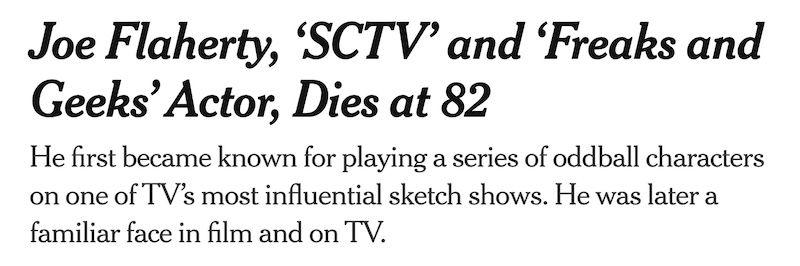
Yes, first and foremost one of TV's most influential sketch shows; and then, yes, a short-lived but beloved and influential sitcom from 2000. Right? Right. Done and done.
What's that? IMDb has something to say about Joe Flaherty? OK, go ahead:

I guess I should be happy that “SCTV” made the cut at all amid all those cameos. One wonders why these cameos and bit parts rate when others don't. Mae Clarke's, for example. Grapefruit in the face from James Cagney? One of the most iconic moments in early Hollywood history? Nah. We'll take “King of the Rocket Men” and “Daredevils of the Clouds,” two late 1940s, low-budget Republic pictures barely anyone has seen or remembers. Although I guess the former did inspire 1991's “The Rocketeer.”
Obits are often when attention must be paid. For IMDb, it's just another sign of its grand inattention.
Thursday April 11, 2024
Joe Flaherty (1941-2024)
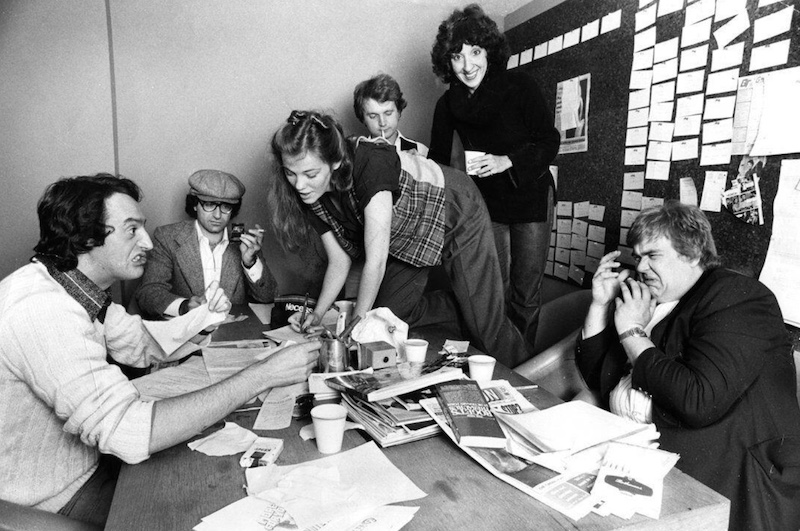
Murderers' Row: Flaherty, Levy, O'Hara, Thomas, Martin, Candy.
I heard about Joe Flaherty's death when I was at the Minneapolis airport flying back to Seattle after a week of sorting through my brother's possessions. Perfect timing, cosmos. This is one of those deaths I wish I could talk over with Chris.
We watched SCTV religiously—tough to do since the place of worship kept changing. I think we first saw it in syndication, Friday nights at 6:30 PM on some local Minneapolis station. This was in the Harold Ramis days, and it was funny and oddball, and what the hell was it? What was it mocking? Everything? Where was it from? How come nobody else knew about it? Then it disappeared and wound up on PBS, sans Ramis, John Candy and Catherine O'Hara, and with Tony Rosato, Robin Duke and Rick Moranis. Finally it went over to NBC for a much-ballyhooed 90-minute show late Friday nights, at which point they jettisoned Rosato and Duke, kept Moranis, got back Candy and O'Hara, and eventually added Martin Short.
Talk about your all-star rosters. Over the years, Chris, Dad and I talked up our favorites. Dad usually went Eugene Levy, case closed. Chris might've gone Candy? I sometimes went Ramis, sometimes Dave Thomas, but I remember a few times choosing Flaherty. His Count Floyd alone, man, the hapless host of “Monster Chiller Horror Theater,” emerging from a crypt, clad as a vampire, and forced to talk up the latest “scary movie” they'd booked, which usually wasn't scary at all. “The Odd Couple,” for example. “Aooooooo! ... It stars, uh, Walter Matthau and Jack Lemmon. And they play two roommates. One guy's real clean and the other guy, uh, is a sportswriter ... that DRINKS BLOOD!” I loved both his bad lies (in Bela Lugosi accent) and his eventual angry admission (in his own). Has anyone listed all the movies they booked? Yes, of course, it's the internet age: It's everything from their parodies of schlocky '50s 3-D movies (House of Wax/Cats/Pancakes/Stewardesses) to Dick Cavett interviewing Bobby Bitman about his latest vanity project. My favorite may be “Whispers of the Wolf,” which sounds scary, but is in fact an Ingmar Bergman parody, with O'Hara as “Leave Ullman” visiting her sister in Room 1313 (tarten tarten) of a hotel, and getting into the usual Bergman oddities. Cut back to Count Floyd, who maintains his composure for about five seconds before dropping the Lugosi to demand, off-camera, “Who booked Bergman!”
The initial premise of “Monster Chiller Horror Theater,” a send-up of local horror shows (for me, “Horror Incorporated”), was funny enough. But then add the nonsensical bookings as well as the never-mentioned in-joke that Count Floyd is in fact superserious newsman Floyd Robertson with a magic-marker widow's peak? Classic.

Flaherty also gave us half of “Farm Film Report,” the unctuous and untalented Sammy Maudlin, a brilliant satire of William F. Buckley, and a pitch-perfect Bing Crosby counseling Moranis' Woody Allen on how to deal with an irascible Bob Hope (Thomas) in “Play it Again, Bob.” Not to mention station president Guy Caballero, appearing in white suit and fedora, and sitting in a wheelchair—but occasionally getting up to perch casually on his desk because, as he states baldly, he only uses the wheelchair for sympathy. For years I was able to crack up my father doing Guy mid-SCTV telethon: “We need $10,000 ... PER PERSON!”
Flaherty's post-SCTV career didn't quite break the way it did for the others. Candy, Short and Moranis starred in movies, while Levy, O'Hara and Andrea Martin had strong supporting roles in big hits. Flaherty kept popping up mostly in bit parts, notably “Stripes” (Czech border guard), “Back to the Future II” (western union man), and “Happy Gilmore” (jeering fan). His biggest post-SCTV role was probably in the short-lived “Freaks and Geeks,” as Harold Weir, the father of Lindsay and Sam. The name alone, perfect.
Because of “SCTV,” I always assumed Flaherty was Canadian. Nope. Born and bred in Pittsburgh, PA. A lot of tributes from the famous and not-so-famous on social during the past week, including this one from Adam Sandler: “Oh man. Worshipped Joe growing up. Always had me and my brother laughing.”
Amen.
Friday March 15, 2024
What Is Kirstie Alley Known For?
And I don't mean the late-life Trump craziness. Or the mid-life Scientology craziness.
Last month I watched “Star Trek II: The Wrath of Khan” for the first time in forever, and I was like, “Oh right, Kirstie Alley as Lt.—or Mr.—Saavik.” I'd forgotten how sexy she was. To be honest, I'd also forgotten she'd died in 2022—age 71. Cancer. But while perusing all of this on her IMDb page, I, inevitably, came across this.
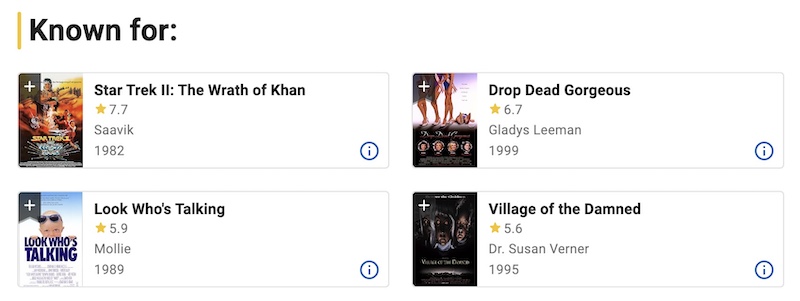
What's missing from this “Known For”? Just what she's known for.

That algorithm really disrespects TV, doesn't it? That algorithm really disrespects us, doesn't it?
Sunday December 10, 2023
Norman Lear (1922-2023)

Lear in The Chair.
A few years back I read Norman Lear's autobiography, “Even This I Get to Experience” and could've sworn I included excerpts on this blog. But that was just another thing I thought about doing and didn't. So here you go, all at once:
ON FATHER COUGHLIN
He despised Franklin Roosevelt, fulminated endlessly about the New Deal as a betrayal of American values, and attached prominent Jews to everything he was railing against. Coughlin repulsed me thoroughly, but I listened to him enough and was so chilled by his polarizing and divisive rhetoric as to be reminded of him throughout my life whenever I’ve run into an irrational, self-serving mix of politics and religion.
WORKING WITH SINATRA ON “COME BLOW YOUR HORN”
Frank was notorious for not doing retakes ... I looked at the scene in question and was even more certain that it needed to be reshot. I picked up the phone. Frank, whose day didn't start until eleven A.M., was in a makeup chair. “Frank, I just looked at that scene and we really have to do it again.” He asked why, and I told him. “My mother in New Jersey ain't going to notice that,” he said. “But, Frank—” “Did you hear me, pally, there is no fucking way I'm doing that again.” “But we have to, Frank,” I said earnestly. “You give me one reason why,” he fumed. “Because I fucking said so!” I exploded. “Okay,” he said.
ON FOCUS GROUPS
Some 30 people, likely recruited at a mall, were brought to a screening room and seated before a large TV screen. They were a bused-in midlife group, carrying shopping bags, dressed on a warm day in shorts, sandals, and blowsy short-sleeved shirts, all wearing the “What the hell am I doing here?” expression. The host explained that they were going to be shown a 30-minute situation comedy [“All in the Family”] and the network was interested in their reaction to it. At each chair there was a large dial at the end of a cable. They were to hold that dial while watching the show and twist it to the right when they thought something funny or were otherwise enjoying a moment. If they didn’t think something was funny, if it offended them or simply bored them, they were to twist their dial to the left. ... The group howled with laughter, rising up in their chairs and falling forward with each belly laugh. But wait! Despite the sound and the body language, they were dialing left, claiming to dislike much of what they were seeing, and they were really unhappy with it. But really! While I can’t say I could have predicted this behavior, unlike my friends at CBS I understood and was elated by the audience’s reaction. Who, sitting among a group of strangers, with that dial in his or her lap, is going to tell the world that they approve of Archie’s hostility and rudeness? And who wants to be seen as having no problem with words such as spic, kike, spade, and the like spewing from a bigot’s mouth? So our focus group might even have winced as they laughed, but laugh they did, and dialed left.
ON THE UNIVERSALITY OF ARCHIE BUNKER
The most telling letter we received was from a woman who had been divorced many years before, when her son was four years old. The boy had never seen his father after that. On the night All in the Family debuted, her son was now 32 years old and living 1200 miles away. The show was on for about 10 minutes when the lady ran to the telephone and almost broke her dialing finger phoning her son. When she reached him she screamed across the miles: “You always wanted to know what your father was like—well, hurry up and turn on channel two!”
ON THE ESSENCE OF ARCHIE BUNKER
Archie's primary identity as an American bigot was much overemphasized because that quality had never before been given to the lead character in an American TV series. But the show dealt with so many other things. Yes, if he was watching a black athlete on television, he'd make an offhand bigoted remark, and Mike would call him out on it. But the episode in which that exchange occurred might have been about Archie losing his job and worrying about how he was going to support his family. ... He was lamenting the passing of time, because it's always easier to stay with what is familiar and not move forward. This wasn't a terrible human being. This was a fearful human being. He wasn't evil, he wasn't a hater—he was just afraid of change.
ON CARROLL O'CONNOR
The marvel of Carroll's performance as Archie Bunker was that at some point each week, deep into the rehearsal process, he seemed to pass through a membrane, on one side of which was the actor Carroll O'Connor and on the other side the character Archie Bunker. Fully into the role of Archie, he was easily the best writer of dialogue we had for the character. ... If Carroll O'Connor hadn't played Archie Bunker, jails wouldn't be a “detergent” to crime, New York would not be a “smelting pot,” living wouldn't be a question of either “feast or salmon,” and there would not be a medical specialty known as “groinocology.”
ON 'MESSAGE' SHOWS
“If you want to send a message,” I was told, “use Western Union.” In the early years I would face that accusation by denying it. ... Then came a moment when—after expressing this for the umpteenth time—I thought: Wait a second. Who said the comedies that preceded All in the Family had no point of view? The overwhelming majority of them were about families whose biggest problem was “The roast is ruined and the boss is coming to dinner!” Talk about messaging! For 20 years TV comedy was telling us there was no hunger in America, we had no racial discrimination, there was no unemployment or inflation, no war, no drugs, and the citizenry was happy with whomever happened to be in the White House. Tell me that expressed no point of view!
**
All the obits say Lear changed American television, and he did—for about five years. Then it changed back. His shows thrived in the aftermath of the “Rural Purge,” when sitcoms like “Mayberry R.F.D.,” “Petticoat Junction” and “Gomer Pyle” went away or were canceled; and for a time, per Paddy Chayefsky, Lear replaced them with the American people. “He took the audience and he put them on the set,” Chayefsky said. By the 1974-75 season he had five shows in the top 10: “All in the Family” (1), “Sanford and Son” (2), “The Jeffersons” (4), “Good Times” (7), and “Maude” (9). The characters were bold and brash, and the sum total looked more like America, and everyone argued with everyone. And soon audiences tired of it. It was like what happened with the movies. For a time, we wanted reality, or hyped reality, or maybe just violence and sex, but before long the No. 1 movies were not “The Godfather” or “One Flew Over the Cuckoo's Nest” but “Star Wars” and “Superman,” while the No. 1 TV shows were “Happy Days,” “Charlie's Angels” and “Three's Company.” And by 1980-81? It was rural redux. The No. 1 shows were “Dallas” and “The Dukes of Hazzard,” and Lear's real people were replaced by “Real People,” the beginning of reality television, and the beginning of the end. That year, Reagan was elected by a landslide and began to change everything. Archie Bunker won and made things worse for the Archie Bunkers of the world.
I didn't know, watching “All in the Family” in the early 1970s, that I was watching America for the rest of my life. This line above gets at it: “Yes, if [Archie] was watching a black athlete on television, he'd make an offhand bigoted remark, and Mike would call him out on it.” One side was racist, the other side was annoying, and they just swirled together forever. We're still caught in that dynamic. “Didn't need no welfare state/ Everybody pulled his weight” has been, along with a touch of Father Couglin, the GOP platform since forever.
But what a life Lear led. From the above, you get a sense of how he did it. It was not just that he was funny, it's not just that he had original ideas and a good moral compass, it's that he didn't compromise. If he could stand up to Sinatra, what chance did CBS have? None. By forcing the suits to go his way, he made them millions. And yes, he changed television. Until it, and America, changed back.
FURTHER READING:
- “Norman Lear Reshaped How America Saw Black Families,” The New York Times
Tuesday October 17, 2023
Suzanne Somers (1946-2023)
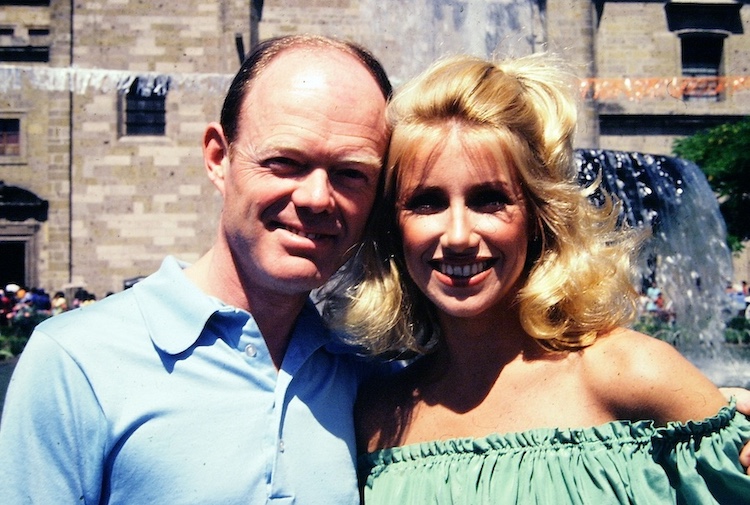
My father and Suzanne Somers in Mexico in 1978. And no, not that way, it was just a press junket.
This is how The New York Times began its obit:
Suzanne Somers, who gained fame by playing a ditsy blonde on the hit sitcom “Three's Company” and then by getting fired when she demanded equal pay with the series' male star — and who later built a health and diet business empire, most notably with the ThighMaster — died on Sunday at herhome in ...
If she'd died in the 1990s, I think the lede would've read more like this:
Suzanne Somers, who gained fame by playing a ditsy blonde on the hit sitcom “Three's Company” and was fired after making salary demands — and later wound up selling exercise equipment on late-night TV — died on Sunday...
What's the line from “The Dark Knight”? You either die a hero or live long enough to see yourself become the villain? Somers lived long enough to see herself become the hero. And a feminist icon! I don't think anyone thought Somers was a feminist icon in 1978. Particularly the feminists.
Contempating her trajectory—from walk-on eye candy, to sexy blonde TV star, to failed film star—I thought of Farrah Fawcett, and lo and behold they had the same manager, Jay Bernstein, who was apparently great at publicity, and getting actresses to leave successful TV shows, but not much else. It feels slightly shady to me, but he became a producer on their stabs at film stardom: “Sunburn” for Farrah, “Nothing Personal” for Suzanne. In the latter, Somers plays an environmental lawyer who gets entangled with a professor, Donald Sutherland, in preventing the clubbing of (yes) baby seals to make room for (yes) a missile base. That's the late '70s all wrapped into one awful storyline. My father, who, per above, had every reason to give her a pass, lambasted “Nothing Personal” in his usual manner. He quoted the publicity dept.'s take on the film and tore it apart. You call it a “modern comedy”? Neither, actually.
Here's a question: If Somers indeed demanded equal pay with John Ritter, was she right to do so, or was she more replaceable than John Ritter? Since she was in fact replaced—first by Jenilee Harrison, who didn't take, and then by Priscilla Barnes, who did, kinda—it seems like the answer is yes. But as someone who was there, and watching, off and on, the show was never the same once Suzanne Somers was gone. It was fun, and then suddenly she was calling in long distance? That didn't work. And all of her replacements never really replaced her. Chrissy Snow was a dumb blonde, but also sweet and wise. In many ways she was smarter than the others. She knew what mattered in life.
You know who thought she was worth the money? Newsweek magazine:

Look at that. She's literally bursting out of the televsion set—and her nighty. Which is the point. Newsweek was tsk-tsking about SEX AND TV but using both, and particularly the former, to sell the magazine. Suzanne Somers had to deal with that hypocrisy her entire life.
Her most memorable film role was one of her first—the blonde in the white T-bird that Richard Dreyfuss spends the night, and the movie, chasing after in “American Graffiti.” Smart boy. Oddly, I always thought she was in the backseat. Nope. He was—in the other car. She was driving. Not a bad metaphor, particularly if the posthumous accolades are correct. All the time I thought she was a passenger, she was actually in the driver's seat.
Sunday October 15, 2023
Phyllis Coates (1927-2023)
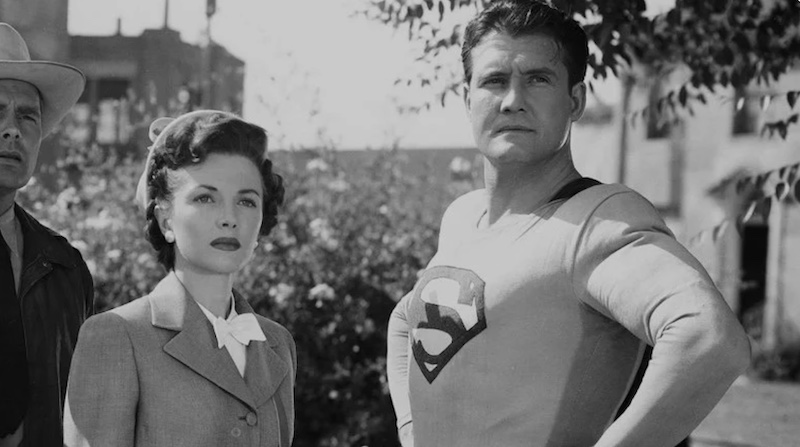
Phyllis Coates was the third woman to portray Lois Lane (after radio star Joan Alexander and Noel Neill), the second live-action Lois (after Neill), and the first non-Minnesotan (from Wichita Falls, Texas). She died last week at age 96.
Overall, Coates' Lois seemed more grown up and officious than Neill's. You feel you might get away with crossing Neill but not Coates. She was also the first actress to walk away from the role. After filming the B-movie “Superman and the Mole-Men” and the first season of the “Adventures of Superman” TV series, she gave it up and the role reverted to Neill again for the final five seasons. Looking through IMDb's photos, you get an idea why she might have done this:

OK, so the first shot is classic Lois and the third shot is from a cheapie serial. But the other two are from “Supes.” Seems a girl reporter couldn't get through a 30-minute episode without giving the fetishists something to fetish about.
Looking over these photos, what's surprising is how different Coates can look from role to role: here blonde and Teutonic for “Jungle Drums of Africa”; there, suburban housefrau for an episode of “Leave It to Beaver”; young and coquetteish for her early pinups, and leggy for low-budget Republic serials. She always seemed smarter than her roles, but I guess that wasn't hard.
Though she ditched a great character for those sad Republic serials, she was part of one of the great unheralded moments in early superherodom. It's from the “Mole-Men” movie which wasn't even much of a movie—it's barely an hour long. At one point, the “Mole-Men” are discovered in an oil-drilling Texas town, and, being Texas, a lynch mob is quickly assembled. A rabble rouser rags on “them two reporters from back east” (Lois and Clark) and tells the crowd that no strangers are going to stop them. But one stranger does. After a gun goes off, an illegal alien named Superman says the following:
Whoever fired that shot nearly hit Miss Lane. Obviously none of you can be trusted with guns. So I’m going to take them away from you.
And he does.
Man, I'd love to watch this with an NRA crowd someday.
Saturday September 02, 2023
Ginger Snaps

How many women have played Ginger Grant, the Marilyn Monroe-esque movie star stranded with “the rest” on Sherwood Schwartz' much-syndicated 1960s sitcom “Gilligan's Island”? I knew that for some of the subsequent TV movies another actress had been tapped, since Tina Louise had been uninterested in reprising the role; but it turns out, no, not just some: She never reprised the role, through all of its various reiterations. Which means this is our Ginger roll call:
- Tina Louise: “Gilligan's Island” (1964-67)
- Jane Webb: “The New Adventures of Gilligan” (1974-75) (Animated)
- Judith Baldwin: “Rescue from Gilligan's Island” and “The Castaways on Gilligan's Island” (1978, 1979) (TV movies)
- Constance Forsland: “The Harlem Globetrotters on Gilligan's Island” (1981) (TV movie)
- Dawn Wells: “Gilligan's Planet” (1982-83) (Animated) *
* Is this the ultimate revenge of Mary Ann?
But wait: Apparently there was a pilot episode, too—like Star Trek's “The Cage”—which resurfaced in the 1990s. And while Gilligan, Skipper, Thurston and Lovey were played by familar actors, the Professor was played by John Gabriel, Mary Ann was someone named Bunny and played by Nancy McCarthy, while Ginger Grant was played by yet another redhead, Kit Smythe. So:
6. Kit Smythe: “Gilligan's Island: Pilot episode” (1964)
I know she was a bit of a diva, but it's a testament to Tina Louise that no one compares.
Friday June 23, 2023
The Reason Behind TV's 'Rural Purge' in 1970
This is from Sherwood Schwartz' book “Inside Gilligan's Island” (don't judge):
In 1970 there was an important survey of the buying habits of TV viewers by an authoritative advertising publication. This survey revealed a tremendous difference in the buying power of urban viewers versus viewers in rural areas. Consumers in large metropolitan cities spent twice what their country cousins did, and were far more important for sponsors, and, therefore, to the networks who served them. As a result of that survey, Bob Wood, Programming Chief at C.B.S., cancelled all the rural situation comedies on his network, four of which were in the top twenty in the Nielsen ratings. The inside joke in the industry that year was that Bob Wood had “cancelled every show with a tree in it.”
I assume he's talking “Mayberry R.F.D.” and “Hee Haw,” among others. But yes, this is what helped lead to the diverse, urban, Norman Lear-style sitcom that dominated from 1971-74. Then we got our fantasy jiggle shows in the mid-70s. And by the end of the decade we'd come full circle, with “Dallas” and “The Dukes of Hazzard,” both on CBS, leading the way. And then we got Reagan.
I knew about the rural purge, just didn't know the rationale behind it.
Who knew this divide, rural/urban, country mouse/city mouse, would wind up being the great continuing battle of my American lifetime? And ongoing. Tune in next week for more exciting episodes.
Wednesday May 31, 2023
S4.E10: 'The Question is Why?'

“The Question is Why?” is a chapter heading in the 8th inning of Ken Burns' 1994 “Baseball” documentary (the 1960s), because it's a question a reporter asks of Sandy Koufax when he announced his retirement from baseball, at the top of his game, at age 31. Sandy repeats it before answering: The question is why. (The answer is he'd like to use his arm for the rest of his life, thank you very much.)
That's the phrase that came to mind after the final, painful episode of “Succession.” And not because Jesse Armstrong was retiring the show at the top of its game. I just couldn't fathom why Shiv (Sarah Snook), at the 11th hour, betrays her brothers, particularly heir-apparent Kendall (Jeremy Strong), allowing their father's company, Waystar, to pass into the hands of an Elon Musk-ish douche named Mattson (Alexander Skarsgard).
Shiv began the episode on Mattson's side, with the idea that she would become Waystar's CEO. But she's too powerful, with too many opinions, and Mattson wants a puppet. And that's her husband Tom Wambgams (Matthew Macfadyen). She was the one who suggested he needed an American CEO to allow the deal to go through, but she's going to be shut out. Tom learns this first and does nothing. Cousin Greg (Nicholas Braun), via Google Translate, learns it second and phones Kendall in Barbados, where both he and Shiv are working to get the vote of third sibling Roman (Kieran Culkin). The knowledge bands the siblings together, and they head into New York with the board votes to squelch the sale. The Roys will maintain control with Kendall as CEO.
And then she votes against him. She votes for the men who betrayed her. She lives up to her name. She doesn't do it happily but she does it. And the question is why.
Friends who have watched one or two episodes of “Succession” and then quit, often say, “There's no one to root for. All the kids suck.” And sure, kinda sorta. But I've rooted for Kendall from very early on. Someone—and I wish I could find it—wrote that Jeremy Strong has a bone-deep sadness in his performance, a sadness that fits John Berryman's Dream Song #29, which its creators are forever culling for their season finale titles:
There sat down, once, a thing on Henry's heart
so heavy, if he had a hundred years
& more, & weeping, sleepless, in all them time
Henry could not make good.
Wait, I found it: It's Michael Schulman in a New Yorker piece titled “Farewell, Kendall Roy.” He writes: “Strong never lost sight of Kendall's undertow of pain, his head stooped or self-consciously propped up straight. ... Other characters use the show's diamond-sharp dialogue as armor—Roman's wisecracking, Shiv's chess-playing—but Kendall seems the most dissociated from his own banter, as if his real self is wandering out of the boardroom, perhaps straight into the sea. ... More than anyone on 'Succession,' Kendall seems possessed of a soul.”
And Kendall seemed to be growing—I thought. He would never have his father's decisiveness—he held his siblings close, one felt, because he needed them to help make up his Hamlet-ish mind—but he was developing his own brand of ruthlessness. More, he had something his father never had: empathy. And he began to utilize it in a way that worked in the marketplace. When Mattson tweets a jokey Nazi reference (“”Doderick macht frei“) to try to undercut a Kendall press conference, and Kendall hears it in real time, his impulse is not to attack but to empathize: How we all say things we don't mean, things we wish we could take back. It's not only the most human response but the most devastating. It turns the tables on Mattson, at least for a day.
What he didn't do? At the 11th hour, when Shiv showed her shitty hand, he didn't make the argument he should've made. His argument became ”I.“ Me me me. I'm ready for this, I deserve this. It should've been ”we.“ If he'd stuck with ”we,“ if he'd told the board what everyone knew—that Shiv was being brushed aside by Mattson because she was too strong, and he wanted a puppet, and that was Tom, and hey, maybe the U.S. government shouldn't allow the sale because there really is no American CEO of this company—he might've won the day. There was a path but he didn't take it and he loses. He loses everything that mattered to him and shouldn't have. He just gets billions from the deal. And in the end we see Roman in a bar with a martini and a smile on his face, Shiv bereft in the backseat of a limo with her newly powerful but still sycophantic husband, while Kendall walks—is it lower Manhattan?—with his bodyguard behind him, a broken man, looking ready to walk straight into the sea. I haven't ached for a TV character this much since Jesse on ”Breaking Bad."
Saturday May 27, 2023
S4.E10: 'With Open Eyes'
I wrote about John Berryman's Dream Song #29 a year and a half ago, because “All the Bells Say” was the title of the Season 3 finale of “Succession.” What I didn't know until this year? All the season finales were from Dream Song #29:
There sat down, once, a thing on Henry's heart
so heavy, if he had a hundred years
& more, & weeping, sleepless, in all them time
Henry could not make good.
Starts again always in Henry's ears
the little cough somewhere, an odour, a chime.And there is another thing he has in mind
like a grave Sienese face a thousand years
would fail to blur the still profiled reproach of. Ghastly,
with open eyes, he attends, blind.
All the bells say: too late. This is not for tears;
thinking.But never did Henry, as he thought he did,
end anyone and hacks her body up
and hide the pieces, where they may be found.
He knows: he went over everyone, & nobody's missing.
Often he reckons, in the dawn, them up.
Nobody is ever missing.
The creators have actually gone backwards in the poem. Season 1 (“Nobody is Ever Missing”) is Kendall's Chappaquiddick moment, when his car crash causes the death of a young man during a wedding but he gets away with it because of who he is. Season 2 (“This is Not for Tears”) ends with Kendall taking on his father, despite his father blackmailing him about the Chappaquiddick moment; and season 3 (“All the Bells Say”) is the kids banding together to prevent Dad selling the company but arriving, as all the bells say, too late. BTW, that's a great fucking line in a great fucking poem: too late, too late, ding dong, too late. Brilliant. I've loved this poem since college. I think it's true for all of us, particularly that first stanza. We all have our moment when the world parts from us. The third stanza is about guilt, seemingly unjustified, but maybe not? Maybe just nobody is paying attention? That feels real, too, even if, at age 60, it feels like too many people are missing. Not because I hacks them up but because I lets them go. I stopped paying attention.
So what will the series finale (“With Open Eyes”) be? Who succeeds Lear/Logan? What makes sense for our world? What resonates? I hope they find it. Roman is out of it. Roman rose and fell. It's just Kendall and Shiv now, and maybe none of them? Maybe it winds up with the conglomerate? The line to the top is frayed, and indistinct, and no one is accountable.
“Ghastly/With open eyes, he attends, blind.” He is blind despite the open eyes. Who is he? Kendall? Shiv? Both? No matter what, it's a bad world and it's a reflection of our world. Either the Elon Musk figure takes over Fox News (Shiv triumphant) or the Donald Trump figure blocks it (Kendall triumphant). Ghastly.
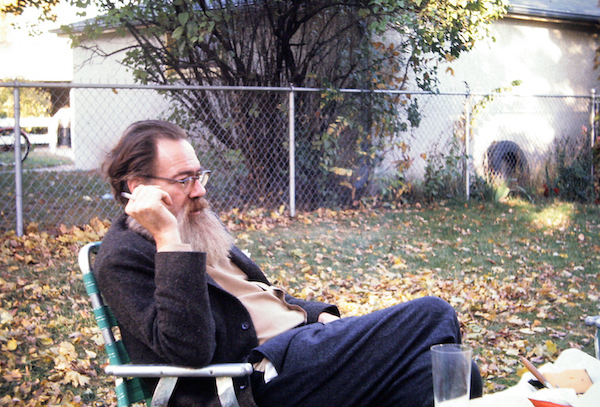
Berryman, in our backyard, with open eyes. Photo by Bob Lundegaard.
Thursday May 25, 2023
Ray Stevenson (1964-2023)
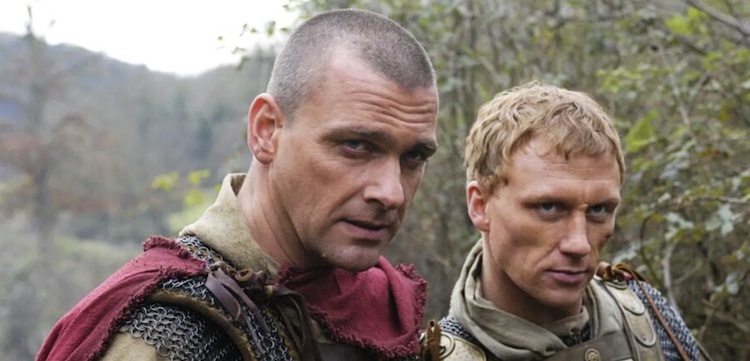
Stevenson, left, and McKidd, as Titus Pullo and Lucius Vorenus, the Rosencrantz and Guildenstern of HBO's “Rome.”
Wasn't HBO's “Rome” built just yesterday? It feels like we were just watching new episodes. Nope, Erik, that was 20 years ago, and as of yesterday, the real yesterday, HBO is now called “Max,” just a few days after the man who played Titus Pullo, Ray Stevenson, died at the age 58.
Patricia and I had recently seen Stevenson in India's Academy Award-winning “RRR,” white-haired and white-bearded, and playing British imperial villain rather than Roman working class lovable lout, so it took me a minute. “Wait, isn't that the dude from 'Rome'?” That was a great show that never got its due; Stevenson and co-star Kevin McKidd as Lucius Vorenus had such great chemistry as two mismatched Roman soldiers wandering through history. They were basically the Rosencrantz and Guildenstern of the rise and fall of the Roman empire—if HBO had let it fall. Instead they dropped it after two seasons. Too expensive. But it had a nice run. I should rewatch it.
Titus Pollo was not a nice man—rapey, not bright—but somehow Stevenson made him lovable. He seemed the big man who would protect you—unless you were on the wrong side, then he'd crushed your skull like a grape. Stevenson had charisma and a strong physical presence, and he went on to bigger roles, like Marvel's “The Punisher,” which seemed right but not quite. That character is humorless and that wasn't Stevenson. Humor shone in his eyes. After Titus, I don't think the entertainment industry quite found the right role for him. He was better than the roles he got.
Saturday April 01, 2023
Lance Reddick (1962-2023)

The first time I watched all five seasons of “The Wire,” I tended to root for the rebellious cops like Jimmy McNulty and Lester Freamon. Particularly Lester: the intellectual as natural police. I liked the guys taking on the system even though they'd get punished for it. I was young. Well, 46.
The second time I watched all five seasons of “The Wire,” I had, in the interim, become a manager, and man did I identify with Lt. Cedric Daniels, played by Lance Reddick, the officer trapped between those fomenting for change from below and the powerful, calcified (and often corrupt) entities above. The first time through, to be honest, I was a little annoyed with Daniels. Did he care enough? Why wasn't he doing more? Didn't he know who the heroes were? Second time through, I immediately recognized what an awful position he was put in—constantly. How the demands for change made sense but why they were ignored. The people below were interested in quality and the people above were interested in quantify—the numbers game. How you tried to protect your little corner of the world; how you tried to protect your people and yourself. How it usually didn't work out and you wound up in the pawn shop unit.
This is from Jonathan Abrams' oral history of “The Wire.” It's Reddick on an early meeting with creator David Simon:
I remember him saying organizations can't be reformed, but people can. I remember being struck by it when he said it, because I knew that I had never thought of it that way, and I knew that there was something profound in the insight. Then, over time, particularly when I watched the show, I realized how we see both on the criminal side and on the police side, you see people struggling to live up to the codes of the institutions that they're a part of and seeing how it chips away at their humanity.
Reddick initially read for Bunk Moreland (three times) and then for Bubbles (he'd recently played addicts on other shows). Once he got the Lt. Daniels role, he spent a day with a cop, a narcotics lieutenant who was getting his MBA at night school at Johns Hopkins, and who told a story about busting a dirty cop that stayed with Reddick. The dirty cop lunged for a drawer, possibly a gun, and Reddick's cop thought: Please go for it. Because I'd love to blow your head away. The story made Reddick realize “that level of savagery and ferocity that you have to be able to call up in an instant and be able to tame and put away in an instant.” You'd see that ferocity flash in Daniels' eyes from time to time. But more, there was just a burden on him, a silent burden. A fan has collected scenes of Daniels' “catchphrase,” where he's asked stupid or obvious questions, or questions he can't answer, and just walks away. It's fucking great.
I also remember that episode—I think it's third season—when we finally see Daniels out of uniform. I think he gets a late call some evening, and he's standing on the landing in just pajama bottoms, and ... holy crap he's cut. He looks like a prize fighter. Not an ounce of fat on him.
That's part of what makes Reddick's recent death, “from natural causes,” so bewildering. That guy died of natural causes? At 60? My age? It's almost an argument against being in shape. If it can happen to Lance Reddick...
I've written about how great “The Wire” is, and how during its run it was only nominated for two Emmys, both writing, never for show, and it never won anything. What I like? That never bothered Simon. If the Emmys were the calcified entity above him, he was the Daniels figure. And the McNulty figure fomenting from below? That was Reddick. “I'll always be angry about [the lack of Emmy recognition],” he said. “I'll be pissed off about it until the day I die.”
Saturday January 28, 2023
Lance Kerwin (1960-2023)

Oh, man. Too soon.
He was once my jokey answer whenever I had that stupid conversation about who you’d want to play you in a movie. This was in the ’80s or ’90s, long after his Tiger Beat heyday. Friends would be picking the big movie stars of the day while I went with a semi-forgotten TV actor.
When I was just becoming a teenager, though, Lance Kerwin was one of the main teenage stars of sensitive “issue of the day” TV drama. He was on five ABC Afterschool Specials, where the plots related to school bullies, step moms, and shortness. Over the years, he played a blind kid (“Shazam!”), the younger brother of a kid who ODs (“The Death of Richie”), and the child of divorced parents (“Children of Divorce”). He kept running into Kristy McNichol and Melissa Sue Anderson, and got to hang with Lynda Carter on “Wonder Woman” (where he played a rancher’s son) and Lindsay Wagner on “Bionic Woman” (where he played, cough, an Arabian prince). And in the pilot episode of “James at 15/16,” the show that made him famous, he runs away from home and winds up hitch-hiking with and learning life lessons from a Charlie’s Angel, Kate Jackson, who got Emmy-nominated for the part.
I don’t think I really watched “James at 15/16.” Right, it was opposite “Barney Miller” in pre-VCR days, so no. But it was critically acclaimed, and, I believe, quotidian. Some issue of the day stuff—a deaf kid, teen pregnancy, teen alcoholism—but mostly just, you know, crushes and friends and trying to fit in. The episode where he turns 16 and loses his virginity was controversial, and not because his uncle tried to buy him a prostitute, or because two episodes later he worried he contracted VD, but because, per The New York Times, “the network objected to the script’s use of the word ‘responsible’ as a euphemism for birth control.” Who was the lucky girl? A Swedish cultural exchange student. Quotidian.
But the performance of his that hit home for me was the 1976 TV movie “The Loneliest Runner,” a Michael Landon production about a teen who wets the bed, as I did. IMDb’s little descriptor is actually incorrect—or misses the point:
A young boy who still wets the bed finds escapism from his abusive mother and his own embarrassment by going running after school.
Not quite. His mother was abusive because she assumed his bed-wetting was laziness, and she hoped to cure him of it by hanging the wet, stained sheet out his bedroom window to dry—and where all the neighbors could see it. That’s why, every day, after school, he’d run home to pull it up. This went on for months. We got a montage of him running and running and running. And then in gym class one day, when everyone has to run 600 yards, or a half mile, or whatever it was, he pulls away from the other students. Eventually he becomes an Olympic runner, played by Michael Landon, but that’s just at the end. The brunt of the movie is him dealing with his awful mother, hoping to grow out of his bed-wetting ways, hoping to get the girl (Melissa Sue Anderson).
He continued to act into the 1980s—he, Eric Stoltz and James Spader play brothers who break their father, Robert Mitchum, out of prison in the 1983 TV movie “A Killer in the Family”—but he struggled with sobriety and left the profession in the 1990s. Per the Times obit, he was busted for theft and falsifying documents to get food stamps in 2010, which makes it sound like he was on his last legs; but in the AP story on the incident, the apparent problem was omitting the three properties he owned on the mainland, so hardly last legs. It also seems he was already running a rehab program and being a youth pastor, so not sure of his trajectory. Plus he was returning to acting? IMDb has him fourth-billed in a 2022 movie, “The Wind & the Reckoning,” about leprosy in 19th-century Hawaii.
The cause of death isn’t mentioned. He was just 62.
Sunday January 08, 2023
Another IMDb 'Known For' Quiz
I'll show you the actual IMDb “Known For” image in a second, but it's tougher these days to cut out the character names that might give it away. So for now I'll just list off the productions this actor, per IMDb's algorithm, is KNOWN FOR.
In this order:
- The Waterboy
- Night Shift
- Click
- Arrested Development
I knew he was in 2). I also knew he was in 4) but he's not the first name I associate with that great show. I did not know he was in 1) and 3), but then I'm not a huge Adam Sandler guy. Maybe that puts me at odds with the culture and IMDb's algorithm. If the algorithm truly taps into the culture. Which I doubt.
The point is, there's a massive #1 that IMDb's algorithm is somehow missing. It's older than these others but it was seismic. And it's still part of the culture—particularly as a recent catch-phrase. And if you're like “Forget it, old is old,” and you want a recency bias, there's a current, critically acclaimed show for which this actor has won Emmys. The algorithm supposedly cares about that.
More clues? He was one of the most famous faces of the 1970s for playing this character on this TV show. He wound up starring in movies as a result. But he's mostly known for TV. For this missing TV show.
Hell, when he's introduced, people often place this character's name between the actor's first and last name: X “Y” Z. He's referenced in “Pulp Fiction.” There's a statue of him, as this character, in Milwaukee.
Want more? Ayyyyyy.
Exactamundo. It's Henry “The Fonz” Winkler, who, per IMDb, is somehow not known for playing the Fonz on “Happy Days.”
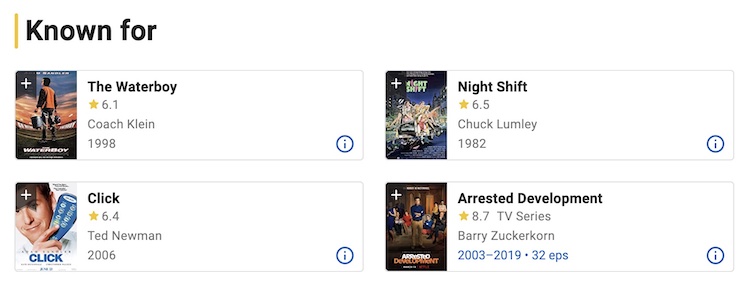
I think IMDb's jumped the shark.
Saturday January 07, 2023
The Stars (Trek/Wars) Align
I've seen a few articles or posts about “Andor,” the prequel “Star Wars” TV series starring Diego Luna, which seems to appeal to people who don't like “Star Wars,” like my wife, but I haven't seen anyone mention the following.
Whenever Bix (Adria Arjona) needs to send a message to Stellan Skarsgard's Luthen Real, one of the leaders of the rebellion, she climbs a tower to do so—I guess for the privacy or protection, or because the signal goes further. This is how it looks.
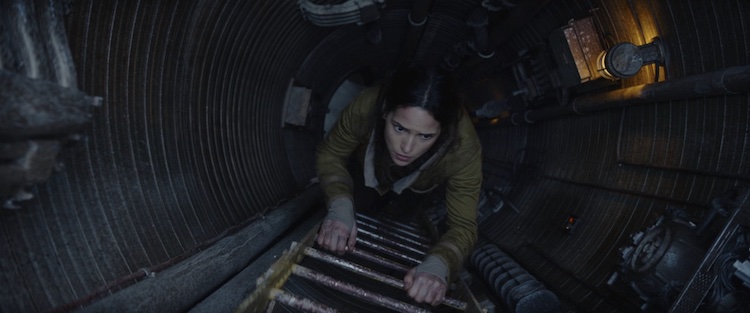
I immediately flashed on the Jefferies Tube from “Star Trek”:

So is this a “Trek” homage from “Wars”? The “Star”s aligning? I thought the usual nerds would be all over this, but if they are it's elsewhere, out of my range.
All previous entries

Baseball's Active Leaders, 2023
What Trump Said When About COVID
Recent Reviews
Everything Everywhere All at Once (2022)
Black Panther: Wakanda Forever (2022)
Doctor Strange in the Multiverse of Madness (2022)
Spider-Man: No Way Home (2021)
The Cagneys
A Midsummer Night's Dream (1935)
Something to Sing About (1937)
Angels with Dirty Faces (1938)
A Lion Is In the Streets (1953)
Man of a Thousand Faces (1957)
Never Steal Anything Small (1959)
Shake Hands With the Devil (1959)