






Tuesday April 23, 2024
Something Important to Acknowledge
“It's important to recognize the historical moment: that notwithstanding all the dilatory tactics, the delays, the whining, the yelling, the motion practice, that even though you have three trials that are delayed for some reason—whether it's the Supreme Court or this ethics issue that was raised in Georgia, or other appeals issues in the DC case—this trial is going forward, and someone who was the president of the United States, aspires to be the president of the United States again, with secret service agents in tow, is finally facing accountability. ... That's something I think is important and special to acknowledge.”
-- former U.S. attorney for SDNY Preet Bharara, on his podcast “Cafe Insider,” last week as voir dire began in the Trump hush-money trial in Manhattan
Monday April 22, 2024
Movie Review: A Fistful of Dollars (1964)
WARNING: SPOILERS
Clint Eastwood became a major movie star the year after I was born. I’m 61 now and he’s still a major movie star. He’s had a run like almost no one in Hollywood history.
And he owes it all to James Coburn, Charles Bronson and Eric Fleming.
Those are among the actors who turned down the lead in “Il Magnifico Strangero” a western to be helmed by some sword-and-sandals Italian guy, Sergio Somethingorother, and filmed in the backwater of Spain—get this, without an audio track. It would be dubbed. Oof. Plus they were about to get sued by Akira Kurosawa for plagiarizing “Yojimbo,” so the movie might not even be seen in the States anyway. Thanks but no thanks.
 Eastwood, 34 years old and on hiatus from another season of playing callow junior partner Rowdy Yates in the TV western “Rawhide,” was initially a no, too. But he agreed to read the script, caught the whiffs of “Yojimbo,” and overall liked its roughness. He liked how, in the opening scene, the hero, Joe, witnessed a cruel act—a child kept from his mother, who was apparently a concubine—and did nothing. He just kept getting the lay of the land. That made sense to him. He wound up reasoning: If the movie bombed, most people in the States wouldn’t even know it existed; and he’d get to see Italy and Spain. So why not?
Here’s what Eastwood brought to the project:
- The guns, belt, boots and spurs he wore on “Rawhide.”
- Several boxes of thin, foul-smelling cigars that he cut into thirds. “They put you in the right mood—cantankerous,” he later told his biographer, Richard Schickel
- The leather vest he wears more often than the iconic poncho
- His dialogue trimmed to its essence
What he brought, in other words, was the Clint Eastwood persona—as if he already had it fully formed in his head. Indeed, when director Sergio Leone tried to get him to act more like Toshiro Mifune in “Yojimbo,” Eastwood told him, “Sergio, I’ve got to do my own thing here.”
The anarchic threat
I’ve never seen “Rawhide,” but apparently it was a bit like “The Lone Ranger” in that Bob Dylan way. In each episode, Rowdy Yates and Gil Favor, leaders of season-long cattle drives, would encounter folks on the trail, often name guest stars, and help them solve whatever problem they had, then move on. But Schickel identifies a deeper theme:
Gunsmoke, Wagon Train, Bonanza, The Virginian and The High Chaparral featured all-wise elders rallying a real or surrogate family against the anarchic threat posed by the outsider, the other.
Eastwood’s role was, of course, restorer of the status quo, but he was bored with it. With “Strangero,” he got to play the outsider and anarchic threat. More, since the town of San Miguel is corrupt, the threat he poses is not only anarchic but moral. It’s necessary. Thus, in a blink, Eastwood went from a ’50s sensibility (the system is good and I'll uphold it) to a decidedly ’60s one (the system is corrupt and I'm going to bring it down). All within the framework of the western genre.
He starts out as a stranger, stopping for water, and silently witnessing the tableau of mewling child and distraught concubine. There’s no dog carrying a human hand here, as in “Yojimbo,” but as he rides into town he sees a noose hanging from a tree, frightened faces in windows, and a somnambulant horserider who’s actually a dead man with a note tacked to his back: “Adios, Amigo.” A bell ringer laughingly tells him he could get rich or get killed. The latter nearly happens when a gang of toughs pick on him but merely spook his horse. As it rides off, he grabs a wooden overhang, swings for a moment, then says his first line of dialogue to a townie: “Hello.” We’re eight minutes in.
The townie, Silvanito (Jose Calvo), tell him two families, the Baxters and Rojos, are fighting for supremacy of San Miguel and creating chaos as a result. The town is dead, Silvanito says, and urges the American to leave as soon as he can. Joe's got another idea.
Baxters over there, Rojos there, me right in the middle. … Crazy bell-ringer was right. There’s money to be made in a place like this.
That’s why he confronts the toughs, who are on the Baxter side of things, and shoots them all dead before they can draw—demonstrating his worth. He’d told the coffin-maker to get three coffins ready, but now, as he strolls away, he adds, in the laconic Eastwood manner, “My mistake. Four coffins."
You know what’s odd? Before this confrontation, he talks aloud to the Rojos but we don’t see any of them. He’s just a guy in the street talking to the air. It’s like Leone decided they needed that scene after everyone went home.
I’ll just state outright that “Fistful of Dollars” is not in “Yojimbo”’s class. Actions that make sense there, don’t quite here. When the matriarch overrules her husband about paying Sanjuro, I bought the Lady Macbeth vibe. When it’s the younger Rojo brother, Esteban (German actor Sieghardt Rupp), questioning his older brother Don Benito (Spanish actor Antoni Prieto, 25 years older), I didn’t buy it—particularly since the power of the family lies with Ramon (Italian actor Gian Maria Volonte), who’s, what, off getting ready to slaughter armies? The wild card in “Yojimbo” is tech—the gun of Unosuke (Tatsuya Nakaadai)—while here it’s Ramon, who’s crazier and more malicious than the crazy, malicious men around him. Kurosawa went for “A plague on both your houses” feel but most of the evil in San Miguel resides with Ramon. You get the feeling the town wouldn’t suffer much with the Baxters in charge.
| Ushitora | Seibei | |
| Pay the hero/kill the hero | X | |
| Wild card (gun) | X | |
| Concubine | X | |
| Rojos | Baxters | |
| Pay the hero/kill the hero | X | |
| Wild card (loco) | X | |
| Concubine | X |
Even the concubine isn’t quite on the Ushitora side of the ledger. Sold by a local farmer immersed in gambling debt, Ushitora gives her to Tokuemon, the sake brewer, to curry his favor. She’s transactional, a pawn in the game, who’s only introduced halfway through the film. Leone’s concubine, Marisol (German actress Marianne Koch), is there from the start and is one of the main drivers of the plot. And she belongs to Ramon, not some third party. He wins her through trickery and is obsessed with her. It’s personal.
Why does the hero decide to help the concubine and her family? In the Leone script, there was a prologue about Joe’s mother caught up in a similar situation, but it wasn’t filmed, so Leone tried to add it as exposition. It’s one of those pieces of dialogue Eastwood trimmed. It became: “I knew someone like you once and there was no one there to help.” But Mifune doesn’t even need that much. He just acts. His ronin is disgusted that the situation even exists, so he fixes it. Not out of nobility but disgust. It’s brilliant, and it doesn’t need an explainer. It’s all right there.
I could go on. Ramon’s slaughter of the armies and the stagecoach—with Joe and Silvanito watching from over the hillside—is overlong and dull. So is Joe’s trickery with the corpses at the graveyard. It’s a stupid plan that works because everyone else acts stupidly. Joe is undone only because of a change of plans. And the final showdown works only because Joe games the system with an iron chest-plate beneath his poncho.
Here's the thing: I still like it.
Jesus, this isn’t too bad
In Schickel’s biography, Eastwood describes, better than any critic, why Leone’s films work:
Leone, Clint thought … was trying to recreate the very feelings a child brings to his first experiences of the movies—the enormity of the screen looming over him, the overpowering images of worlds previously only imagined suddenly made manifest, made realer than real in the mysterious darkness of the theater. … Clint sees it in the low angles Leone favored for the characters he played, angles that offered, to put it simply, a child’s-eye view of heroism. He sees it, too, in the vast panoramic views of countryside and town streets that Leone loved, and loved alternating with extraordinarily tight close-ups of faces, of guns being drawn and fired, even of boots carrying their wearers toward their violent destinies, the jingling of their spurs unnaturally loud on the soundtrack. “Everything’s enhanced,” says Clint. “You’re seeing the films as an adult, but you sit and watch them as a child.”
That’s pretty fucking sharp.
Leone’s movie has its share of Christ metaphors: Joe rides into town on a low-slung beast, derided as a mule, as Jesus rode a donkey into Jerusalem on Palm Sunday; the mewling kid’s name is Jesus, while his parents are Joseph and Mary knock-offs: Julian and Marisol. Julian is ineffectual, etc. The main Christ metaphor, though—rise, death, resurrection—is in the original Japanese. It's storytelling 101.
So what did young Eastwood think after shooting this thing in Spain? He wasn’t sure. “Could be something, could be nothing,” he later told Schickel. During that summer and fall, he didn’t hear at all from Italy, while the American trade publications reported bad news: the western genre was dying in Italy. Only one film was doing well and it wasn’t “Il Magnifico Strangero”; it was something called “Per un Pugno di Dollari.” So much for that, Eastwood thought.
Eventually he realized “Dollari” was the Leone movie, and it—and he—were huge in Italy. A copy of the film was shipped to him in LA. Per Schickel:
Clint booked a screening room at the CBS Production Center and one night after work invited a few friends over to see it. He was careful, he says, not to heighten their anticipation. “You want to watch some little joke?” he remembers saying. “There’s this thing, and it’s all in Italian. I mean, it’s [probably] a real piece of shit.” But then everyone assembled, the lights went down, the picture started unreeling, and “in a while we said, ‘Jesus, this isn’t too bad.’”
No. Not bad at all.
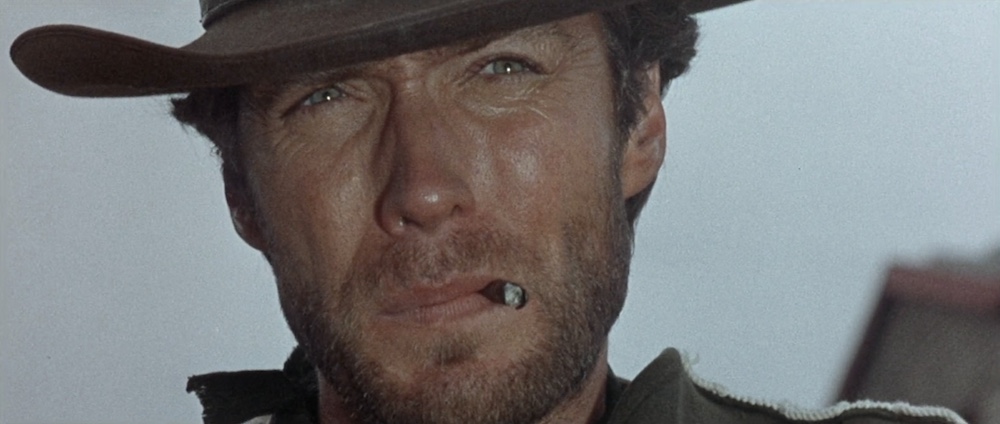
Rowdy grows up.
Thursday April 18, 2024
M's One-Hit Reds on a Sunny Afternoon

Bryce, Bryce, baby.
Well, that's a little better.
Two weeks ago, I attended my first Mariners game of the season, an 8-0 drubbing at the hands of Cleveland, in which our D kept booting the ball and our O couldn't move a man past second even if he led off with a double. That loss, to a team who did poorly last year but is currently one of the top teams in baseball, dropped the Mariners to one game below .500.
In yesterday's afternoon game, on a super-sunny, mid-50s mid-April day, the Reds and Mariners traded solo shots in the 2nd (Elly de la Cruz for them, Cal Raleigh for the good guys, a no-doubter), then there was nothing for several innings. Immediately after Cal, with two outs, Dylan Moore hit a triple thanks to a misplay by Reds centerfielder Stuart Fairchild, but he was stranded at third. With one out in the bottom of the 3rd, Julio Rodriguez, off to an abysmal start (sub-.300 everything), ripped a double off the glove of Fairchild but was also stranded at third. Stranding at third seemed our lot.
Then in the bottom of the 6th, we got another solo shot, this one from clean-up hitter Mitch Garver. Was that our lot? The solo shot? Because in the bottom of the 7th we got another one, from lead-off pinch-hitter Josh Rojas, making it 3-1. Four solo shots, four runs. That inning, though, finally gave way to another way to score. Newbie whippersnapper Jonatan Clase walked, stole second, and scored on a Mitch Haniger line single to left. Fun! Then Reds pitchers couldn't find the plate. Less fun! With two outs, Garver walked, and France walked to load them. Would Cal Raleigh get out the rye bread and mustard? No, he walked, too. Could Dylan Moore hit another triple to clear the bases? No, he struck out. But now we were up 5-1.
It was my friend Jeff who pointed out that the Reds weren't exactly hitting. Meaning beyond de la Cruz's homer, they didn't have any other hits.
“Did they even walk?” I wondered aloud. “I guess they're two over the minimum right now, so they must've walked.” They did: catcher Tyler Stephenson immediately after de la Cruz's homer. Those turned out to be the Reds' only baserunners for the day. Every other inning: three up, three down. Bryce Miller pitched six and got the win. Our first series win of the season was a series sweep, and it raised the Mariners record to .... right, one game below .500. This again. But I'll take the W.
Throughout the game, Jeff and I kept moving to stay in the sun. We began on the first-base side of the 300-level and wound up in shallow left field, but I still felt cold and stiff at the end. Maybe I'm getting too old for this shit? I screwed up the game time, too—thought it was a 12:40 start rather than 1:10—but was rewarded with a Griffey bobblehead doll. I normally say no to bobbleheads but I couldn't say no to that.
Tuesday April 16, 2024
Movie Review: Coogan's Bluff (1968)
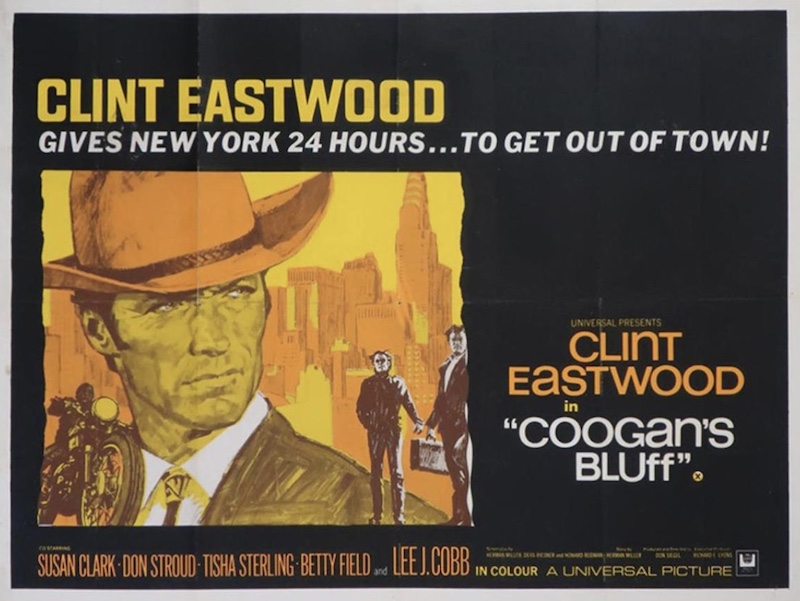
WARNING: SPOILERS
It’s a little ironic that after his successes with spaghetti westerns and “Hang ‘em High,” Hollywood’s attempt to bring Clint Eastwood into the modern age feels more dated than any of those 19th-century dramas.
I get what they’re trying to do: take Clint’s cowboy, make him a modern lawman, and tell a fish-out-of-water tale about extraditing a prisoner from New York City back to Arizona. Smart. Coogan shows up in string tie and cowboy hat, way taller than anyone around him, unable to blend in, with everyone assuming he’s from Texas. Even when he politely corrects them, they still say Texas. That’s a good recurring bit.
I also like the luggage routine. The cab driver tells him his briefcase counts as luggage, which is 50 cents extra, while the hotel clerk has a different view.
Clerk: That’ll be $7. In advance.
Coogan: The sign says $5.
Clerk: $7 without luggage.
[Coogan places briefcase on desk]
Clerk: That ain’t luggage.
Coogan: There’s a cab driver in this town that’ll give you an argument.
Good line reading from Clint, too. It’s more amused shrug than angry rube. He’s not being taken for a ride; he knows what’s going on but figures “When in Rome…”
Except, oddly, when it comes to police bureaucracy. The prisoner he wants, Ringerman (Don Stroud), has taken LSD, and is now incarcerated in the prison ward at Bellevue, which means another layer of bureaucracy he has to get through. His gruff NYC contact, Lt. McElroy (Lee J. Cobb), tries to lay it out for him. First, Coogan needs a doctor’s OK to get Ringerman out of Bellevue. Then he has to check papers with the DA’s office. Finally he has to go to the NY Supreme Court (?!) so a judge can render him into his custody.
Instead, Coogan sneaks Ringerman out of Bellevue and tries to spirit him out of the state. But at the airport he’s clocked by one of Ringerman's men—David Doyle of “Charlie’s Angels” of all people—and Ringerman gets away. Now Coogan has to track him down, with the higher-ups in both NY and AZ agin him.
None of this is particularly dated. And I’m not really talking about the hippies he encounters, either. That’s just the time period—like flappers in the ’20s or preppies in the ’80s. There’s a scene where Coogan enters a hippie nightclub, with everyone dancing and grooving to Hollywood’s awful version of what 1967-68 rock music is supposed to be, and with Coogan a head taller than the swirling bodies around him. You anticipate something great—like Robocop or Terminator in a nightclub, or when Eddie Murphy goes looking for Billy Bear in a country-western bar in “48 Hrs.” But I got the sense the filmmakers were less interested in culture clash than bringing in the youth market. “Hey, hippies! It’s you guys, look: dudes with long hair and chicks with words painted on their bodies! So come see our movie!” At one point, a near-naked woman swings over to Coogan on a trapeze (you remember those in nightclubs), slides into his arms, and says, “Hey, groovy! … Ooh, looking for anyone special?”
And that’s the dated part. Not the lingo. The sex and the sexual politics. Coogan has one job to do, extradite Ringerman, but he keeps getting distracted. By girls.
OK, so it's the lingo, too.
Pigeon-Toed Orange Peel
The movie opens a bit like the opening to “For a Few Dollars More“: an unseen rifleman from a high position watches an approaching rider. Here, the rider is in a Jeep. It’s Coogan, and the man in the high position is an escaped Navajo native, who’s thrown away the accoutrements of modern living (jeans, shoes) and apparently wants to live the natural life like his ancestors. Did he commit a crime? Not sure. But for some reason it’s Coogan’s job to bring him back.
After he’s got him in custody, though, Coogan gets distracted. He stops off at the home of a beautiful married blonde for a little nookie. And it’s there, mid-bath, mid-cleavage joke, that his superior finds him and barks at him about the NYC gig.
In NY, the romantic interest is Julie Roth (Susan Clark), whom Coogan first spies outside McElroy’s office in a busy, gritty 23rd precinct. She’s talking to Joe (Seymour Cassel), who’s well-groomed, wearing a suit, and sitting at a desk. Joe mentions the brooch pinned to her chest and touches it. And again. And insinuates. She responds: “Next you’re going to ask me if I make it with all the good-looking fuzz around here,” adding that nothing he says or does will upset her. That’s like an invite. And he takes it. He cops a feel. And again. And when he ignores her polite remonstrations, our hero, Coogan, intervenes. He tells Joe to back off. When Joe doesn’t, Coogan slaps him around.
Which is when Julie gets mad. At Coogan.
Turns out she’s not a cop (as Coogan assumed), and Cassel isn’t a cop (as I assumed). No, she’s his parole officer. And I guess she thought the gentle touch-my-breast approach might mother him into reforming? Who knows? It’s post-sexual revolution but pre-women’s lib, which is a bad period. It's all a little icky.
And it gets worse. After defending her from sexual assault, Coogan does everything he can to get in her pants. She keeps resisting, but with a smile, half caving in. It’s like that until two-thirds of the way through, when she tells him off. Sure. Except at the end, with no reconciliation scene, there she is, waving frantically from the rooftop of the Pan Am building as he flies off. Poor Susan Clark. What a thankless role.
Anyway, Ringerman is on the loose.
So after everyone says “Go home, Coogan,” Coogan questions Ringerman’s mother, Ellen (Betty Field), but apparently blows the cover of a cop pretending to be a junkie. How he blows the cop’s cover, we can’t fathom. Then it’s another date with Julie, where, rifling through the file cabinets she happens to keep in her living room, he discovers the address of Ringerman’s far-out hippie chick, Linny Raven (Tisha Sterling), and leaves to question her. Oddly, not at her pad. This is the scene at the trapeze-swinging nightclub, “The Pigeon-Toed Orange Peel”; and it’s only after a confrontation in a back room (with Albert Popwell, the “I gots to know” guy in “Dirty Harry”) that Coogan takes Linny back to her pad, where, again, he forgets about his job. They make out. Sex is implied. Then it's 4 AM and she takes him to a pool room to meet Ringerman. It’s a set-up: It's Ringerman’s gang, all of whom look like rejects from a 1950s B-movie.
At least we finally get a good fight—admittedly with that fake, too-red blood of the first post-production years. When Coogan can’t get David Doyle to talk, he returns to Linny Raven’s place and smashes a fist into her wall. That’s the move that finally jangles free Ringerman’s hideout: Fort Tryon Park in the Heights. They walk there. Gunfire is exchanged, there’s a foot chase, then a motorcycle chase, and Coogan, after so many women, finally gets his man.
Are lessons learned? Yes! From both sides in the culture wars. Bidding farewell on the rooftop of the Pan-Am building, Lt. McElroy finally remembers Coogan is from Arizona. As for Coogan? In the beginning, he’d crushed a cigarette beneath his boot rather than let the Navajo take a puff. Now, in the helicopter, he offers a cig to Ringerman. He even lights it for him. So I guess Coogan realizes that perps are people, too.
That, or he’s racist.
Where have you gone, Willie Mays?
1968 was a tough year to make a Hollywood movie. The Production Code was dead, the studio system was in shambles, the culture was shifting so much that nothing felt solid to the oldsters running things. Three years later, Eastwood and his first-time director here, Don Siegel, would navigate it all better, or at least with a particular point of view, in “Dirty Harry.”
You know what might make a good triple feature? “In the Heat of the Night,” “Coogan,” and “Midnight Cowboy.” Three fish-out-of-water stories from three years in a row: big city cop in the country (1967), a country cop in the big city (1968), and a country gigolo in the big city (1969). Do we try this anymore—navigating this clash of American cultures—or have things worsened too much to even attempt it?
Betty Field impressed, by the way, as Ringerman’s mom, so I had to look her up. She made her name on Broadway in the 1930s (“Boy Meets Girl,” “Room Service”), while her turn as Henry Aldrich’s girlfriend in “What a Life” led to the Hollywood adaptation of same, opposite Jackie Cooper. She played the first screen version of Curley’s doomed wife in 1939’s “Of Mice and Men,” and Daisy Buchanan in the Alan Ladd “Great Gatsby.” In the 1950s, she played moms: to Kim Novak in “Picnic,” to Hope Lange in “Peyton Place." She was also the Grace of Grace’s Diner in “Bus Stop.” She kept doing theater throughout. She’s good here. Her character has layers.
Love the location shooting. That whole “helicopter from JFK to the Pan Am Building rooftop” is a great slice of New York history. You can read more here. It began in 1965, stopped by the time “Coogan” was released, started again in 1977. Then an accident led to five deaths and there went that. Helicopter service over Manhattan traffic is now just for celebs.
During the final chase scene, did they include Coogan’s Bluff—former site of the Polo Grounds—among the shots? I assume so, but probably in the background. It’s still not a bad title, even if the location doesn’t figure in and the man doesn’t bluff much.
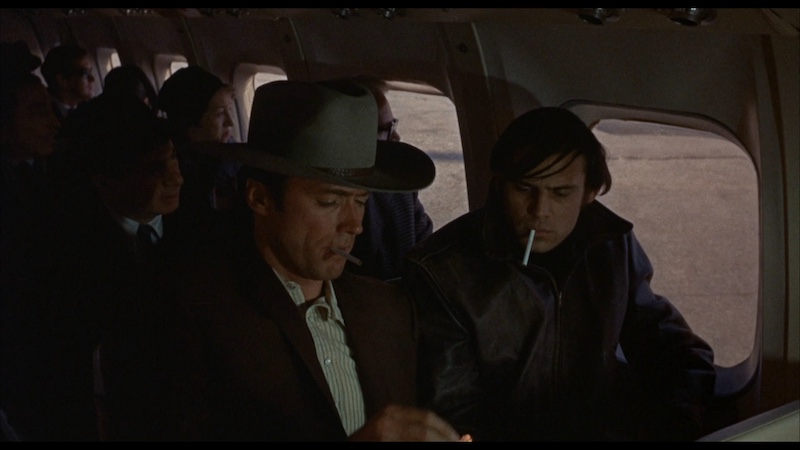
Lesson learned.
Monday April 15, 2024
IMDb Doesn't Make Eastwood's Day
Can IMDb do anything right anymore? In the early days, without Amazon's money, somehow they made it work, but now, with tons of dough, and (I imagine) layers upon layers of Amazonian management, it's just one pratfall after another. There's obviously the algorithm from hell. That's a daily occurence. And then there's stuff like this.

What is it? That's the bottom portion of Clint Eastwood's acting credits on IMDb, in the usual reverse chronological order. So it's his first acting credits—that early Universal Studios crap he had to do. You know: the sequel to “Creature from the Black Lagoon,” “Tarantula,” “Kelly's Heroes”...
Wait, what? “Kelly's Heroes”? From 1970? As his screen debut? You don't even need to know movies to know that's wrong. You just need to know how to count. I guess IMDb doesn't know how to count.
I tried to alert IMDb to this glitch two weeks ago but nothing's changed.
Sunday April 14, 2024
Movie Review: Black Tuesday (1954)
WARNING: SPOILERS
Is this Edward G. Robinson’s last gangster role? He played a couple of Big Jims in the 1960s: Big Jim Riva in an episode of “The Detectives” and Big Jim Stevens in a cameo in “Robin and the 7 Hoods.” And of course there was Dathan, governor of Goshen, in “The Ten Commandments,” who, as Billy Crystal reminds us, was a little too gangsterish. But in terms of the classical gangster, the genre he helped create with “Little Caesar” in 1931, I think this was the real end of Rico.
What a way to go out. Robinson plays Vincent Canelli, a brutal gang boss in prison, and a day from going to the chair for his sins. Except he’s got a plan, see?
 Actually, as B-movie plans go, it’s not bad:
- His gang, including one-time moll Hatti (Jean Parker), kidnaps Ellen (Sylvia Findley), the grown-up daughter of a benevolent prison guard, whom they then blackmail into planting a gun under a chair in the death-row visitors gallery
- Then they kidnap a journalist, Carson (Jack Kelly), assigned to the execution and replace him with one of their own: Joey (Warren Stevens)
- Joey grabs the gun, and he and Canelli make a break
They also take the death-row inmates, including his partner Peter Manning (Peter Graves)—who knows less where the bodies are buried than where the money is hidden—along with hostages: the prison priest (Milburn Stone), prison doctor (Vic Perrin), and a nasty guard who will get his. Plus they still have the reporter and the daughter. Quite a picnic.
Except the other death-row inmates are dropped off off on a street corner without a plan. They’re pawns in Canelli’s game, since they give the cops something to do besides chase him. Smart. But in the getaway Manning gets shot, he’s the one guy Canelli needs alive, so they hole up in a warehouse where tensions mount. Can Manning pull through? (Yes) Will the guard survive Canelli’s brutality? (No) Will romance develop between Ellen and the reporter? (I think?)
Canelli winds up pushing Manning too quickly. Against the doc’s advice, Manning goes to a bank to retrieve the dough, which is in a safe-deposit box, but he winds up bleeding over a newspaper account of the prison break—altering the cops. The trail of blood leads to the warehouse, which is surrounded. But Canelli, in classic fashion, won’t be taken alive, see? One wonders which less-sadistic gangmember—Joey or Manning—will take matters into their own hands.
I saw “Black Tuesday” as part of the SIFF Noir fest this year, and then bad shit happened afterwards and I lost the thread of the review. Apologies. Main thoughts: the movie is never dull, and it’s over too soon. If Hitchcock ripped the Band-Aid off, this one took some skin with it.
It’s also another of those ’50s movies (see: “Illegal”) that marries a 1930s star with actors who will become very familiar on 1960s television. We get not only “Mission: Impossible”’s Jim Phelps and “Gunsmoke”’s Doc, but The Professor (Russell Johnson) and Chief O’Hara (Stafford Repp). And Warren Stevens was in everything: “Twilight Zone,” “Have Gun, Will Travel,” “Rat Patrol” and “Star Trek”—Rojan in “By Any Other Name.”
Final thought: Peter Graves was a looker when he was young. Burroughs Elementary, represent.
Saturday April 13, 2024
What Is Joe Flaherty Known For?
If you ask my in-laws, apparently, it would be nothing. During Zoom calls, we often mention celebrity deaths, and this week I brought up Joe Flaherty and got stares. They knew SCTV, kinda sorta, just not him much.
The New York Times obit has it correct, though:
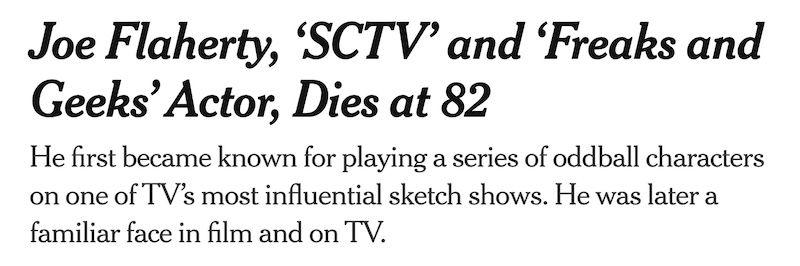
Yes, first and foremost one of TV's most influential sketch shows; and then, yes, a short-lived but beloved and influential sitcom from 2000. Right? Right. Done and done.
What's that? IMDb has something to say about Joe Flaherty? OK, go ahead:

I guess I should be happy that “SCTV” made the cut at all amid all those cameos. One wonders why these cameos and bit parts rate when others don't. Mae Clarke's, for example. Grapefruit in the face from James Cagney? One of the most iconic moments in early Hollywood history? Nah. We'll take “King of the Rocket Men” and “Daredevils of the Clouds,” two late 1940s, low-budget Republic pictures barely anyone has seen or remembers. Although I guess the former did inspire 1991's “The Rocketeer.”
Obits are often when attention must be paid. For IMDb, it's just another sign of its grand inattention.
Friday April 12, 2024
Stumbling Toward Vegas
In his Friday column, Joe Posnanski takes questions from “brilliant readers” as he calls them, mostly about the start of the season. Are the Astros really this bad? Are the Royals really this good? I was going to say something snide about Pos staying away from any mention of the Seattle Mariners, his dark horse to win the AL West, even as they started the season 4-8 (and looked worse); but then he included a takedown of Oakland A's owner John Fisher that just made me smile:
Will the A's ever play in Las Vegas?
I'm putting the percentage chance at 50. And falling.

It is stupefying—utterly stupefying—just how badly A's owner John Fisher has bungled things every single step of the way. I mean, you would think he would get something right by mistake. The latest fiasco involves the A's decision to play the next two years or three years or four years or 100 years in Sacramento, in a 14,000-seat, minor league ballpark that they will share with the Giants' Class AAA River Cats.
Sure, it takes quite the mastermind to cut a deal to play Major League Baseball in a shared minor league stadium in Sacramento. But, beyond that, Fisher had to share his excitement about how everyone in Sacramento (a few thousand at a time) would soon be able “to watch some of the greatest players in baseball, whether they be Athletics players or Aaron Judge and others launch home runs out of this very intimate, most intimate park in all of Major League Baseball.”
There are so many incredibly dumb statements in those few words that, honestly, I'm kind of in awe.
Pos adds that MLB should have forced Fisher to sell the team long ago but sadly that shipped has sailed. Joe's gut tells him the A's won't wind up in Vegas, but adds, “John Fisher does seem to have fully developed his failing upward act, and I'd say there's probably a 50-50 shot that by simply being super-rich and owning one of 30 big-league clubs, and being part of a sport that seemingly wants to go all in on gambling, he will somehow stumble his way into Vegas.”
Stumbling Toward Vegas would make a good title for a book on Fisher's ineptitude. Maybe wrap in some Yeats while you're at it.
Thursday April 11, 2024
Joe Flaherty (1941-2024)
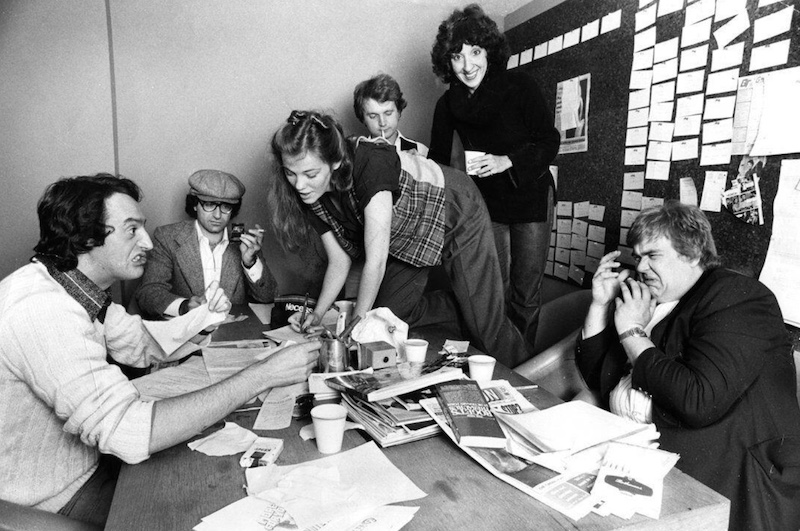
Murderers' Row: Flaherty, Levy, O'Hara, Thomas, Martin, Candy.
I heard about Joe Flaherty's death when I was at the Minneapolis airport flying back to Seattle after a week of sorting through my brother's possessions. Perfect timing, cosmos. This is one of those deaths I wish I could talk over with Chris.
We watched SCTV religiously—tough to do since the place of worship kept changing. I think we first saw it in syndication, Friday nights at 6:30 PM on some local Minneapolis station. This was in the Harold Ramis days, and it was funny and oddball, and what the hell was it? What was it mocking? Everything? Where was it from? How come nobody else knew about it? Then it disappeared and wound up on PBS, sans Ramis, John Candy and Catherine O'Hara, and with Tony Rosato, Robin Duke and Rick Moranis. Finally it went over to NBC for a much-ballyhooed 90-minute show late Friday nights, at which point they jettisoned Rosato and Duke, kept Moranis, got back Candy and O'Hara, and eventually added Martin Short.
Talk about your all-star rosters. Over the years, Chris, Dad and I talked up our favorites. Dad usually went Eugene Levy, case closed. Chris might've gone Candy? I sometimes went Ramis, sometimes Dave Thomas, but I remember a few times choosing Flaherty. His Count Floyd alone, man, the hapless host of “Monster Chiller Horror Theater,” emerging from a crypt, clad as a vampire, and forced to talk up the latest “scary movie” they'd booked, which usually wasn't scary at all. “The Odd Couple,” for example. “Aooooooo! ... It stars, uh, Walter Matthau and Jack Lemmon. And they play two roommates. One guy's real clean and the other guy, uh, is a sportswriter ... that DRINKS BLOOD!” I loved both his bad lies (in Bela Lugosi accent) and his eventual angry admission (in his own). Has anyone listed all the movies they booked? Yes, of course, it's the internet age: It's everything from their parodies of schlocky '50s 3-D movies (House of Wax/Cats/Pancakes/Stewardesses) to Dick Cavett interviewing Bobby Bitman about his latest vanity project. My favorite may be “Whispers of the Wolf,” which sounds scary, but is in fact an Ingmar Bergman parody, with O'Hara as “Leave Ullman” visiting her sister in Room 1313 (tarten tarten) of a hotel, and getting into the usual Bergman oddities. Cut back to Count Floyd, who maintains his composure for about five seconds before dropping the Lugosi to demand, off-camera, “Who booked Bergman!”
The initial premise of “Monster Chiller Horror Theater,” a send-up of local horror shows (for me, “Horror Incorporated”), was funny enough. But then add the nonsensical bookings as well as the never-mentioned in-joke that Count Floyd is in fact superserious newsman Floyd Robertson with a magic-marker widow's peak? Classic.

Flaherty also gave us half of “Farm Film Report,” the unctuous and untalented Sammy Maudlin, a brilliant satire of William F. Buckley, and a pitch-perfect Bing Crosby counseling Moranis' Woody Allen on how to deal with an irascible Bob Hope (Thomas) in “Play it Again, Bob.” Not to mention station president Guy Caballero, appearing in white suit and fedora, and sitting in a wheelchair—but occasionally getting up to perch casually on his desk because, as he states baldly, he only uses the wheelchair for sympathy. For years I was able to crack up my father doing Guy mid-SCTV telethon: “We need $10,000 ... PER PERSON!”
Flaherty's post-SCTV career didn't quite break the way it did for the others. Candy, Short and Moranis starred in movies, while Levy, O'Hara and Andrea Martin had strong supporting roles in big hits. Flaherty kept popping up mostly in bit parts, notably “Stripes” (Czech border guard), “Back to the Future II” (western union man), and “Happy Gilmore” (jeering fan). His biggest post-SCTV role was probably in the short-lived “Freaks and Geeks,” as Harold Weir, the father of Lindsay and Sam. The name alone, perfect.
Because of “SCTV,” I always assumed Flaherty was Canadian. Nope. Born and bred in Pittsburgh, PA. A lot of tributes from the famous and not-so-famous on social during the past week, including this one from Adam Sandler: “Oh man. Worshipped Joe growing up. Always had me and my brother laughing.”
Amen.
Saturday April 06, 2024
The Bane of Feedback Emails
I got this email the day after I sat for three hours in 50-degree weather watching the Mariners lose 8-0:

We hope you had a great time at the game? You see the score there? Does your left hand know what its right hand is doing, or are you fumbling around as much as the Mariners' defense on Wednesday?
I know, I know, every corporation does this now, but you'd think they might pause now and again. But I imagine whoever is running this dept. wants/needs engagement, for quarterly and annual goals, and it doesn't matter if it's negative engagement or engagement that in the long run sours the customer on the product, as long as they get their short-term clicks. Short-term numbers trump long-term viability in the minds of every middle manager in every American corporation. It's why we're all doomed.
I get these from my insurance company as well, Cigna, after doctor visits. “How was your visit with Dr. A?” A week later: “REMINDER: How was your visit with Dr. A? Your feedback in IMPORTANT!” OK, here's some feedback. How about go fuck yourself? Your feigned solicitiousness isn't fooling anyone. Hell, I get these from Ticketmaster, fucking Ticketmaster, getting all chummy with me: “ERIK: What did you (really) think of Silent Movie Monday?” The parenthetical is the nails on the chalkboard for me. Yeah, just a couple of girls chatting and spilling the tea. Me and Tick.
OK, I'm making a list:
- Ticketmaster
- Cigna
- Seattle Mariners
Just STOP. You assholes. Just fucking stop.
Thursday April 04, 2024
Pos: Mariners Will Win Division! M's: Not So Fast
On the day that Joe Posnanski predicted the Seattle Mariners would be the fifth-best team in baseball, I attended my first game of the 2024 season, where the Mariners did a brilliant job of showing Joe he's not exactly Nostradamus.
 We trotted out young ace George Kirby, who finished eighth in Cy Young balloting last season, and began this season by shutting down the Boston Red Sox in a 1-0 victory. Here, against the Cleveland Guardians (nee Indians) in the first inning, Kirby gave up a seeing-eye single to Steve Kwan, an HBP to Andres Gimenez, and a ringing double in the right-field corner to Jose Ramirez. 1-0. Then our defense fell apart. Josh Naylor grounded sharply to Ty France at first, who stepped on the bag but lost control of the ball—bloop—trying to complete the DP at home. 2-0. Will Brennan then grounded to drawn-in second baseman Jorge Polanco, our “big” off-season acquisition, and bloop again: the ball shot up in the air. 3-0. Brennan stole second as backup catcher Seby Zavala (part of the Eugenio deal) aired it into center. Kirby got the next batter, Bo Naylor, to strike out, but the ball bounced away from Zavala, and Naylor took first. Mercifully we got a pop out and a groundout to end it, but the next inning they got two more. In the 4th, they got three more, 8-0, the first on another Ramirez double. The Guardians kept repeating themselves that way. The most obvious example is when Bo Naylor struck out again in the 7th but got to first again when the ball bounced away from Zavala. I rarely see that once in a game anymore—taking first on a dropped third strike—let alone twice by the same player.
Mariner bats, meanwhile, strung together two doubles and three singles over nine innings and never managed to get a guy to third. The highlight of the game, for Mariners fans, was the top of the 9th when backup infielder Josh Rojas (part of the Sewald deal) pitched. I first noticed when a curveball floated in at 64 mph. Apparently he'd pitched last season with Arizona, two one-inning stints, getting shelled the first time, giving up a hit and no runs the second. Yesterday? No hits, no runs, just a walk, then a foul out (to himself), and a 6-3 DP. What remained of the crowd roared its approval.
So we're having Salmon Runs this season? That's the innovation? A between-inning race between four dudes dressed as different types of salmon? And this is how many years after Milwaukee was doing brat battles?
After the game, I listened to the latest Poscast and their 98.6% accurate predictions, in which Joe, again, said the Mariners would win the division. Then this admission: “I just want it so badly. I might not even be thinking straight, but I want Julio to win the MVP, I just want that team to be great.” Yes, it's pretty to think so.
Wednesday April 03, 2024
Movie Review: The Conspirators (1944)
WARNING: SPOILERS
We finally get to see Victor Laszlo in Lisbon!
OK, so not quite. Paul Henreid isn’t playing a Czech freedom fighter here but a Dutch one, Vincent Van Der Lyn, and he doesn’t have a deep past with a Swedish beauty but a new romance with an Austro-Hungarian one (Hedy Lamarr, yowsah).
Either way, you understand what Warner Bros. is trying to do: So whatever worked with “Casablanca,” um, can we repeat that?
No, you can’t.
Play it again and again and again and again, Sam
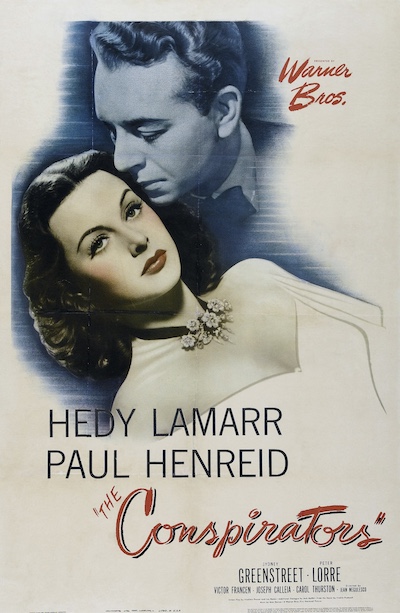 Van Der Lyn is a one-time teacher in the Netherlands whose student wrote the words “Long Live Liberty” (or its Dutch equivalent) on the chalkboard, and for that he was killed by the Nazis. Van Der Lyn was then imprisoned but escaped, and he became such a famous saboteur he was given a nickname: The Flying Dutchman. Now he’s arriving in Lisbon so he can travel to Britain to fight the Nazis head on. Though … why? Isn’t he more valuable where he is? I mean, aren’t the Allies trying to drop spies and saboteurs into Europe to do exactly what he’s doing? So why is he going the other way?
Hold onto that thought.
We get the “Casablanca” echoes right away. In Lisbon, there’s a police captain named Pereira (Joseph Calleia, looking very much like a young Cesar Romero), and you don’t know which side he’s on, but he winds up being on the right side. He’s basically Capt. Renault without the rascally charm.
At a restaurant and casino, Van Der Lyn meets a beautiful woman with a past. She’s married to a German, Hugo Von Mohr (Victor Francen), who rescued her from Dachau. And no matter how she feels about Vincent, she just can’t leave Hugo. She's Ilsa without the sense of deep love.
Van Der Lyn is Rick without the cool. In the 36 hours he’s in Lisbon, a neutral city, where he’s supposed to meet a replacement named Jennings—there are passwords about pawn shops—he mostly just wants a good meal and maybe a romance. He’s about to get the former at a nightclub when the latter, Irene, sits at his table. She’s running from the law after her underground contact in a back alley is shot by the police. He flirts, she doesn’t, then she says she has to make a phone call and sneaks out the backdoor.
He pursues—to Casino Estoril—but, in the pursuit, seems more annoying than charming. The next day it’s worse: He finds out where she lives and basically kidnaps her. Inexplicably she warms to him. They even kiss. But then he discovers the hubby backstory.
Meanwhile he meets Lisbon’s underground leader Ricardo Quintanilla (Sydney Greenstreet), who introduces him to an international assortment of resistance fighters: Polish (Peter Lorre), Norwegian (Gregory Gaye) and French (Louis Mercier). Which is when Quintanilla warns Van Der Lyn—privately—about a traitor in their midst. Talk about your tossed-in plot points! If I’m Van Der Lyn, I go, “Wait, why did you introduce me to everyboy? Aren't you putting me at risk? Shouldn’t you be cleaning house first? Also—and no offense—aren’t you a little pale for a Ricardo?”
Eventually Van Der Lyn meets Jennings … lying dead in Van Der Lyn’s room. A second later the cops shows up and Van Der Lyn goes to prison. He immediately assumes Irene traduced him, based on no evidence, and berates her when she shows up. After he escapes and returns to the gang, he find Quintanilla now suspects him. “Wait, didn’t you think there was a traitor in your midst before I arrived? So how could it be me?” is what he doesn't say. Instead he relays Jennings’ dying words, something about an eagle, and for whatever reason that allays Quintanilla’s suspicions.
Then the two set a trap for the traitor: a last-minute (but fake) meeting with Jennings’ replacement. Now let’s see who contacts the Germans with the intel. Will it be:
- The dull Frenchman
- The dull Norwegian
- Peter Lorre
- Hedy Lamarr
- Hugo, Irene’s German husband, whom we’ve just learned is actually with the resistance
Ready? The person secretly working with the Germans is … the German.
We get a shootout, Pereira proves himself a righteous dude, a Capt. Renault, and Van Der Lyn decides to become his own replacement. That’s right, he’s returning to occupied Europe. The whole trip—the whole movie—was a mistake. Except for the love! On the beach, as Portuguese fishermen get ready to row him back to France, he says his heartfelt goodbyes to Irene. Why doesn’t she go with him? I guess because they needed a goodbye like the goodbye in “Casablanca.” Except Lamarr isn't Bergman and Henreid isn't Bogie. There’s no fog, no passion, no poignancy. No looking at you, kid.
Geography 101
“The Conspirators” is directed well enough by Jean Negulesco—a Romanian artist who would go on to greater success in the technicolor 1950s with “How to Marry a Millionaire” and “Three Coins in a Fountain”—and it helps that his cinematographer is Arthur Edeson, who’d been filming since 1914 and was DP on “Casablanca,” “The Maltese Falcon,” and “Frankenstein,” among others. The problem is the script, which is derivative, all over the place, and not clever. The pawn shop line is the best line.
This is one of the first Hedy Lamarr movies I’ve seen, and she’s a knockout, but I don’t know what kind of actress she is. The love scenes went nowhere. She seems more distracted than anything. She’s much better at casting a dismissive eye at the clumsy advances of men. I’m sure she had practice.
Final thought: How many WWII-era movies begin with a map like this one does? War, what is it good for? Geography lessons.
All previous entries

Baseball's Active Leaders, 2023
What Trump Said When About COVID
Recent Reviews
Everything Everywhere All at Once (2022)
Black Panther: Wakanda Forever (2022)
Doctor Strange in the Multiverse of Madness (2022)
Spider-Man: No Way Home (2021)
The Cagneys
A Midsummer Night's Dream (1935)
Something to Sing About (1937)
Angels with Dirty Faces (1938)
A Lion Is In the Streets (1953)
Man of a Thousand Faces (1957)
Never Steal Anything Small (1959)
Shake Hands With the Devil (1959)