






Movie Reviews - 2013 posts
Monday April 27, 2020
Movie Review: Blue is the Warmest Color (2013)
WARNING: SPOILERS
At one point, as the sex scene continued into its second or third minute, I leaned over and whispered to Patricia:
When are these beautiful French girls going to put some clothes on so we can get back to the story?
I was only half joking. OK, I wasn’t joking at all.
 “Blue is the Warmest Color” is many things, including a coming-of-age story with feints into issues relating to homophobia and class, but it’s mostly a love story. It’s about the passion and pain and pang of first love, and in this regard the long sex scenes actually serve a purpose beyond getting asses on the screens so they’ll get asses in the seats. Remember when you first become involved with that special someone and you couldn’t keep your hands off each other? Right? And remember how boring you were? Probably not. But happy loving couples are dull, deadly dull, even in person. And on screen? Worse. There’s a reason dramatists keep the lovers apart. There’s a reason I don’t watch pornography: sex is generally a suspension of the story.
Even so, I admired the effort.
We get a good performance from Adèle Exarchopoulos, who plays Adèle, the main character, our eyes and ears. She has about a dozen faces in this film. At times she seems as young as 12 or as mature as mid-twenties. At times she seems too cute, at other times almost tomboyish or butch. Occasionally she looks very, very dumb. For a few scenes I actually thought she was unattractive. But for much of the movie, sans makeup, with her hair up, she simply looks lucious. It’s impossible to look at her and not think of the word “ripe.”
We watch Adèle go from being taught to teacher; from inexperienced to weighed under by experience; from unsure what she wants, to knowing exactly what she wants (Emma, the alpha female, played by Lea Seydoux), to no longer able to get exactly what she wants. It’s a lesbian relationship but it’s an everyperson’s story, too. I flashed back to my own youth many times in a way that I didn’t with, say, “The Spectacular Now.” Adèle’s story is specific but universal.
ADDENDUM: This is as far as I got in my review back in 2013. I think I got stuck because the movie was being lauded by everyone—it won the year’s best foreign language film from both NY and LA critics—and I just didn’t feel it, and I didn’t have the words, or the courage, to say so. I saw it seven years ago, in a movie theater that no longer exists (Harvard Exit), and my main memories of it are: 1) the scene where they meet in a park, 2) Adèle’s masturbation scene, 3) my joke to Patricia, 4) how long it was. Overlong. I guess that’s the main criticism I have. “Blue” is a vaguely interesting story about not very interesting people which goes on too long. Those are the simple words I couldn't find to say in 2013. Fin.
Monday October 14, 2019
Movie Review: Milius (2013)
WARNING: SPOILERS
John Milius is a legendary figure among legendary figures. He was big brother to George Lucas at USC Film School, where he was considered the breakout talent, the guy who was going to make it, while Steven Spielberg considers him the greatest storyteller among all of these great filmmakers—a spellbinding raconteur. He wrote “Apocalypse Now,” directed the first “Conan,” wrote the U.S.S. Indianapolis scene in “Jaws.” He took on the b-picture “Evel Knievel,” starring George Hamilton, which inspired my brother to jump neighborhood kids on his stingray bike at age 11. Plus he’s the supposed inspiration for John Goodman’s gun-toting, keeping-kosher Walter Sobchak in the Coen Bros.’ “The Big Lebowski.”
Not a bad resumé. Yet he still felt the need to pad it. Here’s Harrison Ford: “He likes to blow it up bigger than life.” Here’s George Lucas: “And then he’s created this ... persona.”
“Milius,” directed Joey Figueroa and Zak Knutson, acknowledges Milius’ tendencies to inflate himself while doing a bit of the same themselves. Early on, for example, we get a voice saying, “John Milius had more movies made than any writer in the history of Hollywood.” A quick IMDb check reveals 29 writing credits, of which about 18 are feature films. Pull a name out of a hat. Woody Allen has 80 writing credits, of which approximately 61 are feature films. Nope.
Basically, the doc loves the big guy too much. As a result, they miss opportunities to clarify the inconsistencies.
Toy soldier
 Here’s one—an early comment from Milius’ son, who’s now a prosecutor in LA:
There’s something about his personality that is sort of oppositional. If the counter-culture was going left, he was going to go right. To be the opposite of the counter-culture. He was trying to be as controversial in a way as possible.
He’s explaining his father’s right-wing tendencies on college campuses in the 1960s. That’s actually where Milius got the title for “Apocalypse Now.” In an archived interview, sucking on his ever-present cigar, Milius explains that back then kids were wearing “Nirvana Now” buttons with a peace sign on them. So to tweak them he modified one. He changed the peace sign into a B-52 and changed “Nirvana” into “Apocalypse.” Apocalypse Now.
Great story. But ... if he were truly oppositional, why, in the right-wing ’80s, did he go further right? He directed and co-wrote “Red Dawn,” the most paranoid of Reagan-era flicks. How is that oppositional? I guess you could say he was still tweaking noses but this time in liberal Hollywood, but I don’t completely buy that argument. You put him in a Republican convention, with his stogie and his AK-47, and he’d fit right in.
Hollywood movies have always glorified guns and violence, and for all his talents he pushed this tendency further: “Dirty Harry” (uncredited), “Magnum Force,” “Conan,” “Red Dawn.” “He doesn’t write for pussies and he doesn’t write for women,” actor Sam Elliott says proudly but a bit defensively. “He writes for men. Because he’s a man.”
The doc begins with an epigraph from the manliest of men, Teddy Roosevelt, about how critics don’t count (we know, we know), and how the credit belongs to the man “who is actually in the arena.” First, and not to get all critic-y, but it’s kind of a self-serving quote from TR, isn’t it? Since TR was that man in the arena? I never really thought about that before. Second, how does it fit Milius? He wasn’t in the arena. He was a man writing about the man in the arena. Or the man filming a story about the man in the arena. I guess a film set can be a kind of arena. But then so can a book group.
He was a failed soldier who wound up playing with guns for the rest of his life. He says he wanted to go to Vietnam and die before he was 26, but he had asthma and washed out. “I missed my war,” he says.
I would’ve liked more on his big-brother friendships with Lucas and Spielberg. They don’t seem like motorbike-riding, gun-shooting types. What did they do together? When did they drift apart? When did Milius realize the ride was over? That his friends were creating mythic stories that were part of the culture and he was ... not? Or no longer?
After “Red Dawn,” he claims he was blacklisted by Hollywood. “I’ve been blacklisted as surely as anybody in the ’50s,” he says. The doc, to its credit, then cuts to Arnold Schwarzenegger and Clint Eastwood not buying it. Here’s Arnold:
I have always been out there as a Republican. They don't care if you‘re Libertarian, if you’re an independent, if you decline to state if you’re a Republican or a Democrat, that means nothing to Hollywood. In Hollywood, the only thing that means [anything] is money.
That said, if you are going to blacklist someone, it wouldn’t be stars like Eastwood or Schwarzenegger. A writer-director is way easier.
That said, “blacklisted as surely as anybody in the ’50s”? C’mon, John. Did you have to go before a Senate subcommittee and explain your past political convictions? Did you have to name names? Show up hat-in-hand before, say, Tim Robbins, trying to get a job? No? Then don’t compare yourself to true victims of government-industry oppression.
Basically it sounds like people just decided he wasn’t worth the hassle. We get a story about how he brought a .45 to a notes meeting with the head of MGM. That’s going to wear fast. At one point, Charlie Sheen quotes Milius saying the following: “‘My fantasy’—it’s insane—‘was to fly across tree tops and drop fire on children.’” The “It’s insane” part is Sheen commenting on the quote. And if Charlie Sheen is questioning your faculties, maybe it’s time to drop the “let’s play with guns” shtick and re-examine.
Tough fall
He didn’t. We hear audio of him self-mythologizing about his post-“Red Dawn” career:
That was the point where they said, “He’s gone too far, now we’ve got to shut him down.” Critics said, “We said he was a threat to western civilization. This is proof.” Pauline Kael told us he was a fascist. He’s genuinely a right-wing character. I am not a fascist. I am a total man of the people. They are the fascists. They are creating the fascist society. I am much closer to a Maoist. However, I am a Zen Anarchist.
What garbage. Not a fascist ... because a man of the people? As if Hitler wasn’t? And who bragged about being a Maoist in the ’80s and ’90s? Not even the Chinese.
He had a tough fall. Opportunities dried up, his manager/best friend embezzled his money, which he never got back, and earlier this decade he suffered a stroke. He lost coordination, some ability to walk, and, perhaps worst of all, the ability to speak. Spielberg is poignant and empathetic on the great raconteur suddenly silenced.
I had issues with “Milius” but it’s worth checking out. (It's currently streaming on amazon prime.) The man was a pivotal figure at a pivotal time for movies. But his friends created myths that resonated with the world; Milius wound up creating self-myths that didn’t.
Thursday December 06, 2018
Movie Review: Ip Man: The Final Fight (2013)
WARNING: SPOILERS
I expected little from “Ip Man: The Final Fight.”
It’s directed by Herman Yau, who’s made 70 feature films, of which I was aware of exactly zero. One of his more popular films, at least according to IMDb ratings, is “The Legend is Born: Ip Man,” which was released in 2010, and seemed designed to capitalize on the success of the Donnie Yen “Ip Man” series. This is the sequel to that one. Meanwhile, its star, Anthony Wong, is hardly a kung fu master and claims to have been drunk when he accepted the offer.
 But it’s good. This Ip Man is older, his stomach troubles more pronounced. His wife comes and goes, dies quickly, and he embarks upon a discreet affair with a nightclub singer, Miss Jenny (Zhao Chuchu), which scandalizes his students. The movie is as much about his students as him. He is the calm center of a flurry of activities and outsized emotions.
香港,我来了
Did no one make a movie about Ip Man until 2008? Is that right? There was nothing, and then there was everything:
- 2008: “Ip Man,” with Donnie Yen
- 2010: “Ip Man 2,” with Donnie Yen
- 2010: “The Legend is Born: Ip Man,” with To Yu-hang
- 2013: An Ip Man TV series, with Kevin Chang
- 2013: “The Grandmaster,” directed by Wong Kar-wei, and starring Tony Leung
- 2013: This one
- 2015: “Ip Man 3,” with Donnie Yen
- 2018: “Master Z: Ip Man Legacy,” a spinoff of “Ip Man 3,” with Zhang Jin
- 2019: “Ip Man 4,” with Donnie Yen
According to Ip’s Wiki page, a biopic was long considered:
The idea of an Ip Man biopic originated in 1998 when Jeffrey Lau and Corey Yuen discussed the idea of making a film based on Bruce Lee's martial arts teacher.
Yet for all that, none of these movies say exactly why he moved from Guangdong province to Hong Kong in 1949. Or they fudge it. They say, you know, he was looking for work. But c’mon—1949? That’s the year the communists routed the Kuomintang and took over China. Ip Man, according to Wiki, was an officer in the KMT. So he was fleeing the communists—the party that is now making him a cinematic hero. Irony, irony everywhere, if we‘re allowed to think.
The movie opens with that—Ip’s arrival in Hong Kong. He has a few tenuous connections and a stellar reputation. Leung Sheung (Timmy Hung) asks him about Wing Chun, almost demanding a demonstration, and Ip calmly says they should eat first. After the meal, he asks for a piece of paper. He lays it on the floor, stands atop it, and tells Sheung to try to knock him off. You know how that ends.
He gathers students—or students gather to him. We learn about them briefly: the factory worker, the cop, the prison guard. Two students get into a fight and Ip Man tells them kung fu is not about starting fights. If he taught them to swim, he says, he wouldn’t want them pushing people into the water, either. Love that.
Little things keep happening. One of Ip’s students—the cop, Tang Sing (Jordan Chan)—is offered a bribe by the corrupt Hong Kong police force and doesn’t know what to do. He goes to Ip, who counsels without suggesting a course. Then another student, Le King (Jiang Luxia), hits a British officer during a union strike and winds up in prison. So Tang uses the bribe money to bribe the British officer to drop the charges.
Much of the movie is like this. It’s episodic—as much about Hong Kong as Ip. Some of his students date, get married, have children. A dinner with old family friends turns horrifying when it’s revealed that the father sold one of his sons to make ends meet. (This supposedly happened to Jackie Chan as a child.) Tang has several encounters with a local gang boss, Dragon (Xiong Xinxin), who takes control of everything inside the “walled city.” Ip must fight a rival master, Ng Chung (longtime HK character actor Eric Tsang), but on the politest of terms. One of Ip’s students opens a Wing Chun school opposite his with a big ceremony and a big sign, and his remaining students are aghast. He shrugs. Life goes on.
Then there’s the Miss Jenny complication. At an outdoor nightclub, some jerks manhandle her, she slaps one of them, they give chase. Ip Man gets in the way. You know how that ends. Later, he helps her write the English-language postal address of a place in San Francisco that caters to Chinese wives—but in helping, he discovers she can’t read or write Chinese, either. As always, he’s polite and discreet, and says, “I hope you find your Mr. Right.” She’s about to drop the letter into the mailbox, then retracts it and smiles to herself. It doesn’t get sent. She’s already found her Mr. Right. It’s a sweet scene.
Is he smitten? I certainly was, and became curious what else Zhao Chuchu has done. Not much. But she seems all over the Chinese gossip pages. Was she on a reality TV show? And what exactly breaks up Jenny and Ip Man here? At one point she gives him opium when he’s writhing in pain from stomach troubles. When he recovers, he gets angry, she cries, she apologizes. Ip and his son move in together, and the son, narrating, says, “Then, for some reason, she stopped coming.” We get her deathbed scene later in the movie. It’s quiet, discreet, sweet.
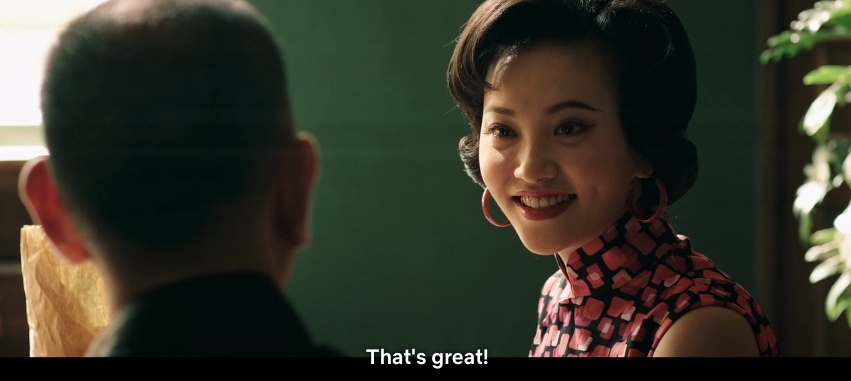
周楚楚: May we all have such complications.
再次
The big battle doesn’t come until about 15 minutes from the end. One of Ip’s former Wing Chun students, Tung, is now a star in Dragon’s arena, and Dragon asks him to throw a fight. He refuses. So Dragon both 1) drugs him, and tells his opponent, Ngai (Ken Lo of “Drunken Master 2”), to 2) kill him. He’s about to do so when Tang Sing intercedes, Tung’s pregnant wife arrives, and Ip, informed by his students, takes control. When Sing tells Ip he can't arrest Ngai because they're inside the walled city and thus outside police jurisdiction, Ip, with hands clasped behind his back, calmly asks, “If I take them out of the city, can you do your job?” You know how that ends.
Bruce Lee, Ip’s most famous student, comes off poorly here. He shows up at the end, a movie star with sunglasses, western friends, a big car and a big attitude. Ip ignores him. Bruce is also played by an actor much less attractive than the real Bruce Lee. It feels like someone is getting back at someone.
I like the very end. We get some Wing Chun philosophy (“One’s attitude should be like a [Chinese] coin, square on the inside and smooth on the edges”), and then old, grainy footage of the real Ip Man, practicing.
It should be one Ip Man too many but I guess I’ll never tire of the story he represents: The martial arts master who doesn’t want to fight; but there’s just too many assholes in the world.
Tuesday November 14, 2017
Movie Review: Finding Mr. Right (2013)
WARNING: SPOILERS
How often is the man the moral corrective in a romantic comedy? Ever? Generally, the men in these movies have issues (think “Pretty Woman,” “As Good As It Gets”), and it's up to the woman to, you know, make them want to be a better man.
Not so in Xue Xiaolu’s “Finding Mr. Right” (Chinese title: “Beijing Meets Seattle”). Here, the male lead, Frank (Wu Xiubo), is quiet and centered, lovely around his daughter, and with infinite patience around even the worst of humanity. The female lead? She's the worst of humanity.
 Jia Jia (Tang Wei) is somehow both former editor of a gourmet food magazine and spoiled, pregnant mistress to a Chinese tycoon. And since she can’t legally have the baby in China (since she's not married), she flies to the U.S., specifically Seattle (because she loves “Sleepless in...”), to have the baby there.
And she's just awful. She berates the driver who meets her at the airport (Frank), calls him “mouse boy” (for the gerbil cage he has in the backseat), and makes him carry her heavy, designer luggage everywhere. At the illegal maternity center—the house of Mrs. Huang (Elaine Jin of “Yi Yi”)—she demands a bigger room, then demands and gets Mrs. Huang’s room. She glares, pouts, mocks, flashes money. She walks into a room where a movie is being watched and gives away its ending. She gets drunk at a nightclub, and after Frank gently suggests she not drink for the baby, she accuses him of looking down on her and declares, “As a mother, I’m a hundred times better than any of those women!” You want to be a million miles from her.
It's almost refreshing.
Was it refereshing to Chinese moviegoers? For they not only made “Finding Mr. Right” one of the highest-grossing movies of 2013, they made Seattle the destination spot for Chinese living abroad.
Last exit to First Hill
That's how I first heard about “Finding Mr. Right." In 2014, our office moved from lower Queen Anne near downtown Seattle, to Bellevue, Wash., and I was surprised by the number of Mandarin-speaking Chinese people there. What happened? According to The Guardian, this movie happened.
Gotta say: It's kinda fun to see your city through foreign eyes. That freeway exit you encounter after a long slog up from Portland is suddenly exotic. Same with those tired buildings in downtown during the Christmas months. Because it means you’re here. Or at least Vancouver, B.C., where most of the non-establishing shots were filmed.
Christmastime is when Jia Jia begins to be a better woman. The Chinese tycoon is supposed to visit but instead sends another designer handbag, and Jia Jia, despondent, walks in the drizzle of Mrs. Huang’s residential neighborhood—the kind without sidewalks—where she comes across Frank’s car, invites herself in, marvels at how nice the place is given his circumstances, then finds out why. Just as she's really a magazine editor, he’s really Hao Zhi, a famous surgeon from Fuwei hospital in Beijing! So why is he picking up pregnant girls at the airport?
To be honest, I never quite got that. He and his wife needed to move for their daughter, Julie (Jessica Song), who’s asthmatic, and probably averse to Beijing pollution, and for some reason one of them has to give up their career? And since she makes more, as executive at some international company, he drew the short stick?
The wife, Linda (Rene Wang), turns out to be even more of a piece of work than Jia Jia, while the daughter’s a pill in that overly cutesy way of Chinese movie kids. At one point, she fakes an asthma attack to get away from mom and everyone treats it with a smile and a mock finger wag. But it gives Frank and Jia Jia (and Julie) a chance to bond and watch fireworks. On Christmas. Nothing like good old-fashioned, all-American Christmas fireworks.
The movie has its charms. After Jia Jia and Julie hop a flight to New York, where Frank is taking the medical board exams, they disagree on where to go first—MOMA (Julie) or the Empire State Building (Jia Jia/“Sleepless in Seattle”)? Jia Jia wins, and Julie, bitter pill that she is, writes HELP on her hand and shows it to a cop. Nice going, kid. They’re arrested, Frank is called in (missing his boards), and, because Jia Jia is there vaguely illegally, they have to concoct a better story while being interrogated in separate rooms. They come up with the “We’re really in love” story, which allows them to talk up the quality in the other they truly admire. That’s kind of sweet.
Better, at one point Jia Jia tells her cop, a Chinese woman who speaks Mandarin, that she’s trying to create the kind of ideal family she sees in Hollywood movies: mother, father, two cute kids, and a dog. Then she says aloud: Wait, Julie is allergic to dogs. There’s a pause. The cop, who surely isn’t buying any of this, suddenly bursts out angrily: “That’s not an issue! Obama’s daughter is allergic to dogs, too. But they have a Portuguese water dog and everything’s fine!”
Love that.
Finding a sleepless affair to rightly remember
Are there too many subplots? Jia Jia's tycoon boyfriend is arrested for fraud, freezing her accounts, and of course speeding up her return to normalcy. Mrs. Huang has to leave before her baby is born, conveniently sticking Jia Jia with Frank—who, by the way, is actually divorced. Has been for a year. His wife is even getting remarried. So we know where it's all going.
But damn does it take a while to get there.
Frank doesn’t help. “You know what your problem is?” Jia Jia tells him. “You’re too nice. Women don’t like guys who are too nice.” She’s not wrong. Frank actually picks up his ex-wife's wedding dress. He's there at the wedding. Thankfully, Jia Jia shows up, too, trashtalks through it, then has a catty face-to-face with Linda, in both English and Chinese, in which Linda gets the upper hand. We watch Jia Jia stew, wondering what crazy thing she’ll do, while Frank stares at her in silence. After several beats, he says it: “You spoke good English.” Another charming moment.
But even from here it’s a long slog to the end. Jia Jia collapses at the wedding and Frank diagnoses her problem and saves her life. He and Jia Jia and Julie (and the new, uncrying baby) are enjoying an idyllic American time together when a thicknecked man pulls up in an expensive car. Seems the tycoon beat his fraud rap and wants Jia Jia back. And gets her! The designer luggage is loaded into the trunk again, and she looks at Frank longingly. And then off she goes to Beijing.
Wait, what?
Then we get a montage of opulent clothes-buying and cold, opulent Chinese hotel rooms, along with complaints to the still absentee tycoon—who apparently can’t be torn away from business deals to be with her—and so Jia Jia finally ends it. “Two years later...” we‘re told and see her fixing a sink and face-timing friends. It’s idyllic mommy time in that Hollywoody way: hardwood floors and morning light and quiet playtime while mommy works on her website about gourmet Chinese food. And Frank is...?
Out of the picture. Yeah, they’re still not together.
Wait, what?
Here's why: As “Sleepless in Seattle” needed its “An Affair to Remember” ending on the observation deck of the Empire State Building, so “Finding Mr. Right” needs its “Sleepless in Seattle” ending on the observation deck of the Empire State Building. Frank takes the med boards again (are they only given in New York?), and celebrates with Julie from the observation deck of the ESB. Julie takes a selfie and sends it to Jia Jia, who receives it ... from the observation deck of the ESB! She's there! But she looks around and can’t find them. Because ... ? Yeah, they’re already back on the street. (Good god.) So she takes her own selfie, sends it to Julie, and eventually, finally, Christ already, our romantic leads are united romantically. He holds her hand, she puts her head on his shoulder, and the camera pans out from the observation deck and into a wider shot of New York, while, on the soundtrack, Louis Armstrong sings “What a Wonderful World.”
Somewhere Nora Ephron smiles. Or sues.
Tuesday March 24, 2015
Movie Review: Violette (2013)
WARNING: SPOILERS
In 2008, Martin Provost directed and co-wrote “Séraphine,” a movie about an acclaimed but relatively obscure French female painter in the early part of the 20th century. It was nominated for nine Césars and won seven, including best picture, screenplay and actress. I thought it one of the best movies of the year.
In 2013, Martin Provost directed and co-wrote “Violette,” a movie about an acclaimed but relatively obscure French female writer in the middle part of the 20th century. It was nominated for zero Césars, and no, it won’t make my retroactive list of the best of that year. It's not bad but doesn't resonate.
Emmanuell Devos (“Kings & Queen,” “Read My Lips”) plays Violette Leduc, a novelist and memoirist who ... Here. This explains a lot of it. It’s the first time Leduc's name appears in The New York Times:
Fame Through Confession
Roger Straus Jr., president of Farrar, Straus & Giroux, recently acquired in Paris the American rights to “La Batarde,” by Violette Leduc, an autobiography. The 57-year‐old author has previously written five novels that won her the approval of such literary people as Jean‐Paul Sartre and Albert Camus but brought small financial return. Then, with what Simone de Beauvoir describes in a foreward to the book as “intrepid sincerity,” she confessed her way to literary fame, to sales that have passed 50,000 copies and to contracts for publication in Britain as well as the United States.
That was from 1964 but the movie begins in the middle of World War II, when Leduc survives by selling goods on the black market. 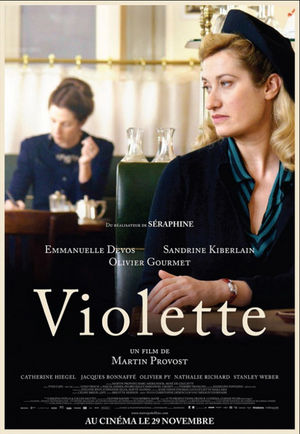 She’s enamored of and living with a writer, Maurice Sachs (Olivier Py), who, as portrayed here, is a bit precious with his talent. When she turns up days late after being imprisoned, he shushes her so he can finish a sentence. “Where did you get to?” he says finally. “I was worried sick.” He doesn’t sound like it.
She, on the other hand, is all id: pungent and needy. “To think I washed my hair for you,” she says, and when he doesn’t react, she leans forward and tells him, “Smell.” Later, she deals with his disinterest (he was gay) by showing even greater interest. “Take me in your arms. Touch me. Shut your eyes. Imagine I’m someone else.” It’s almost a relief when he’s out of the picture, since we think it’ll stop her from embarrassing herself so.
It won’t. Raised an orphan, and without a filter, she will always be recklessly needy. But she is also brutally honest, which is what you want in a writer. "Spit out on paper everything that makes you so miserable,” he tells her; and since he tells her, she does. We see her hold the pen over the page, and hold it, and then write, “Ma mère ne m'a jamais donné la main” (“My mother never gave me her hand”), which will be the first sentence of her first book, “L’Asphyxie.” Good first sentence. And very Violette.
In Paris, she thrusts the manuscript into the hands of Simone de Beauvoir (Sandrine Kiberlain), who is the opposite of Violette in most respects: successful, intellectual, cool to the point of chilliness. But she knows talent, and one evening sits Violette down and says the following:
First, I must apologize. I was expecting dull childhood memories by a frivolous snob. You’ve written a fine book. Powerful, intrepid. That’s what matters. Have you been writing long?
When Violette says Maurice Sachs is the real writer, de Beauvoir is blunt:
Sachs is the opposite of you. He hides his true self—behind words especially. But he urged you to write, that’s the main thing.
“He hides his true self—behind words especially” should be a warning issued to every writer.
With Sachs out of the picture (apparently he died at the end of World War II), de Beauvoir, in effect, replaces him, becoming both spur to Violette’s career and that unattainable thing that makes her needy. Violette wants into the inner sanctum of de Beauvoir, Sartre, et al., but gets only their distant encouragement. She wants their success but only achieves her own. She deals miserably with her mother. Eventually, per the above Times clip, she writes her way into popularity.
But it’s not a great movie. Why does “Séraphine” work and this not? Is it the difference between the art of the writer and painter? Painting is at least a visual medium, which suits the cinema better.
In the end, I think it comes down to personality. Seraphine was quiet, uncomplaining, and expected little; we were drawn forward to wonder over her. Violette is needy, loud, forever complaining. For all the art of the picture, and there is art, we can’t wait to get away from her.
Friday December 12, 2014
Movie Review: Only Lovers Left Alive (2013)
WARNING: SPOILERS
Jim Jarmusch’s “Only Lovers Left Alive” is a dreamy vampire movie for adults. If you could live for centuries, after all, would you hang out in high school per Edward in the “Twilight” series? Isn’t that a little creepy? Isn’t Edward a little Wooderson for doing that? With one change: “That’s what I love about these high school girls, man. I stay the same age and they stay the same age.”
Jarmusch’s vampires aren’t chasing after freshmen or sophomores but have steeped themselves in science, the arts, ennui. They can explain quantum physics, speak Latin, and play classical violin. They’ve hung out with Byron and Shelley. They were Shakespeare. One of them anyway.  There’s a great exchange when Eve (Tilda Swinton), living in Algiers, actually suggests that her friend Christopher Marlowe (John Hurt) finally drop that literary bomb on the world and let everyone know that Shakespeare wasn’t Shakespeare:
Eve (eyes lighting up): It would cause such thrilling chaos.
Marlowe (weary): I think the world has enough chaos to keep it going for the minute.
These blood-suckers actually try to get along with us. They bribe hospital workers to get “good blood,” and take it home and drink it from heavy aperitif glasses, then float back as if in a heroin stupor. They don’t prowl the night in search of people to kill. Either the sport has gotten old or too dangerous. There’s all that “bad blood” out there. AIDS kills. Even vampires.
Christ, you know it ain’t easy
Eve’s husband, Adam (Tom Hiddleston), for reasons we don’t quite fathom, isn’t living with her in Algiers. He’s in Detroit, a half-dead city, where he’s gaining renown as an underground musician. By night he creates his music, and hands it off to his fan/gopher, Ian (Anton Yelchin), who’s signed an NDA, and who gets him things he asks for, such as a specially designed wooden bullet. A bullet introduced in the first act will surely go off in the third ... unless it’s a Jim Jarmusch movie. Then no. Adam wants to kill himself but never pulls the trigger. Instead, Eve, taking red-eyes all the way, comes to visit him. They entwine, like John and Yoko on the cover of Rolling Stone.
Since not much is happening at this point in the movie, we wonder what might happen:
- Adam’s hospital connection, Dr. Watson (Jeffrey Wright), betrays him, and there’s a battle.
- Ian gets too garrulous—or more garrulous—and there’s a battle.
- The rock ‘n’ roll kids, Adam’s groupies, break into his house, and there’s a battle.
Nope, nope, nope. Instead, Eve’s younger sister, Ava (Mia Wasikowska), shows up uninvited and wreaks a kind of quiet havoc. The three of them go out to a nightclub with Ian, come home with Ian, and Adam and Eve leave a thirsty, impulsive Ava alone with Ian. Not smart. They’re centuries old but they don’t see what’s coming? We do. Afterwards, they kick her out and dispose of Ian’s body, then flee the Motor City. They take red-eyes back to Algiers, where, thirsty, they discover Marlowe has drunk bad blood and is dying. Then he dies. And in the end, Adam and Eve, refuting the title, kill two lovers necking under a full moon.
That’s the story. It’s more of a mood piece. Specifically, it’s Jarmusch’s mood. Here’s a quote from him on IMDb:
I feel so lucky. During the late ’70s in New York, anything seemed possible. You could make a movie or a record and work part time, and you could find an apartment for 160 bucks a month. And the conversations were about ideas. No one was talking about money. It was pretty amazing. But looking back is dangerous. I don’t like nostalgia. But still, damn, it was fun. I’m glad I was there.
Adam and Eve are nostalgics but it’s Jarmusch’s nostalgia. They play 45s, listen to obscure R&B and rockabilly (“Trapped by a Thing Called Love,” “Can’t Hardly Stand It”), read great works of 20th-century literature. Adam’s wall is like the wall of the 1970s college student: Franz Kafka, William S. Burroughs, Oscar Wilde, Jimi Hendrix, John Coltrane. Eve reads aloud from Shakespeare’s Sonnet CXVI (“Let me not to the marriage of true minds/ Admit impediments ... ”), which is the most famous of the sonnets. My thought: She’s lived for centuries and she’s still reading that one? When was she born? Fourteenth century? Tenth century? Earlier? What could they tell us of human history instead of spinning those 45s?
Too late.
The way things are going
In this way, “Only Lovers Left Alive,” while beautifully art directed, is less a story of bored vampires isolated in a world of zombies (their term for us) than of a certain type of hipster artist isolated in a world that doesn’t know or care about art. We’re zombies to Adam and Eve because we’re literally the walking dead: we are creatures who die. We’re zombies to Jarmusch because we have no taste and no soul; we’re the culturally dead.
When Adam and Eve return to Algiers, for example, the nom de passports they use are Stephen Dedalus and Daisy Buchanan. You can read this two ways: 1) Adam and Eve, and Jarmusch, are a little precious with their literary references; or 2) Those are the safest names to use in a world full of the culturally dead.
Friday September 19, 2014
Movie Review: The Strange Color of Your Body's Tears (2013)
WARNING: SPOILERS
The Italian horror/sex genre giallo, popularized by directors like Mario Bava in the 1960s and ’70s, uses elements of nightmare within its narrative but the narrative itself is fairly straightforward. “The Strange Color of Your Body’s Tears,” a French-language homage to the genre by Hélene Cattet and Bruno Forzani (“Amer”), is less narrative and more nightmare.
It’s also boring. The way other people’s dreams are boring.
As Dan (Klaus Tange) returns to Paris from a business trip, we see, intercut, a woman involved in kinky sex games gone awry.  At home, Dan’s wife, Edwige (whose name is an homage to giallo actress Edwige Fenech), is missing, yet the apartment door is chained from inside. How?
Dan searches, obsessed, anxious. A detective shows up, suspicious. A older neighbor woman in apartment 7 sits in the shadows (with great legs) and talks of how her husband went missing. She blames the apartment above, but when Dan ascends the stairs he’s on the roof, where a naked woman stands on the ledge. They share a cigarette.
By this point, it’s almost a parody of a foreign movie: the sexuality, the incomprehensibility, the dreamscape.
It gets more confusing. Does Dan wake with his wife’s head in his bed? Doe he wake to get slashed in the back? Is he awake? Where does sleeping end and waking begin? Do we care?
Everyone has their own story, even the suspicious detective. We get his in flashback. When we came back to the apartment, Dan asks, straight-faced, “What has it got to do with my wife?” I laughed out loud.
The movie, suffused in reds and greens, is as repetitious as hell, and includes many closeups of male eyes in panic or desire, and women, losing clothes or encased in fetishistic gloves, forever out of reach. I found a few lines and images in the second half intellectually stimulating but it wasn’t enough, and the resolution was awful: clouding what felt like a rare insight.
Larger question: Why are we getting all of these arthouse versions of exploitation flicks? They were part of my “11 Worst Movies and Five Worst Trends of 2013,” and they still seem with us.
-- This review originally appeared in shorter form in the Seattle Times.
Wednesday August 27, 2014
Movie Review: The Immigrant (2013)
WARNING: SPOILERS
I think of the word “traduced” when I think of this movie. As in: Someone must have traduced Ewa C., for without having done anything wrong she found herself in America one fine morning.
Marion Cotillard plays Ewa Cybulska, a Polish immigrant arriving in America in 1921 with her sister Magda (Angela Sarafyan), who is suffering from tuberculosis and thus taken out of line at Ellis Island and placed into quarantine. She disappears into the bowels of an uncaring, faceless bureaucracy. Ewa, meanwhile, is traduced: declared a woman of low morals because of a shipboard incident. But she is saved from disappearing into bureaucratic bowels by Bruno Weiss (Joaquin Phoenix), a man who insinuates himself into every situation and exudes ickiness from the get-go.  He declares he will vouch for her, does, and off they go into the uncaring bowels of New York City: the lower east side.
Bruno, it turns out (and big surprise), runs a kind of burlesque show. He’s half barker, half pimp, and our concern for Ewa is of a traditional nature: Will she be forced into prostitution? What of her virtue? Oh, what of it? My concern for the movie, meanwhile, was graver: Would this just be a sad, downward-trajectory film or would it veer in unexpected directions? Could it retain our interest and still feel true?
The good news is it’s not simply a downward-trajectory film. Ewa isn’t just a victim and Bruno isn’t just a victimizer; but the prostitution thing still happens. Off camera, mostly.
Unraveled, Ewa’s story is a sad one:
- Her parents were killed during the Great War.
- On the ship to America, she is raped, which is why she is declared “a woman of low morals.”
- Her uncle, who is supposed to meet her at the dock, abandons her when he discovers her new, traduced reputation. When she finds her way to his and his wife’s place in Brooklyn, he hands her over to the cops, who hand her back to Bruno. She’s trapped.
The arrival of Emil (Jeremy Renner), a Houdini wannabe, cousin to Bruno and rival for Ewa’s affections, adds energy and comedy to the story. Ultimately tragedy, too. The cousins fight over her and Emil is killed. For some reason that I can’t quite fathom, Ewa immediately becomes a suspect in his murder. It was Emil’s knife, they had been seen fighting publicly, yet somehow she is suspect. She could wind up in prison. Or worse.
It’s almost the Perils of Ewa. We’re just missing the traintracks.
Two wrongs, two rights
“The Immigrant” does two things wrong. One is that poster. Look at that thing. Who designed it? How incompetent do you have to be to make Marion Cotillard look both airbrushed and unattractive? You airbrush people to make them look more attractive, but she looks better in any frame of this film than she does in this lifeless thing. (Mouse over for a better version of the poster.)
The second thing the movie does wrong—and I hate to mention this because I’m a fan—is Joaquin Phoenix. He does not seem to be the man he’s supposed to be. He’s supposed to be slick but he’s not, a salesman but no, a user of women but how? Instead he gives us his usual, muddled, self-hating Joaquin schtick. This is a character who fended for himself as a kid on the lower east side? Since when?
But the movie also does two things right. First, it cast Marion Cotillard as Ewa. She’s a wonder to watch. She’s not only makes us feel this woman’s vulnerability, her toughness, her dedication to her sister, but she’s beautiful enough that you understand why both men fall in love with her. Yeah, I know: the movies are full of beautiful actresses. But ... Maybe it’s just me. We lust after actresses (Halle Berry, et al.), we get smitten by others (Carey Mulligan, et al.), but she’s the only one that makes my stomach do little flips. I get joy just out of watching her face. You know the line about how you’d pay to hear John Houseman read the phone book? I think I’d pay to watch Marion Cotillard read the phone book.
There’s also the film’s message of forgiveness. Throughout, Ewa is repulsed by Bruno; she despises him. But when she’s wanted for murder (which, of course, he committed), Bruno hides her. The cops beat him and he doesn’t talk. They steal everything he’s saved; ditto. Shortly thereafter, Ewa returns to her aunt’s home to ask for the money to free her sister. She asks this: “Is it a sin to want to survive when I have done so many bad things?” She says this. It’s like a break in the clouds:
God has sent me to someone so very lost, someone who made my life a sin. And now, this person suffers for me. So I am learning the power of forgiveness.
“The Immigrant” was written and directed by James Gray, who’s made, among others, “We Own the Night,” “Two Lovers,” and “The Yards.” Those are gritty, “good effort” movies. They’re trying for something and don’t quite get there. You want to like them more. This is another one.
Friday August 15, 2014
Movie Review: Unforgiven (2013)
WARNING: SPOILERS
The most original thing about Lee Sang-il’s “Unforgiven,” which at times feels like a shot-for-shot remake of Clint Eastwood’s 1992 Oscar-winning western, is the character of Goro Sawada (Yuya Yagira), who is more dynamic and memorable than “The Schoefield Kid” (Jaimz Woolvett) in Eastwood’s version.
Unfortunately, Goro Sawada is completely reminiscent of an even more famous character: Toshiro Mifune’s Kikuchiyo from “Seven Samurai.” 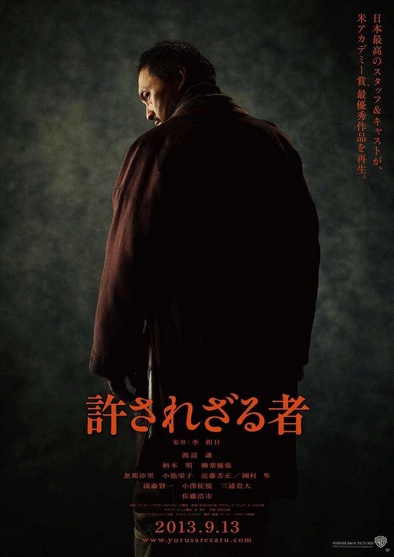 He jumps, shouts, scratches his beard, and grunts similarly. And just as Kikuchiyo was with the samurai but of the farmers, having come from peasant stock himself, so Goro Sawada is with Jubei (Ken Watanabe) and Kingo Baba (Akira Emoto), former Samurai in the 13th year of the Meiji restoration, even if he is actually Ainu, a native of the island of Hokkaido, where the action takes place and the movie was filmed.
It’s as if The Schofield Kid had been Native American. Which, to be honest, might have been an interesting choice.
There are other, subtle differences between the two movies, of course, including using the hero’s drinking less effectively. Plus the villain isn’t building a house as Hackman’s was. Instead of the end of the Civil War (1865) we get the end of the Shogunate (1868). We also lose—or lose in translation—some of my favorite lines: “Deserve’s got nothing to do with it,” and “We all got it coming, kid.”
Otherwise, it’s pretty much the same. A whore laughs at a dude’s penis, a whore is cut, a reward goes up. An aged hero and his aged sidekick decide to go for it. Before they get there, another man, a good samurai, tries, and gets his ass kicked. Our aged heroes are joined by a kid who doesn’t get it, arrive in a town that doesn’t want them, and the hero, sick with the flu, barely makes it out alive. Afterwards, he and the kid kill one of the guys who cut the whore, but his aged sidekick is captured and killed. Leading to ... You know.
So the big question with Lee Sang-il’s “Unforgiven” is: Why bother? I didn’t find an answer to that. Lee doesn’t improve upon Eastwood. Might as well remake “Seven Samurai.”
Oh, right. Well, there, too.
Thursday July 24, 2014
Movie Review: The Lunchbox (2013)
WARNING: SPOILERS
“The Lunchbox,” set in the bustling city of Mumbai, India, has a slow-paced, patient approach that suits the means of communication between its main characters: hand-written letters left in the lunchboxes that she makes (and which were originally meant for her husband), and that he eats. In this manner, gradually, they share their stories and insights with one another. He mentions that his wife is dead and buried, and that he recently sought out a grave for himself, but only vertical graves are left. A commuter who has to stand on the trains to and from work, he adds, “Now I’ll have to stand even when I’m dead.” There’s also this, which is true and isn’t: “I think we forget things if we don’t have anyone to tell them to.” Then they talk up the GNP, and how Bhutan has the GNH, or Gross National Happiness index, and wouldn’t it be great to live in Bhutan? Then she drops the bomb. “My husband is having an affair,” she writes. “I think it’s time for us to meet,” he writes.
Will they? What will happen then? 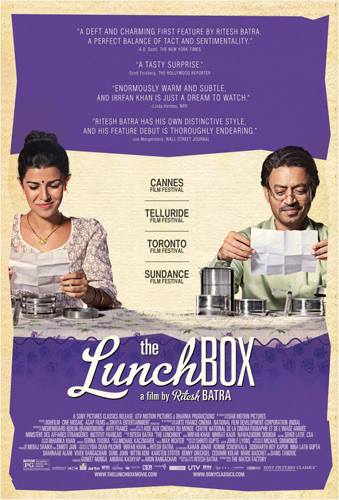 Do they fall in love? Are they already in love?
Yeah. I didn’t care, either.
Indie lite
“The Lunchbox” is indie lite. It has its charms, but its slow-paced approach tends to lead to the obvious and precious rather than the wise and profound. You think you’re sitting down to a true Indian meal but it’s actually prefabricated and packaged and smuggled in through the kitchen door, then slowly heated. You’re supposed to not notice.
Ila (Nimrat Kaur) is a Mumbai housewife and mother who converses with the unseen (“Auntie,” who lives upstairs and gives her cooking advice), but not with the seen (her husband, Rajeev, who is that movie staple: the busy phone guy). So she tries to woo him with food. Not dinner, lunch. Which is picked up and taken to her husband through Mumbai’s “massively efficient” delivery system. Except it gets delivered to the wrong dude. Oops. So much for “massively efficient.”
The wrong dude is Saajan Fernandes (Irrfan Khan), a grumpy, longtime accountant on the verge of retirement after 35 years, who has to train in his replacement, the grinning, gladhanding Shaikh (Nawazuddin Siddiqui). But Saajan is also the right dude, since Ila’s husband is obviously the wrong one. Look, he’s still on the phone! Look, he’s not even noticing her! Despite the cooking! And he didn’t even notice the food he ate wasn’t her food! But Saajan? He notices. It hasn’t exactly warmed his heart yet—he’s mean to Shaikh, and doesn’t return the ball the neighborhood cricket-playing kids hit on his balcony—but give it time, give it time.
I liked, somewhat, the Shaikh subplot. Was Saajan being forced out? No, he voluntarily took early retirement. Is Shaikh a fake and a phony? No, he’s a decent, friendly man who inexplicably has no friends. That’s why he drags Saajan to his wedding. I also liked Saajan—or at least Irrfan Khan’s acting. Even eating, he gives you something.
I also liked the upstairs auntie, unseen, like Carlton the Doorman, who gives Ila cooking advice. I’m glad they kept her unseen.
But Ila? What’s there? She cooks, she listens, she hopes, she does the laundry, where she smells on her husband’s shirt another woman and knows. And knows. And opens up to the unseen Saajan. But there’s no there there.
India Lite
We get a touch of magic realism. When she shoos a fly, he shoos a fly. That kind of thing. It’s a bit of a magic-food movie, isn’t it? Like “Like Water for Chocolate”? And “Chocolat”? But muted? For foodies? And sensitive, international people? But I was bored. I’m a patient, book-reading man but I saw where most of the story was going. Look, he’s nice to the cricket-playing kids now! How nice.
It’s a bit like “You’ve Got Mail,” isn’t it? About as profound, too. It does a good job, as romance needs to do, of keeping the couple apart for most of the movie, but then it does too good a job of it. The day they’re supposed to meet, he smells his grandfather in the bathroom and realizes it’s him. Then on the train, a young man offers him his seat. “Uncle, would you like to sit?” He’s old, she’s young, she needs to move on. “No one buys yesterday’s lottery ticket, Ila,” he writes. Then channels are crossed. He retires, disappears, returns. She looks for him, can’t find him, decides to leave her husband anyway. Her husband was never much in the picture anyway. Just in her life.
The ending itself is unnecessarily open-ended. They never meet. Are they still searching for each other? Don’t you want them to?
Yeah, I didn’t care, either. Maybe I’m cold-hearted. Maybe I need someone to make me hot Indian lunches.
Wednesday May 28, 2014
Movie Review: Ekstra (The Bit Player) (2013)
WARNING: SPOILERS
Loida (Vilma Santos), the working class, single mother of a college-age daughter, has a dream. She’s a bit player or “ekstra” on the cheesy, night-time soap operas of the Philippines, but she wants more. She wants a speaking part. She wants to break through. She wants to be a star.
So like everyone, more or less.
“The Bit Player” (“Ekstra” in the Philippines) is essentially a cinema-vérité-like day in the life of Loida. It begins at 2 a.m. with tea, breakfast, and a washcloth shower, and ends at 4 a.m. the next day with the stink of failure.
Among the extras
There’s an early morning round-up of the extras, who travel by van to the location shoot. A few are discharged en route: a young boy, for example, who’s supposed to be the younger version of the male lead in the soap (Piolo Pascual, playing himself), but who, according to the talent scout, doesn’t look enough like Piolo. 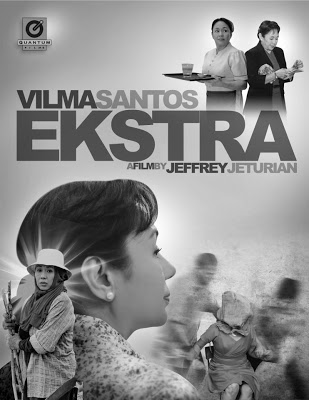 Out he and his father go, onto the side of the road.
At the shoot, the extras find no place for themselves—this area is for the stars, this area is for the caterers—so they wind up sitting in a field. Among them:
- Loida, our sympathetic mother figure, whose daughter keeps texting with money demands from the university.
- Venus (Rita Rosario G. Carlos), the brassy friend of, and quiet competition to, Loida.
- Olga (Hazel Dela Cruz), the girl too pretty for peasant scenes. She’s too pretty for the name “Olga,” too.
- Madonna (Antonette Garcia), who makes a buck on the side selling food and drinks to the other extras.
The soap is like most soaps: the loves and schemes of awful rich folks. Belinda (Marian Rivera), the wealthy daughter, is in love with Brando (Piolo), the peasant stud, but ordered to marry Sir Richard (Richard Yap) for the sake of the family. The extras toil in the fields wearing conical hats or bring product-placement drinks in maid’s uniforms. They’re background. As the casting director tells them, “You’re called ‘talent’ but you lack talent.”
The production team has its own conflicts. The director has to deliver quickly, while the producer is interested in cutting costs. He wants it good, she wants it fast and cheap, but it often winds up out of control. The stars act like stars—leaving and arriving on a whim. One time, Loida has to double for a star who’s gone missing. It’s a kidnap scene. Filmed from behind and tied to a chair, it’s supposed to be a speaking part (extra money), but, no, Loida doesn’t sound like the star. So the director has her gagged. But too much of her face is still visible so he has her hooded as well. After that, she’s slapped, kicked, burned with a cigarette. One of the production people tells her of her dress, “Take care of this: It’s more valuable than you.”
Eventually it all pays off. Late into the night and the early morning, a call goes up for an extra who can speak English reasonably well to play a lawyer. This one is no good, that one, eh ... but Loida? A shrug from the assistant director. She’ll do. The rehearsal goes well, or well enough for a night-time soap opera filming 24 hours from air time. The first take goes less well: Loida walks too far forward and blocks the star from the camera. She’s given a mark to hit but on the next take looks down to find it. The third take she messes up her lines. Finally the director loses it and she’s cast aside: back to the background. She’s not cut out for it. Maybe she never was.
Streep and Schwarzenegger
For most of “Ekstra,” I was only vaguely interested in what was happening. A lot of work, a lot of arguments, a lot of ego, went into the creation of something that was not only valueless to the culture but detrimental. Product placement is the least of it; soap operas, like most movies, sell wish fulfillment. They sell the dream of wealth, beauty, and glamor. At the same time, they sell schadenfreude, as the wealthy, beautiful and glamorous feel the heartache implicit in soap opera storylines.
I also objected when Loida began to stumble during her big scene. It felt way too cruel to me. It felt sadistic and/or bathetic. But ultimately Santos has a restraint that makes it work. You sense Loida’s world has crumbled but she doesn’t know what to do. There’s doubt and pain in her eyes now.
Interestingly, Santos, who looks like the part she plays—someone passed over by life—is in reality a hugely successful actress and politician. She was the Mayor of Lipa City and the Governor of Batangas, a province in the Philippines. There are four major film awards in the Philippines and only 17 times has someone won all four in the same year. It’s called the Philippines Movie Grand Slam, and Santos was the first to do it in 1982. She’s since done it three more times. No one else in Philippines has done it more than twice. She’s basically the Meryl Streep and the Arnold Schwarzenegger of the Philippines.
“The Bit Player,” at 111 minutes, could’ve been 20 minutes shorter. We could’ve used fewer on-set shenanigans and more on Loida’s background. How did she get on this path that’s apparently so wrong for her? And what happens next? Forget a dream deferred—what happens to a dream dashed on the rocks? What do you do when you realize you’re no good at what you’ve struggled for your entire life? We never find out.
Soap operas may be about wish-fulfillment fantasy, but “The Bit Player” is about identification, and never more so than when Loida is surrounded by the stink of failure. Most of us know that smell. Well.
Tuesday May 27, 2014
Movie Review: Leninland (2013)
WARNING: SPOILERS
If people in an absurd situation realize they’re in an absurd situation, are they no longer absurd? Does the situation become tragic instead?
Moot point here, since no one in “Leninland,” a 53-minute documentary from Askold Kurov, thinks they’re in an absurd situation. They take it all very, very seriously.
In Gorki, Russia, where Vladimir Ilyich Lenin died, a museum to honor his legacy—as if he needed another one in the Soviet era—opened to the public in 1987. For the first three years, according to Natalya, a history teacher, it drew 3,000 visitors a week. Visitors fell off a bit in 1990. 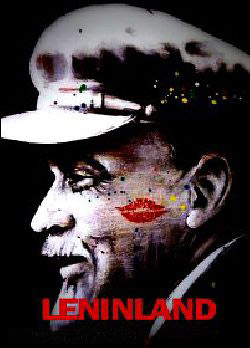 A year later, the U.S.S.R. was swallowed up by history. The museum still exists but now it draws 20 visitors a week—mostly Chinese tourists or field trips of Russian schoolchildren, who, when asked who Lenin was, guess the following:
- A leader
- A Russian
- A human
It’s a bit of a comedown from the days when Lenin was, in the Russian consciousness, a combination of Jesus Christ, Santa Claus and Mickey Mouse.
Lifeless in the death-mask room
On the plus side (for Lenin), he’s got Natalya and Evgenia, the bickering caretakers of the museum.
Evgenia is religious and sees Lenin in this light. He’s her opiate. Not her only one, either. She loves Jesus and Communism, too. You read that right: Jesus and communism. “The truth of the Lord was with the Bolsheviks,” she says at one point. “Great men do not die: they go to Heaven and keep working,” she says at another point. She says she’s at the museum as part of her spiritual journey. She could be from Portland or Seattle.
Natalya? She’s still a true believer: in Lenin, communism, and her way or the highway. You don’t mess. She overwhelms all of her opponents with words. We see her instructing a would-be tour guide at the museum not only on what he should say but on the proper way to point with his pen. When the town council talks up changing the museum from its Lenin-centric focus so that it might draw more tourists, she reminds everyone that Lenin is why the town is known. A beautiful red carpet used to adorn the Lenin “death mask” room, but it was taken for another, more important museum, and she laments its absence. “Now it’s just so lifeless in here,” she says of the death-mask room. You half expect her to say the rug really tied the room together.
Eventually she and Evgenia argue about spirituality versus matter/basic necessities. Their voices are calm but tense, as each strives to get in the last word and get her point-of-view understood. To be fair, as workplace arguments go, it beats Ginger vs. Mary Ann.
Franchise fatigue
Throughout, I kept flashing back to that great line from George S. Patton in the George C. Scott movie: “Americans love a winner ... and will not tolerate a loser.” So with the Russians here. Lenin was the leader of a team that lost. He’s in the dustbin of history. He put Russia there. Why be reminded of that?
Or maybe it’s just franchise fatigue.
“Leninland” is a good doc: short, absurd, indicative of how far the country has come. In the end, a new museum director is appointed, and he’s got plans for the museum—Chinese stage shows, we learn, to bring in more Chinese tourists—but Natalya disputes them in front of everyone. Not smart. But he doesn’t go after her. Instead he points at Kurov and tells him to stop filming. The camera is dutifully lowered but continues recording. Then we hear the director telling him to delete the footage. “Stop and delete,” he says repeatedly. Obviously, Kurov doesn’t do this. He also says the following with the new director still nearby: “I didn’t expect the Spanish Inquisition.”
Friday May 23, 2014
Movie Review: Muse of Fire (2013)
WARNING: SPOILERS
If this doesn’t kill documentaries starring the documentarian, nothing will.
The subject is a great one. Shakespeare: Why does he resonate? Why are we scared of him? Does he still matter? How is he taught and how is that a problem? What the hell is iambic pentameter anyway?
Most of the talking heads are great ones, too: Sir Ian McKellen, Dame Judi Dench, Sir Ben Kingsley, Sir Derek Jacobi, Brian Cox, John Hurt, Tom Hiddleston, Jude Law, Ewan McGregor. On and on. The missing link is Sir Kenneth Branagh, the finest Shakespeare interpreter I’ve heard.
And our guides for all of this? Dan Poole and Giles Terera, two out-of-work, late thirties British actors, children of “Star Wars” and “Indiana Jones,” who, four years ago, for reasons that remain vague, decided to make this documentary.  They spend much of it telling us how difficult it was to make it. Dan, in particular, does this. He almost seems to resent us for watching. Other times he’s giddy and goofy. Does he think their bits together are good? Pissing in this field? Taking the piss out of each other? Eating fast food? When he was on screen, I kept flashing to that scene in “Annie Hall” when Alvy is forced to watch an unfunny stand-up comedy routine: “Look at him mincing around. Thinks he’s real cute, you want to throw up ...”
Their holy grail keeps changing. Oh, if only they could interview Sir Ian McKellen. Hey, they get him! Oh, Jude Law’s playing “Hamlet” in London but they can’t get tickets. Bugger. But wait, there’s a special show at Elsinore Castle in Denmark! And they get to interview him there! Hey, you know how both of us only got into Shakespeare, really understood him, when Baz Luhrmann’s “Romeo + Juliet” was released in 1996? So imagine interviewing Baz, the Wizard of Baz, all the way in Hollywood, right? Guess what?
“We couldn’t believe it!”
That’s a line we keep hearing, as the thing they want to happen happens. Did they try to get other things to happen? Interview Leonardo DiCaprio about playing Romeo or Claire Danes on Juliet? Did they try to get Branagh? Why only talk up the successes? More, why were they successes? How did these two blokes, without even the dignity of Rosencrantz and Guildenstern, get to interview these famous folk? Did one lead to another lead to another? “Oh, you got Sir Derek? OK, then.”
Reading Shakespeare like Vonnegut
On the plus side, I kept thinking of my own experiences with Shakespeare.
We first read him in ninth grade, “Romeo and Juliet,” and then watched the Franco Zeffirelli version of the movie, during which all the boys fell in love with Olivia Hussey and all the girls fell in love with Michael York. I didn’t get that one. Weren’t they supposed to fall for Romeo? Tybalt’s an asshole; he’s the cause of much of the tragedy. I had so much to learn.
Shakespeare didn’t really take for me until college. We were reading “Othello,” Act 1, Scene 1, going through the motions of this passage:
Zounds, sir, you’re robbed! For shame, put on your gown.
Your heart is burst, you have lost half your soul.
Even now, now, very now, an old black ram
Is tupping your white ewe.
Then the professor took over and read the passage with verve and left no doubt the meaning of tupping. “Ohhh,” I thought. By the time I arrived in Seattle in 1991 I was reading Shakespeare regularly. I remember turning pages of “King Lear” on lunch breaks as if it were as easy to read as Kurt Vonnegut. Later, when I worked in the warehouse at the University Book Store, and I got tired of listening to music on my walkman, I switched to BBC productions of Shakespeare: “Hamlet” starring Branagh and “King Lear” starring John Gielgud. That last was the one for me. Branagh was in this one, too, as Edmund, and I kept listening to his soliloquy in Act 1, Scene 2: the “Why bastard? Wherefore base?” speech. He made it sound contemporary. He brought it to life.
That’s the key. Make it resonate. I believe it’s Steven Berkoff in the doc who says you should always put the actors in modern clothes. Update the setting to bring out the universal in the words.
Most of the American actors says Brits do Shakespeare better, but some Brits say Shakespeare and his contemporaries probably sounded more American. They also say that some of the best interpreters have been American: Brando in “Julius Caesar,” for example. Me, I thought of Dustin Hoffman as Shylock in “The Merchant of Venice” on Broadway, which my friend Dean and I were lucky enough to see in 1989.
At some point I expected clips—Brando, Leo, Ian McKellen’s great opening of “Richard III”—but I suppose they cost too much. You can watch them for free on YouTube but they cost too much for these guys to put in the doc. That’s a shame. But surely some Shakespeare movies are in the public domain? According to IMDb.com, more than 1200 versions of Shakespeare’s plays have been filmed in some manner, starting in 1898 with a short version of “Macbeth.” Couldn’t they have given us some of that history? Instead of another shot of Dan pissing in a field?
Done/undone
A few of their road trips are worth it. A British man, with great enthusiasm, teaches Shakespeare in prison, where lines such as Lady Macbeth’s “What’s done cannot be undone,” have a particular resonance. They go to Madrid to see a Spanish production of “Henry VIII,” where one of the actors professes amazement that Shakespeare could so perfectly delineate not just the modern woman but the modern Spanish woman.
Why Shakespeare? Judi Dench recites some lines, then, nodding her head, says, “Now if you’d written that, you’d be up all night looking at yourself in the mirror.”
“I don’t know any actor at the end of their career saying, 'What a waste of time all of that Shakespeare was,'” adds Ian McKellen.
Maybe Tom Hiddleston sums it up best: “He speaks to every man and every woman in every age in every time.”
I couldn’t agree more. I just wanted better guides.
Saturday May 17, 2014
Movie Review: Chinese Puzzle (2013)
WARNING: SPOILERS
“I have a problem with the ending,” the French publisher of French novelist Xavier Rousseau (Romain Duris), now living in New York, tells him at the end of “Chinese Puzzle.” “It’s a horrendously happy ending.”
So it is. The middle is a problem, too.
The French publisher, by the way, knows we all want to be happy in life but we want drama and tragedy in fiction. Maybe. What he should have said is that we want drama and tragedy when we read but we want happy, Hollywood endings when we watch. That feels true but is it true? And if so, why? 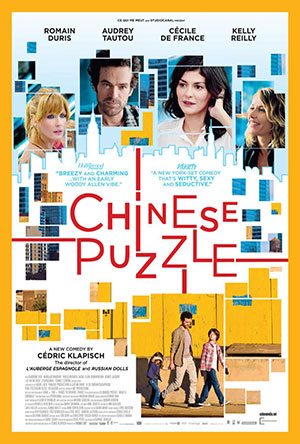 One assumes readers are more intelligent than watchers. But many of us are both—readers and watchers—so do we want different things depending on the medium? I probably find myself pulling for that happy ending more often in movies, even though, intellectually, I know it would be wrong; even though I know it would make the movie less resonant.
But I wasn’t rooting for the happy ending here. I was with the French publisher. The two of us should’ve grabbed a drink afterwards and bitched about the film.
La vie, c’est compliqué
A Chinese puzzle tends to be a complicated and intriguing thing—how do the pieces fit together?—but “Chinese Puzzle” leaves out the intriguing. It tends toward the superficial and downright silly.
Remember that old joke playing off the Army’s slogan, “See the world, meet interesting people—and kill them”? I feel something similar about writer-director Cédric Klapisch’s Xavier trilogy (L’Auberge Espagnol,” “Russian Dolls,” this). Except it’s “See the world, meet beautiful people, and fuck them.”
A year ago, as the film starts, Xavier was happy and content and living with his British wife Wendy (Kelly Reilly) and their two kids, Lucas and Jade (Amin Djakliou and Clara Abbasi), in Paris. But then they drift apart. Xavier’s best friend, Isabelle (Cécille de France), a lesbian, wants a child with her Chinese-American lover Ju (Sandrine Holt), and asks Xavier to provide the sperm. He does. Wendy doesn’t like it. Or something. And anyway she meets an American during a business trip to New York. Then she moves there with the kids. So he moves there to be near the kids. But now he’s out of his element. It’s like Barcelona again except he’s 40.
In a way the problem with the movie is that it is constructed like a Chinese puzzle: here’s this piece, and this piece, and this piece. Here’s this problem, and this problem, and this problem. They all build out but don’t construct much.
Once he moves to New York, he needs a place to live. Ju helps with that, but then he needs a job on a tourist visa. A fellow divorced dad helps with that (bike messenger), and we see him on that bike. Once. Then it’s forgotten. We also see him bartend. Once. Is that how he’s making a living? Isn’t he selling books in Paris? He’s a semi-successful novelist there, isn’t he? Or does he merely have the “small but loyal following” of a T.S. Garp?
For custody and immigration issues, he needs a lawyer, and gets a schlubby Jewish guy (Jason Kravitz), who suggests marrying an American. Guess what? Because he saves his Chinese cab driver from a pummeling, the driver’s nice-looking niece agrees to help. Mazel tov! But the INS ain’t buying it, and spends more man-hours questioning him and her than the CIA did in tracking bin Laden. Then there’s Isabelle. Yes, the baby is born, and that leads to the babysitter, a pretty young Belgian thing (Flore Bonaventura), which leads to an affair. It’s like Garp again but without the guilt. Is this when I began to lose interest? When I saw more beautiful French lesbians naked on the screen? The French are really stuck on that. So to speak. They don’t resolve it, either. Everyone works to shield Ju from Isabelle’s infidelity even as the severe INS officers arrive in the cramped third-floor walkup above the Chinese laundry to double-check on Xavier’s marriage. Life is so crazy!
The movie had promise, too. Early on, Xavier contemplates the difficulty of life going wrong, and mentions that, for an atheist like himself, this means falling back on the German philosophers. So they show up periodically—like Humphrey Bogart in “Play It Again, Sam.” There’s Schopenhauer on his bed dispensing advice. Later, in America, he imagines Hegel telling him, “All nothingness is the nothing of something,” which both Xavier and I liked. And then? Rien. C’est tout. Bummer. I was hoping to learn something. But like everything else in “Chinese Puzzle,” it starts and stops. It begins and goes nowhere.
C’est la vie
Life is messy—that’s the point of the movie—but this is a pretty neat version of messy. You get to be a trim, handsome Frenchman, your New York is both gritty and safe, and your fallback position is Martine (Audrey Tautou). Who’s near 40 now so apparently no one wants her anymore. C’est la vie.
“C’est la vie” used to mean, “Well, life kinda sucks; get used to it.” Here, la vie, c’est compliqué, mais extraordinaire. C’est hereux.
How happy is the ending? How Hollywood is it? Klapisch actually has Xavier run through the streets of New York to stop the girl from leaving. So they can all stay together and be happy together. And in the end they walk in one of New York’s many parades, and Xavier, with Martine by his side, exchanges greetings with the older Chinese dancer he sees every day in the park, whose own story means nothing; and whose appearance here is just another superficial, meaningless piece of the puzzle.
Friday February 28, 2014
Movie Review: Enough Said (2013)
WARNING: SPOILERS
She should have told them sooner. Not for them; for us.
Eva (Julia Louis-Dreyfus) is a middle-aged masseuse in southern California, who, as the movie opens, has to endure, silently and in light-comedic fashion, her clients’ foibles: one woman gabs nonstop, an elderly man has bad breath, a young, fit man lives at the top of a long set of stairs but never bothers to offer a hand with her heavy massage table. She says nothing about any of this. Instead, she gives us the Elaine Benes tics and mannerisms: some combination of endurance for their foibles followed by “am I bad person?” regret for what she’s thinking of their foibles. 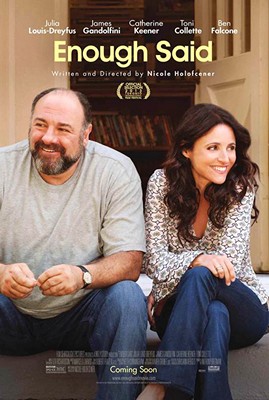 It’s not bad but it did remind me of “Seinfeld.” As did the masseuse thing. As did ... More later.
Early on, Eva attends a party with her friends Sarah and Will (Toni Collette and Ben Falcone), a couple forever squabbling about petty things, and there she meets both a new customer, Marianne (Catherine Keener), who apparently makes a living as a poet (the question that nobody asked that I’d ask? “How?”); and Albert (James Gandolfini), a sweet guy, who, like Eva, has an upfront-but-through-the-back-door kind of sense of humor. They connect in this manner. That’s the interesting thing about Eva: She tends to—as Elaine Benes would’ve said— blah all the time; yet it’s not talking, not being upfront, that gets her into trouble.
Despite not being attracted to Albert—he’s fat (stocky) and bald (bald-ing)—she goes out with him. And they hit it off. He’s funny, she’s funny. They talk like old friends. They talk, to be honest, a bit like George and Jerry on “Seinfeld”: about nothing and everything. At one point, Albert, who works at a museum of television history, bitches about one of those “Real Housewives” shows, and Eva agrees:
Eva: No brains, and the fake cheekbones, and the fake boobs. [Pause] Do you like fake boobs?
Albert: [surprised] No. No, I like real boobs.
Eva: Yeah. [Pause] I got real boobs.
Albert: That’s workin’ out for us then.
I liked them together. I liked him. He’s got a twinkle in his eyes and a gentleness in his spirit. He’s also the grown-up in the room. He’s got an acceptance of the foibles of the world, including, maybe especially, his own.
Marianne? The poet? Who is now Eva’s friend? Unaccepting. Her ex, for example, was also overweight, and he did awful things that drove her nuts. He liked guacamole, for example, but didn’t like the onions in the guacamole; so he used to put his chip in and swirl the guac until the onions were safely off to the side. Drove her nuts.
Guess what? Albert does the same thing! Guess what? Albert is Marianne’s ex.
Up to this point I liked the movie. It was trying to be an interesting story about people like us: people whose bathroom mirrors have dried toothpaste spittle on them. Even at this moment, during this reveal, I thought, “Well, that’s an interesting coincidence. Let’s see what happens when she tells them.”
Except she never does. And that’s what the movie becomes: not telling them. Either one of them. She takes Marianne’s intolerance of her ex into her relationship with Albert and tries to change him. She brings up his lack of bedside tables, his many brands of mouthwash, his ... stockiness. She says she’s going to buy him a calorie book. “Why’d I get the feeling I just spent the evening with my ex-wife?” he says at one point.
Eva realizes the Albert/Marianne connection halfway through the movie but we’re near the end before she’s forced, by circumstances, to own up to it. But by this point, she’s already blown it with Albert. Not to mention us.
“I don’t like any of these people,” Patricia said near the end.
I liked Albert. I also liked Peter, Eva’s ex, played by Toby Huss, who looked immediately familiar to me. He should, he’s been in everything from “Jerry Maguire” to “42,” but I recognized him as Jack, Elaine’s twinkly-eyed boyfriend who turns out to be the B-actor playing “the Wiz” in the schlocky east-coast commercial “Nobody beats the Wiz!” on “Seinfeld.” Peter is another adult in the room.
Isn’t it interesting how the men are the adults? I’ve noticed this more and more in stories created by women, “Girls” particularly, where Adam and Ray are relatively stable dudes, while the girls of the title go off on tangents and on each other. “Enough Said” was written and directed by Nicole Holofcener (“Please Give,” “Friends with Money,” “Lovely & Amazing”), but the women in it are fairly awful. Marianne is carping and bland; she seems like she’s floating in an ether of nothing. Her daughter, Tess (Eve Hewson), is spoiled and rude. Eva is just small. Only Eva’s daughter, Ellen (Tracey Fairaway), is worth a damn.
Lessons are learned, I suppose, but they’re lessons we know. Eva learns she should speak her mind more. She asks the young massage client at the top of the stairs to help her with her table, and he does, apologizing profusely all the way. So that works. She tries to reconnect with Albert. The ending of the movie is the picture on the poster: the two of them sitting on his back steps, maybe together, maybe not. It’s an ambivalent ending for a movie that still feels all tied up in a neat bow.
All previous entries

Baseball's Active Leaders, 2023
What Trump Said When About COVID
Recent Reviews
Everything Everywhere All at Once (2022)
Black Panther: Wakanda Forever (2022)
Doctor Strange in the Multiverse of Madness (2022)
Spider-Man: No Way Home (2021)
The Cagneys
A Midsummer Night's Dream (1935)
Something to Sing About (1937)
Angels with Dirty Faces (1938)
A Lion Is In the Streets (1953)
Man of a Thousand Faces (1957)
Never Steal Anything Small (1959)
Shake Hands With the Devil (1959)